Algeria’s Agricultural Imperative
Algeria imports approximately 70% of its food requirements, spending billions of dollars annually on cereals, dairy, and other staples. With a population exceeding 46 million and arable land limited to a narrow coastal strip comprising less than 3% of the country’s vast territory, maximizing agricultural productivity is not merely an economic goal — it is a national security imperative.
The challenge is compounding. Rainfall across northern Algeria has declined 20-30% over the past three decades. Aquifer depletion threatens irrigation-dependent agriculture in the Saharan south. Climate models project continued aridification, making business-as-usual farming practices increasingly untenable.
Precision agriculture — the application of AI, sensor technology, satellite data, and data analytics to optimize farming operations at the field level — offers a path to producing more food with less water and fewer inputs. Algeria’s adoption of these technologies, while still early, is accelerating through a combination of government policy, academic research, and emerging agritech startups.
Satellite Monitoring and AI-Driven Insights
Multispectral satellite imagery has become the backbone of precision agriculture in Algeria’s cereal-growing regions. Satellites capture data across visible and near-infrared wavelengths, revealing crop health information invisible to the human eye: chlorophyll content indicating plant vigor, water stress patterns before they become visually apparent, nutrient deficiencies identifiable by specific spectral signatures, and pest or disease outbreaks detectable through canopy reflectance changes.
AI algorithms process this satellite data to generate field-level recommendations. Machine learning models trained on historical yield data, weather patterns, and soil characteristics can predict optimal planting dates, fertilizer application rates, and irrigation timing with precision that traditional agronomic advice cannot match.
For Algeria’s large-scale cereal farms in the Tell Atlas plains — where wheat, barley, and oat production concentrates — satellite-based monitoring provides actionable intelligence across thousands of hectares simultaneously, replacing the manual field-by-field inspection that remains the norm.
IoT Sensors and Smart Irrigation
Water scarcity makes irrigation optimization the highest-value application of precision agriculture in Algeria. Drip irrigation adoption is increasing across the country, but technology alone does not guarantee efficiency — without data-driven management, drip systems can still over-irrigate or under-irrigate.
IoT soil moisture sensors, deployed at multiple depths across fields, provide real-time data on water availability in the root zone. Combined with weather station data (evapotranspiration rates, temperature, wind speed) and satellite-derived vegetation indices, AI systems can calculate precise irrigation schedules — delivering exactly the amount of water each crop zone needs, exactly when it needs it.
International benchmarks show that precision irrigation can reduce water consumption by 20-40% compared to traditional scheduling methods while maintaining or improving crop yields. For Algeria, where agricultural water use competes directly with domestic and industrial demand, these savings translate to meaningful water security improvements.
Solar-powered IoT sensors and pumps are particularly relevant for Algeria’s agricultural zones, where grid electricity may be unreliable but solar irradiance is abundant — the country receives over 3,000 hours of sunshine annually.
Advertisement
The 30% Yield Improvement Promise
AI-driven precision agriculture has demonstrated yield improvements of up to 30% in comparable semi-arid environments. The gains come from multiple sources: eliminating over-irrigation that causes root disease, timing fertilizer application to match crop nutrient uptake curves, detecting pest and disease problems early enough for targeted intervention rather than blanket chemical application, and identifying underperforming field zones that need specific soil remediation.
For Algeria’s date palm plantations in the Saharan oases — a high-value export crop — precision monitoring can optimize the complex microclimate management that determines fruit quality. For cereal production in the Tell Atlas, AI can help farmers navigate the increasingly erratic rainfall patterns that make traditional planting calendars unreliable.
Algeria’s Agritech Ecosystem
The national innovation call launched in March 2026 explicitly targets smart agriculture alongside water management, inviting startups to propose AI-driven farming solutions. Several Algerian startups and research groups are already active in the space.
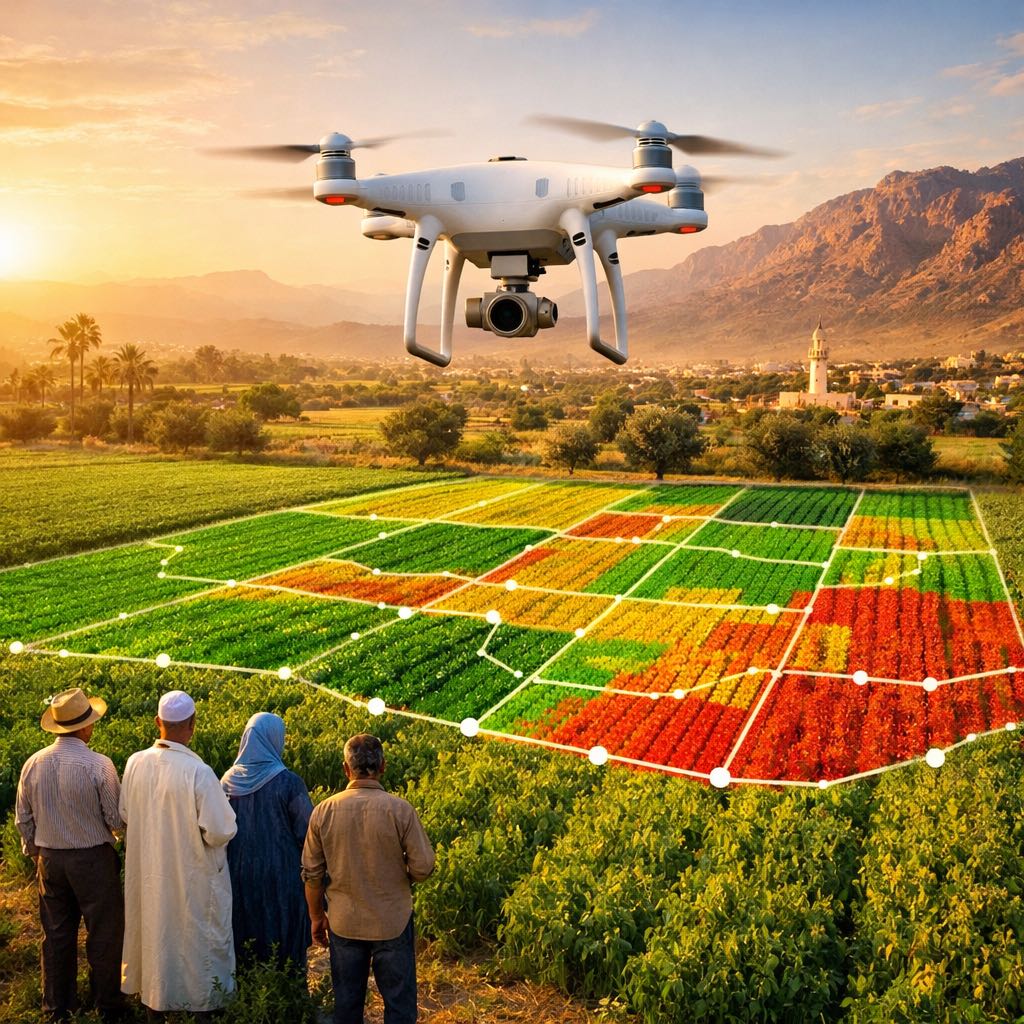
University research programs at USTHB, the University of Tlemcen, and the University of Batna are developing machine learning models for crop disease detection from drone imagery, soil quality mapping using remote sensing, and yield prediction models calibrated to Algerian growing conditions.
The broader African context provides momentum. By 2026, more than 60% of African farms and agribusinesses will be using digital solutions to optimize productivity. Algeria’s participation in this continental trend is supported by the SNTN-2030 digital strategy, which includes agriculture among the priority sectors for AI integration.
Challenges: Connectivity, Cost, and Farmer Adoption
Precision agriculture in Algeria faces several practical barriers. Rural connectivity remains limited — many agricultural zones lack reliable internet access needed for IoT sensor data transmission and cloud-based analytics. The cost of sensor hardware, particularly when imported under Algeria’s currency control regime, puts precision agriculture tools out of reach for small-scale farmers.
Perhaps the most significant challenge is farmer adoption. Algeria’s agricultural sector includes a large proportion of small and medium-scale farmers for whom precision agriculture represents a fundamental shift in practice. Extension services, demonstration farms, and accessible training programs will be essential to bridge the knowledge gap between technology availability and practical adoption.
Cooperative models, where groups of small farmers share precision agriculture infrastructure and analytics platforms, offer a promising approach to addressing cost and scale barriers.
Frequently Asked Questions
How much can AI-driven precision agriculture improve crop yields?
International benchmarks show improvements of up to 30% in semi-arid environments, through optimized irrigation, precise fertilizer application, early pest detection, and targeted soil remediation.
What precision agriculture technologies are being adopted in Algeria?
Algeria is adopting satellite imagery for crop monitoring, IoT soil moisture sensors for irrigation optimization, drone-based field inspection, and AI analytics platforms for yield prediction and farm management.
How does precision agriculture address Algeria’s water scarcity?
Precision irrigation using IoT sensors and AI scheduling can reduce agricultural water consumption by 20-40% compared to traditional methods, while maintaining or improving yields — critical in a country where rainfall has declined 20-30% over three decades.
///
Sources & Further Reading
- Algeria Agriculture: 2025 AI Trends — Farmonaut
- Precision Agriculture 2026: 7 Smart Farming Wins — Farmonaut
- On-device AI for Climate-Resilient Farming With Intelligent Crop Yield Prediction — Nature Scientific Reports
- Agribusiness Sector Trends: Africa Industry Shifts 2026 — Farmonaut
- AI in Agriculture: New Food Innovations for 2026 — Farmonaut