The Arabic AI Gap That Algeria Can Fill
Arabic is spoken by over 400 million people, yet it remains one of the most underserved languages in artificial intelligence. Existing large language models exhibit significant performance gaps on Arabic tasks, with North African dialects particularly underrepresented. The gap between Modern Standard Arabic (MSA) — the formal written register — and the diverse spoken dialects creates a technical challenge that generic multilingual models cannot solve.
Algeria sits at a unique crossroads. With a population that code-switches between Darija (Algerian Arabic), French, Tamazight, and MSA — often within a single conversation — the country’s linguistic complexity is both a challenge and an opportunity. Models that can understand Algerian Arabic must handle dialectal variation, French loanwords embedded in Arabic syntax, and Tamazight phrases — a multilingual reality that no existing commercial LLM addresses adequately.
Hadretna: Algeria’s First Dialectal AI Model
The most prominent Algerian initiative in Arabic language AI is Hadretna (meaning “Our Dialect”), a research project formed by Algerian-French startup Fentech in collaboration with Professor Merouane Debbah — president of Algeria’s National AI Council and founding director of the 6G Research Center at Khalifa University in Abu Dhabi.
Hadretna has pre-trained a large language model on 2 billion tokens of Darija and Tamazight data, making it the first model specifically targeting Algerian Arabic. The project launched a public crowdsourcing initiative to gather conversational Algerian Arabic data from native speakers, building a training corpus that captures the authentic patterns of how Algerians actually communicate — not the formalized MSA that dominates existing Arabic NLP datasets.
The applications are immediately practical: customer service chatbots that understand Algerian callers, government service portals that process citizen queries in natural language, educational tools adapted to how Algerian students actually speak, and media analysis tools for social media monitoring in local dialects. Algeria’s public sector is actively digitizing over 342 services through the Bawabatak portal across 25 ministerial departments, creating a procurement market where Darija-capable AI has direct commercial value.
University Research Powers the Pipeline
Algeria’s academic NLP community, while small, produces work of international significance. Dr. Taha Zerrouki at the University of Bouira leads one of the country’s most respected NLP research programs, producing open-source Arabic language tools including Mishkal — a text vocalizer that adds diacritical marks to unvoweled Arabic text — and Tashaphyne, a morphological analyzer critical for Arabic text processing.
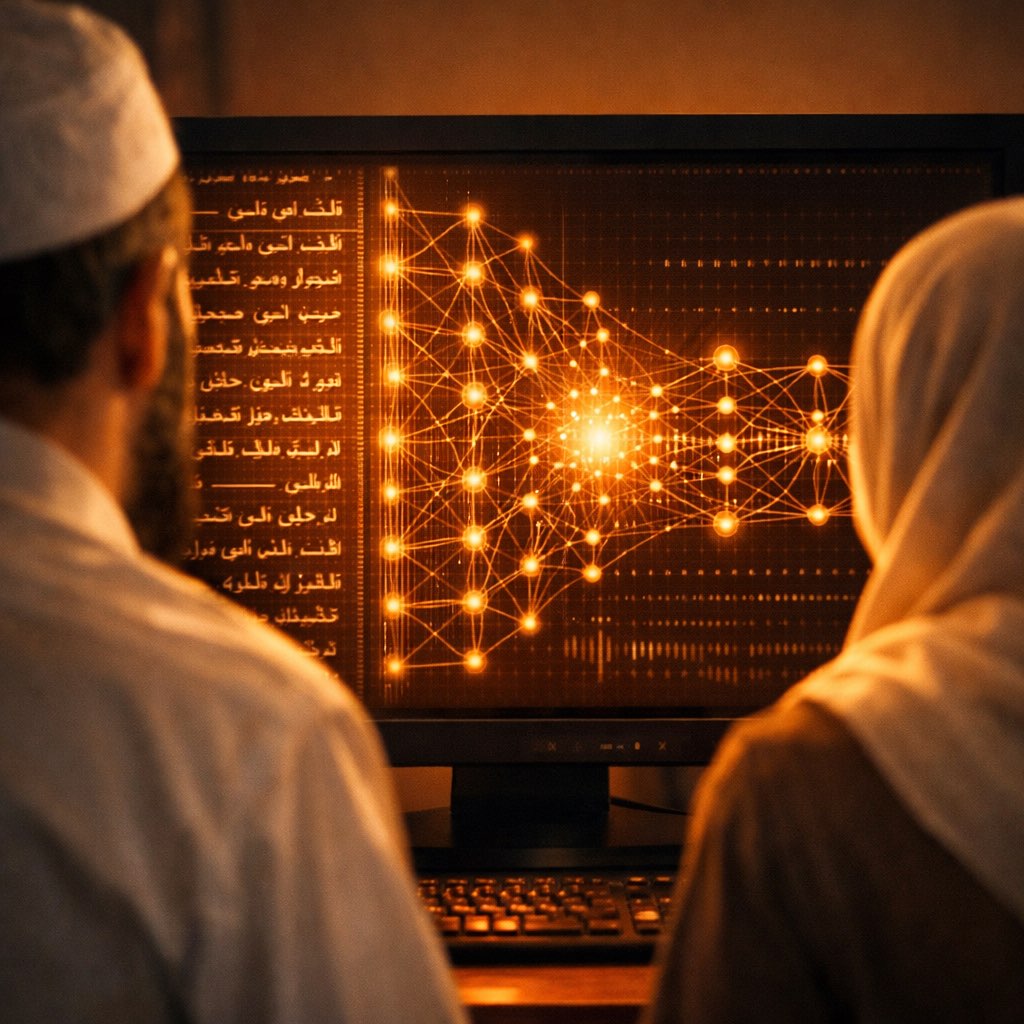
These tools address a fundamental challenge in Arabic NLP: Arabic text is typically written without short vowels, creating massive ambiguity for computational processing. A single consonant skeleton can represent multiple words with entirely different meanings. Tools like Mishkal resolve this ambiguity, enabling downstream applications from search engines to voice assistants.
The University of Biskra, Constantine, and Algiers contribute additional research in Arabic sentiment analysis, named entity recognition, and machine translation — building blocks that feed into larger language model development.
Advertisement
The Regional Competition Heats Up
Algeria’s Arabic AI efforts exist within a rapidly intensifying regional landscape. Saudi Arabia’s SDAIA has developed ALLaM, an Arabic LLM trained on over 500 billion Arabic tokens, available in 7B, 13B, and 70B parameter versions. ALLaM won top ranking on the Arabic MMLU benchmark and is deployed on both IBM Watsonx and Microsoft Azure platforms.
The UAE’s Technology Innovation Institute developed Jais, another major Arabic LLM, while several Gulf-funded initiatives are building Arabic-capable models with compute budgets that dwarf what is available in North Africa.
However, these Gulf-developed models share a significant limitation: they are optimized for Gulf Arabic dialects and MSA, performing poorly on North African Arabic variants. Algerian Darija, with its heavy French lexical borrowing and distinct phonological patterns, is effectively a blind spot for these models. This creates a genuine market opportunity for Algeria-developed solutions.
Infrastructure Constraints and Workarounds
Building competitive language models requires substantial computational resources. Algeria faces specific constraints: GPU access for training large models is limited due to import restrictions and cost, and research teams often rely on cloud-based compute constrained by Algeria’s currency controls and international payment barriers.
The AI Supercomputing Center under construction in Oran — with GPU clusters for AI workloads — will partially address computational limitations when operational. The facility is designed to provide researchers, startups, and companies with intensive computing capabilities for AI development.
Meanwhile, Algerian researchers employ practical workarounds: fine-tuning existing multilingual models rather than training from scratch, using parameter-efficient techniques like LoRA that require less compute, and leveraging open-source models from Hugging Face as base architectures. The SNTN-2030 strategy explicitly plans 500+ digital projects for 2025-2026, with AI language technology among the priority sectors.
The Sovereign AI Imperative
Language AI is inherently a sovereignty issue. When citizens interact with government services through AI systems built on foreign models, the underlying technology shapes what languages, dialects, and cultural contexts are supported. Algeria’s push for indigenous Arabic AI is not merely a technical exercise — it is a strategic move to ensure that the country’s digital transformation is not dependent on AI systems that do not understand how Algerians communicate.
The commercial stakes are real. A well-positioned Arabic AI product in 2026 could dominate by 2030. With 342 government services being digitized and the broader SNTN-2030 strategy calling for AI integration across public services, the addressable market for Darija-capable AI tools — customer service, document processing, citizen engagement — is measured in hundreds of millions of dollars.
Frequently Asked Questions
What is Hadretna and who is behind it?
Hadretna (“Our Dialect”) is Algeria’s first large language model targeting Algerian Arabic (Darija) and Tamazight. It was developed by Algerian-French startup Fentech in collaboration with Professor Merouane Debbah, president of Algeria’s National AI Council.
Why do existing Arabic AI models perform poorly on Algerian Arabic?
Gulf-developed models like ALLaM and Jais are optimized for Gulf dialects and Modern Standard Arabic. Algerian Darija has distinct phonological patterns, heavy French lexical borrowing, and code-switching behaviors that these models were not trained to handle.
What infrastructure does Algeria have for training AI language models?
Algeria is building an AI Supercomputing Center in Oran with GPU clusters. Until it is operational, researchers rely on cloud-based compute and parameter-efficient techniques like LoRA to fine-tune existing models with limited resources.
///
Sources & Further Reading
- The Landscape of Arabic Large Language Models — Communications of the ACM
- North African AI Researchers Crowdsource Arabic Language Data — Middle East AI News
- SDAIA Lists ALLaM 7B Arabic Language Model on Hugging Face — Asharq Al-Awsat
- Arabic LLM Models — Hugging Face Blog
- A Survey of Large Language Models for Arabic Language and Its Dialects — ResearchGate