The Scale of Algeria’s Water Loss Problem
Algeria faces a water paradox. The country has invested billions in supply-side infrastructure — 72 water treatment plants, 10 desalination plants, 2,528 wells, and 1,141 pumping stations managed by the national water utility ADE — yet an estimated 40% of total water produced never reaches consumers. This non-revenue water (NRW) disappears through physical leaks in aging pipes, faulty or absent meters that fail to register consumption, and unauthorized connections.
The distribution network stretches across 105,000 km, much of it installed decades ago and operating beyond its designed lifespan. In rural areas, only 70% of households have tapped connections, and those that do face frequent interruptions from breakdowns and leakage. The system’s scale makes traditional leak detection — sending crews to walk networks and listen for pressure drops — impossibly slow and expensive.
Climate change is compressing the timeline. Declining rainfall patterns have forced Algeria into intermittent water supply (IWS) regimes in several cities, where households receive water for only a few hours per day. When supply is already constrained, every liter lost to leaks represents a direct reduction in human access.
The Smart Metering Solution
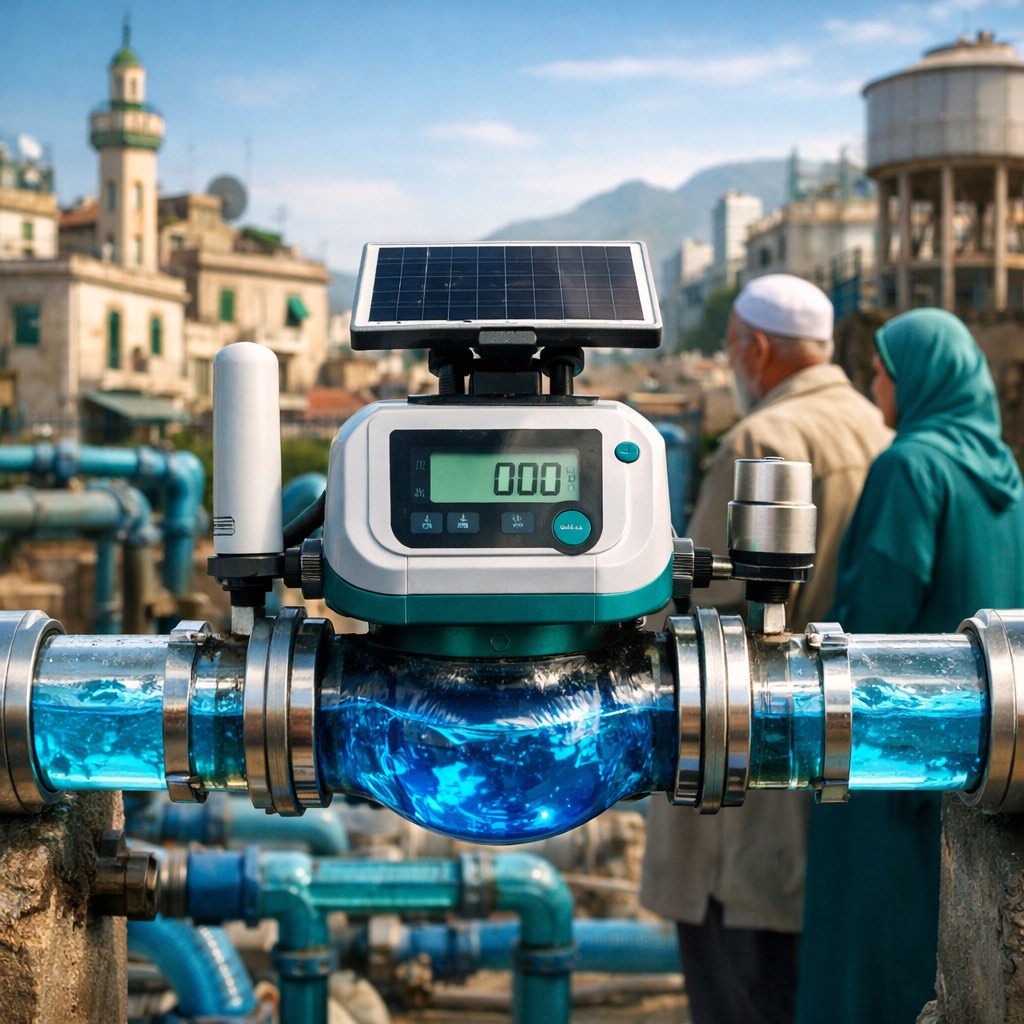
Smart water metering replaces manual reading and estimation with connected devices that transmit real-time consumption data over low-power wide-area networks (LPWAN) like LoRaWAN or NB-IoT. These meters do more than measure volume — they detect anomalies that indicate leaks, unauthorized connections, or meter tampering.
The core value proposition for Algeria is threefold:
Leak detection at scale. Smart meters installed at district metering area (DMA) boundaries can compare inflow against registered consumption in near real-time. When the gap exceeds a threshold, the system identifies the specific zone where water is being lost — reducing the search area from kilometers to hundreds of meters. SEAAL (Société des Eaux et d’Assainissement d’Alger), which manages water distribution for Algiers province, has already deployed computerized network control for leak monitoring, providing a foundation for expanded IoT deployment.
Revenue recovery. Administrative losses — water that reaches consumers but is not billed due to meter errors, illegal connections, or billing system failures — account for a significant portion of NRW. Smart meters eliminate estimation-based billing, detect meter tampering through flow pattern analysis, and provide auditable consumption records.
Demand management. Real-time consumption data enables dynamic pricing, targeted conservation campaigns, and early warning systems for abnormal usage patterns. During water rationing periods, smart meters allow utilities to verify that supply schedules are being followed and identify areas where unauthorized access occurs.
Algeria’s National Innovation Call
In March 2026, the Ministry of Knowledge Economy and Startups, jointly with the Ministry of Water Resources and Water Security and the Ministry of Higher Education, launched a national open call for innovative water management solutions. The call explicitly targets technologies for reducing leakage and waste, including artificial intelligence and Internet of Things applications for water networks.
This innovation call represents a policy shift. Previous water investments focused almost exclusively on supply-side infrastructure — building more desalination plants, drilling more wells, expanding treatment capacity. The new call recognizes that Algeria cannot simply build its way out of a problem where 40% of existing supply is wasted. Intelligence at the network edge — sensors, meters, and analytics — is required to make existing infrastructure efficient.
The call invites submissions across multiple priority areas: reducing water leakage, improving desalination efficiency, promoting water reuse, advancing smart irrigation, and applying AI and IoT to water management systems. Algeria’s 2025 Law 25-02 on circular economy further mandates that public utilities develop valorization plans and integrate reuse into their operations.
Advertisement
Technical Architecture for Smart Water Networks
Deploying IoT smart metering across Algeria’s network requires infrastructure at three layers:
Edge devices. Smart meters with integrated sensors and LPWAN radios (LoRaWAN or NB-IoT) installed at consumer endpoints and DMA boundaries. These devices must operate on battery power for 10-15 years in Algeria’s climate extremes — temperatures that can exceed 45°C in southern wilayas and drop below freezing in highland areas.
Connectivity layer. LoRaWAN gateways or cellular NB-IoT coverage to backhaul meter data to central systems. Algeria’s three mobile operators — Mobilis, Djezzy, and Ooredoo — are deploying 5G networks, and NB-IoT typically runs on existing 4G infrastructure with minimal additional investment. LoRaWAN requires dedicated gateway deployment but offers lower per-device connectivity costs.
Analytics platform. Cloud-hosted or on-premises data platforms that aggregate meter readings, run anomaly detection algorithms, generate billing records, and produce network performance dashboards. Algeria Telecom’s sovereign cloud infrastructure, including its Constantine data center, could host these platforms under data sovereignty requirements.
Pilot Programs and International Models
Research on smart metering for non-revenue water reduction in emerging African cities demonstrates that pilot deployments in comparable contexts have reduced NRW by 15-25 percentage points within the first two years. The key success factors are DMA-level deployment density, integration with hydraulic models, and institutional capacity to act on the data.
SEAAL’s existing experience with Suez’s digital water management tools provides Algeria with institutional knowledge that many African countries lack. The transition from Suez to fully Algerian management of Algiers’ water network means this expertise must be internalized and scaled.
For Algeria, a realistic deployment strategy starts with high-loss urban districts in Algiers, Oran, and Constantine — where infrastructure density makes gateway deployment economical and where NRW rates are high enough to generate rapid ROI. Southern and rural deployment would follow as connectivity infrastructure (5G, LoRaWAN) expands.
Economic Case for Smart Metering
The financial math favors IoT deployment. If Algeria’s water utilities produce approximately 3.5 billion cubic meters annually and lose 40% to NRW, that represents 1.4 billion cubic meters of treated water wasted. Even recovering 25% of those losses — a conservative target for smart metering programs — would yield 350 million additional cubic meters of billed water without any new supply investment.
The cost of smart metering hardware, connectivity, and analytics platforms is typically recovered within 3-5 years through increased revenue collection and deferred capital expenditure on new supply infrastructure. For a country simultaneously building desalination plants at hundreds of millions of dollars each, fixing leaks at a fraction of that cost is the higher-ROI investment.
Frequently Asked Questions
How much water does Algeria lose through its distribution network?
Algeria’s non-revenue water rate is estimated at approximately 40%, meaning that out of the roughly 3.5 billion cubic meters of treated water produced annually, about 1.4 billion cubic meters is lost to physical leaks, meter inaccuracies, and unauthorized connections across the country’s 105,000 km distribution network.
What IoT technologies are used for smart water metering?
Smart water meters typically use low-power wide-area network technologies — either LoRaWAN (long-range, low-power radio) or NB-IoT (narrowband cellular) — to transmit consumption data wirelessly to central analytics platforms. These devices can operate on battery power for 10-15 years and detect anomalies like leaks, tampering, and unauthorized connections through flow pattern analysis.
How quickly can smart metering reduce water losses?
International pilot programs in comparable emerging-market cities have demonstrated 15-25 percentage point reductions in non-revenue water within the first two years of deployment. The key factors are deploying sufficient meter density within district metering areas, integrating data with hydraulic network models, and ensuring institutional capacity to dispatch repair crews based on detected anomalies.
Sources & Further Reading
- Water Challenges in Algeria — Fanack Water
- Water Infrastructure in Algeria — Fanack Water
- Ministry Launches National Open Call for Water Innovation — TechAfrica News
- SEAAL Water Management in Algiers — SUEZ
- Advancing Circular Economy in Water Management in Algeria — EcoMENA
- Smart Metering for NRW Reduction in Emerging African Cities — ResearchGate