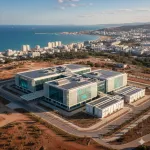
When Algeria’s High Commissioner for Digitalization Meriem Benmouloud unveiled the National Digital Transformation Strategy (SNTN) in May 2025, the roadmap carried a clear message: Algeria intends to become a sovereign cloud destination by the end of the decade. Backed by more than 500 registered digital projects, two national data centers under way, and a new AI supercomputing facility breaking ground in Oran, the strategy is already converting policy ambition into physical infrastructure — and drawing international partners to the table.
Five Pillars, One Destination
The SNTN-2030 rests on five foundational pillars: robust digital infrastructure, digital skills cultivation, effective digital governance, a thriving digital economy, and inclusive citizen integration. The targets are ambitious — training 500,000 ICT specialists, reducing tech-talent emigration by 40%, and raising the digital sector’s GDP contribution to 20% by 2030.
What makes the strategy credible to cloud investors is its implementation cadence. According to AL24 News, more than 500 projects were registered for the 2025-2026 phase alone, with 75% focused on modernizing public services. That concentration creates immediate demand for hosting, compute, and managed cloud services — demand that Algeria is choosing to serve domestically rather than route through foreign hyperscalers.
Mohammadia and Blida: The National Data Center Backbone
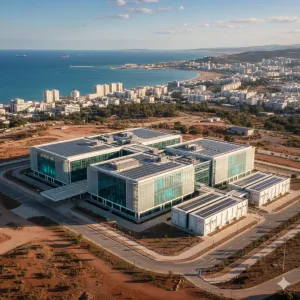
The cornerstone of Algeria’s sovereign cloud ambitions is the national data center in Mohammadia, Algiers. Built in partnership between the High Commission for Digitalization and Huawei, the Mohammadia facility has achieved Tier III Design certification from the Uptime Institute — a first for any Algerian data center. As of February 2026, construction stood at approximately 80% completion, with the facility now pursuing the more demanding Tier III Facility Certification for operational readiness. Tier III guarantees 99.982% availability, with concurrent maintainability that allows hardware servicing without taking systems offline.
A second national data center in Blida is under construction, designed as a geographic disaster-recovery site to ensure business continuity if the Mohammadia facility experiences a major incident. The Blida facility is advancing toward completion, with Tier III Design certification also being prepared.
Together, these two centers form a resilient pair: a primary compute-and-hosting hub in the capital region and a geographically separated backup roughly 50 kilometers south. This architecture is the minimum viable setup for any government serious about digital sovereignty — keeping citizen data, e-government platforms, and critical services on domestic soil rather than in cloud regions abroad.
The Oran AI Supercomputing Center
On March 16, 2025, Minister of Post and Telecommunications Sid Ali Zerrouki laid the foundation stone for Algeria’s first high-performance computing center dedicated to artificial intelligence, located in Oran’s Akid Lotfi district. Equipped with latest-generation GPU clusters, the facility targets researchers, startups, and academic institutions who need intensive compute capacity for AI workloads in healthcare, industry, cybersecurity, and smart cities.
The Oran center represents a different tier of cloud investment. While Mohammadia and Blida handle general-purpose government hosting, Oran is purpose-built for GPU-intensive AI training and inference. Algeria has set an ambitious target for AI to contribute 7% to GDP by 2027, and the Oran facility is positioned as the compute engine behind that ambition.
For the domestic startup ecosystem, the implications are significant. Algerian AI startups have historically relied on foreign cloud providers for GPU access, paying in hard currency and contending with latency to distant regions. A local GPU cluster changes the economics and practicality of AI development within the country.
Advertisement
Huawei as Strategic Cloud Partner
Huawei’s role in Algeria’s cloud buildout extends well beyond hardware supply. The company co-developed the Mohammadia data center, organized the Cloud and Digital Transformation Summit Algeria 2025 in Algiers — bringing together government officials, public institutions, and technology partners — and signed a memorandum of understanding with Yassir in December 2025 to develop local solutions in cloud computing, AI, server infrastructure, digital mobility, and mobile payments.
The Algeria-China Digital Economy Cooperation Deal, signed in May 2024, adds an education layer: beginning in September 2026, vocational trainees will receive instruction in cloud computing, cybersecurity, and AI through a program culminating in a diploma jointly issued by the Ministry and Huawei. This pipeline addresses a critical bottleneck — Algeria cannot operate sovereign cloud infrastructure without homegrown talent to manage it.
Huawei’s Algerian director has framed the relationship within the “Algeria 2030” vision, emphasizing that cloud adoption allows the country to leapfrog fragmented legacy IT systems. For Huawei, Algeria represents a beachhead in North Africa’s underpenetrated cloud market. For Algeria, Huawei provides technology transfer and training at a scale that Western hyperscalers have not offered in the region.
Dzair Services: The Demand Engine
Infrastructure only matters if it carries workloads. The government’s answer is Dzair Services, a national platform designed to centralize all public digital services as part of the SNTN-2030. With 46 ministries and public agencies already connected to fiber optics, the platform is being prepared as the single digital front door for citizen-facing government services.
Dzair Services creates a guaranteed base load for the Mohammadia data center — hosting e-government applications, citizen identity services, tax portals, and administrative platforms. This captive demand de-risks the infrastructure investment and provides a foundation upon which private-sector cloud services can layer.
Algerie Telecom has invested 1.5 billion dinars (approximately $11 million) to fund AI, cybersecurity, and robotics startups, complementing the broader infrastructure buildout. The state telco also operates data centers in Algiers, Oran, and Constantine, offering cloud hosting services that extend the national infrastructure beyond government use.
What the Strategy Still Needs
The SNTN-2030 has moved faster than skeptics expected, but gaps remain. Algeria currently has only six data center facilities from five operators, according to Data Center Map — a fraction of what markets like Morocco or South Africa operate. International connectivity remains constrained, with limited submarine cable capacity compared to Mediterranean neighbors. And while the Startup Act and government funding programs support early-stage ventures, the country still lacks the mature cloud services ecosystem — managed Kubernetes, serverless platforms, multi-cloud orchestration — that enterprises need to fully migrate off legacy infrastructure.
The 500,000 ICT specialist target is also a generational challenge. Algeria’s universities produce strong computer science graduates, but retaining them against Gulf and European salary differentials requires more than training programs alone.
Still, the direction is unmistakable. Two years ago, Algeria had no Tier III data center and no AI compute facility. By the end of 2026, it will have both — plus a policy framework that treats cloud infrastructure as national strategic capacity rather than a line item in an IT budget.
Frequently Asked Questions
When will the Mohammadia data center be operational?
As of February 2026, the Mohammadia data center stands at approximately 80% construction completion. It has achieved Tier III Design certification from the Uptime Institute — a first for any Algerian data center — and is pursuing the more demanding Tier III Facility Certification for operational readiness. Tier III guarantees 99.982% availability with concurrent maintainability. The Blida disaster-recovery site is also advancing toward completion, providing geographic redundancy approximately 50 kilometers south of the capital.
What will the Oran AI center offer that existing infrastructure does not?
The Oran AI center is purpose-built for GPU-intensive workloads — AI training, inference, and high-performance computing — unlike the Mohammadia and Blida facilities which target general-purpose government hosting. Equipped with latest-generation GPU clusters, it will serve researchers, startups, and academic institutions who currently rely on foreign cloud providers for compute-intensive AI work. This is significant because Algerian AI startups have historically paid in hard currency for distant GPU access with high latency.
How does Algeria’s data center capacity compare to regional competitors?
Algeria currently has only six data center facilities from five operators, according to Data Center Map — far fewer than Morocco or South Africa. International connectivity is also constrained compared to Mediterranean neighbors. However, the SNTN-2030 investments (Mohammadia, Blida, Oran) represent a step-change in capacity and certification level. The strategy also addresses the talent gap with a 500,000 ICT specialist target and Huawei vocational training programs, recognizing that infrastructure without trained operators is insufficient.
Sources & Further Reading
- Algeria Aims for Full Digital Transformation by 2030 with New Strategy — We Are Tech Africa
- 75% of Algeria’s Digital Projects to Focus on Modernizing Public Services — Telecom Review Africa
- Algeria: More Than 500 Projects Registered as Part of Digital Transformation Strategy — AL24 News
- Le Mohammadia Datacenter obtient la certification Tier III Design — Maghreb Émergent
- Algerian Gov’t Breaks Ground on AI Data Center in Oran — Data Center Dynamics
- Huawei and Yassir Forge Strategic Partnership to Boost Algeria’s Digital Transformation — TechAfrica News
- Algeria Plans Digital Transformation Agenda with Over 500 Projects by 2026 — Digital Economy Magazine
- Algeria Data Centers — Data Center Map
🔗 Related Intelligence
Algeria’s Cloud Market Will Hit $450 Million by 2035: What’s Driving the Growth

Algeria Digital 2030: 500 Projects, 500K Jobs — Reality Check
Algeria’s Sovereign Cloud: How the Mohammedia-Blida Data Centers Reshape Digital Control

AWS Launches Middle East Region: What Algerian Cloud Strategists Must Know Now