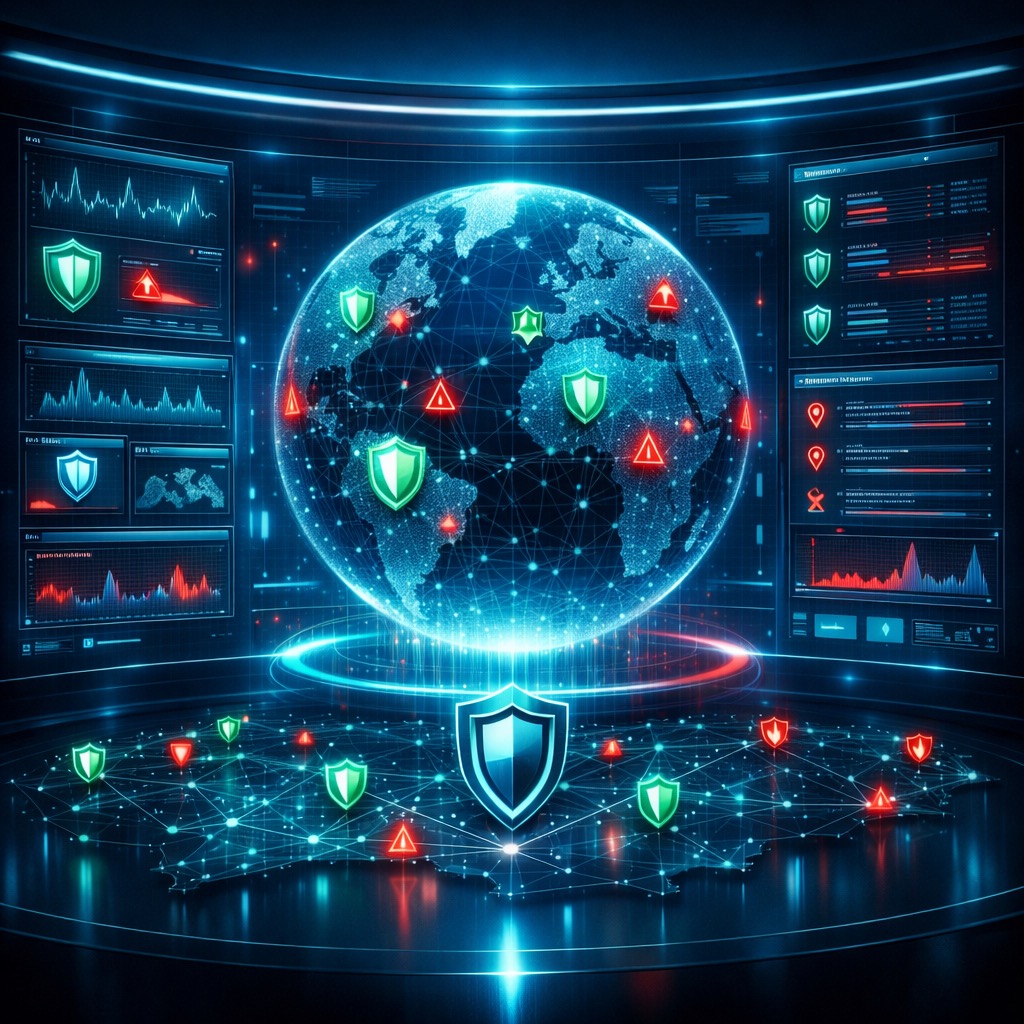
Why Algeria Needs AI-Driven Detection Now
Algeria’s cybersecurity landscape has shifted from aspiration to obligation. Presidential Decree 25-321 (December 2025) established the National Cybersecurity Strategy 2025-2029, and Decree 26-07 (January 2026) mandated that every public institution create a dedicated cybersecurity unit — separate from general IT — reporting directly to organizational leadership.
These units need tools. Specifically, they need SIEM platforms, endpoint detection and response (EDR), vulnerability scanners, and the personnel trained to operate them. With Algeria recording over 70 million cyberattacks in 2024, ranking 17th globally among most-targeted nations, the selection of detection platforms carries strategic weight.
The global managed security services market is projected to reach USD 66.83 billion by 2030, growing at 11.1% CAGR. For Algerian organizations facing an acute cybersecurity talent gap, AI-augmented platforms that reduce the analyst burden are not a luxury — they are the only viable path to compliance.
CrowdStrike Falcon: Speed as a Security Metric
CrowdStrike’s Falcon platform remains the benchmark for endpoint detection, and its 2026 updates are built around a single insight: adversaries now break out from initial access to lateral movement in 27 seconds at best, with an average of 29 minutes. Human analysts simply cannot match that pace.
Charlotte AI serves as a natural-language SOC assistant. Analysts can ask questions like “Show me all lateral movement attempts in the past 7 days” and get structured, actionable answers instead of raw log queries. The new Charlotte Agentic SOAR extends this further, allowing administrators to build automated multi-agent workflows — detect a breach, isolate the machine, and trigger forensic collection without human intervention.
Algeria fit: CrowdStrike is cloud-native with minimal on-premises requirements, making it suitable for Algerian organizations that lack the data center capacity for heavy on-prem SIEM deployments. The platform supports managed detection and response (MDR) delivery, aligning with Algeria’s strategy of partnering with international managed security service providers.
Consideration: Pricing is per-endpoint, which scales quickly for large government agencies. Algerian procurement teams should negotiate multi-year enterprise agreements to manage costs.
SentinelOne Singularity: The Autonomous SOC Vision
SentinelOne’s Singularity platform combines endpoint, cloud workload, and identity protection under a single data lake. Its differentiator is Purple AI, an AI analyst that triages alerts, hunts for indicators of compromise, and responds to incidents through plain-English queries rather than complex query languages.
In 2026, SentinelOne added a suite of four tools focused specifically on AI application security. Organizations can use the toolkit to prevent employees from entering business data into insecure AI services — a growing risk as shadow AI proliferates. The platform works with more than 15,000 AI websites out of the box.
Algeria fit: Purple AI’s natural-language interface dramatically lowers the skills barrier. For Algerian teams where experienced SOC analysts are scarce, a platform that allows junior staff to conduct threat hunting through conversation rather than SIEM query syntax provides immediate value. The shadow AI monitoring capabilities are relevant as Algerian enterprises begin adopting large language models.
Consideration: The full Singularity platform (endpoint + cloud + identity) represents significant investment. Algerian organizations should evaluate a phased rollout, starting with endpoint detection and expanding as the cybersecurity unit matures.
Advertisement
Darktrace: Self-Learning AI Without Predefined Rules
Darktrace takes a fundamentally different approach. Rather than relying on threat intelligence signatures or predefined rules, it deploys an unsupervised machine learning engine — the Enterprise Immune System — that learns what “normal” looks like for every user, device, and workflow, then flags deviations.
The Autonomous Response engine can act in real time to contain threats, while the AI Analyst module accelerates investigations by correlating anomalies across the network and generating human-readable incident summaries.
Algeria fit: Darktrace’s approach is particularly relevant for Algerian environments where threat intelligence feeds may not cover local attack patterns. Because the system builds its baseline from observed behavior rather than external signatures, it can detect novel threats that signature-based tools miss. This matters in a threat landscape where Algeria faces region-specific attack campaigns.
The platform deploys appliances on-premises, which appeals to Algerian organizations with data sovereignty requirements. Sensitive network traffic analysis stays within national borders.
Consideration: Darktrace’s effectiveness depends heavily on the quality of its training period. Deploying it in an environment already compromised will teach it that malicious behavior is “normal.” Algerian teams should conduct a thorough security baseline before deployment.
Palo Alto Cortex XSIAM: The Converged Platform
Palo Alto’s Cortex XSIAM represents the convergence trend — combining SIEM, SOAR, XDR, and attack surface management in a single platform. The 2026 update, Prisma AIRS 3.0, extends protection to AI agents with artifact scanning, agent red teaming, and runtime guardrails that detect memory poisoning and excessive permissions.
XSIAM aims to eliminate the traditional multi-vendor SOC stack. Instead of integrating separate SIEM, EDR, NDR, and SOAR products, organizations get a single pane of glass with AI correlation across all data sources.
Algeria fit: For the handful of Algerian organizations large enough to justify an enterprise-grade SOC — major banks, Sonatrach, Algerie Telecom, ASAL — XSIAM’s consolidation reduces integration complexity. Palo Alto’s existing firewall presence in Algerian networks provides a natural integration path.
Consideration: XSIAM is designed for organizations with mature security operations. It requires dedicated staff and significant log volume to deliver value. Smaller Algerian organizations should consider Cortex XDR (the lighter offering) or partner-managed deployments.
Microsoft Sentinel: The Azure-Integrated Option
For organizations already invested in the Microsoft ecosystem, Microsoft Sentinel ingests logs and signals across the entire Microsoft estate and third-party tools, applies AI-powered analytics, and correlates events into high-confidence incidents. Its Fusion ML engine identifies multi-stage attacks that single-alert tools miss.
Algeria fit: Algerian government agencies and enterprises with existing Microsoft 365 and Azure deployments get Sentinel integration at relatively low marginal cost. The per-GB pricing model is transparent and avoids per-endpoint licensing complexity.
Consideration: Sentinel’s value diminishes significantly outside the Microsoft ecosystem. Organizations running primarily Linux infrastructure or non-Microsoft SaaS tools will find the integration benefits less compelling.
Evaluation Framework for Algerian Teams
When evaluating these platforms, Algerian security teams should weight five criteria specifically for local conditions:
| Criterion | Why It Matters in Algeria |
|---|---|
| Skills floor | How much expertise is needed to operate day-to-day? Algeria’s talent gap makes this the top criterion. |
| Data sovereignty | Can the platform deploy on-premises or in-country? Decree 25-321 emphasizes national information system resilience. |
| MSSP compatibility | Does the vendor support managed delivery? International partnerships are a core pillar of the 2025-2029 strategy. |
| Arabic language support | Do dashboards and alerts support Arabic? Operational efficiency depends on language accessibility. |
| Total cost of ownership | Beyond licensing — factor in training, integration, and the multi-year staffing commitment. |
No single platform wins on all five criteria. The right choice depends on organizational maturity, existing infrastructure, and whether the deployment model is self-operated or MSSP-managed.
Frequently Asked Questions
Which platform is best for an Algerian organization starting from scratch?
For organizations building their first cybersecurity capability, CrowdStrike Falcon or SentinelOne Singularity offer the strongest combination of low skills floor and managed delivery options. CrowdStrike’s Charlotte AI provides natural-language interaction that junior analysts can use immediately, while SentinelOne’s Purple AI enables threat hunting through conversation rather than complex query languages. Both support managed detection and response (MDR) delivery, aligning with Algeria’s strategy of partnering with international MSSPs.
Can these platforms meet Algeria’s data sovereignty requirements?
It depends on the platform. Darktrace deploys appliances on-premises, keeping sensitive network traffic analysis within national borders — ideal for data sovereignty. CrowdStrike and SentinelOne are cloud-native, with data processed in their global cloud infrastructure. Microsoft Sentinel stores data in Azure regions, which can be specified by the customer but are not available in Algeria. Palo Alto Cortex XSIAM can deploy in hybrid configurations. Algerian procurement teams should evaluate each vendor’s data residency options against the requirements of Law 11-25 and Decree 25-321.
How do AI-powered platforms address Algeria’s cybersecurity talent shortage?
AI-augmented platforms reduce the analyst burden in three ways: automated triage (reducing alert fatigue by filtering true positives), natural-language interfaces (allowing junior staff to conduct advanced investigations without mastering query languages), and autonomous response (containing threats in seconds rather than waiting for human approval). For a country facing an acute cybersecurity talent gap, these capabilities compress the time-to-competence from years of SIEM expertise to weeks of platform training.
Sources & Further Reading
- Top 10 Threat Detection Platforms in 2026 — Stellar Cyber
- Top 6 AI Cyber Security Tools to Watch in 2026 — AccuKnox
- AI Threat Detection Tools Review 2026 — IT InfoSys
- CrowdStrike, Cisco and Palo Alto Ship Agentic SOC Tools at RSAC 2026 — VentureBeat
- Algeria Cybersecurity Strategy 2025-2029 — AlgeriaTech
- Cybersecurity Services Market Size 2025-2034 — Precedence Research
🔗 Related Intelligence
RSA Conference 2026: Key Takeaways for Algerian Security Teams
Algeria’s National Cybersecurity Strategy 2025–2029: A Deep-Dive Analysis

Collaborative Cyber Defense: Why Algeria Needs Open Threat Intelligence Sharing

Algeria Under Siege: 70 Million Cyber Attacks and the New National Defense Framework