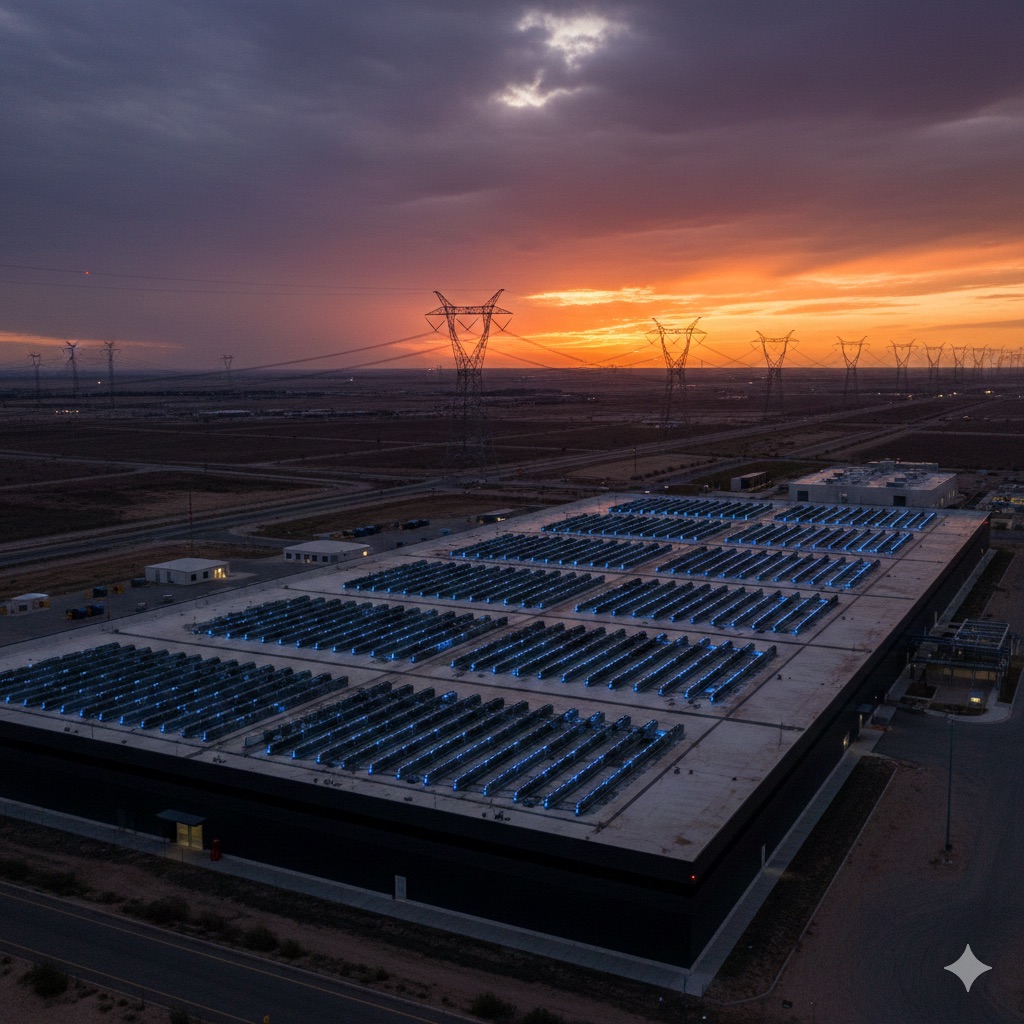
The Power Problem Is Here
The AI revolution runs on electricity, and electricity is running short. Training a single frontier model like GPT-4 consumed an estimated 40 to 50 times the energy of GPT-3 — itself a 1,287 MWh training run equivalent to powering 120 US households for a year. Inference workloads — every ChatGPT query, every Copilot suggestion, every enterprise AI call — multiply that demand across billions of daily requests. And in 2026, as AI agents run continuously, AI video generation scales, and every enterprise deploys AI-embedded workflows, electricity demand from data centers is growing faster than the grid can supply.
The IEA’s 2025 “Energy and AI” report found that global data center electricity consumption reached approximately 415 TWh in 2024 — about 1.5% of global electricity use — and projects it will roughly double to 945 TWh by 2030 under its base case. Meanwhile, the five largest hyperscalers (Amazon, Google, Microsoft, Meta, and Oracle) spent roughly $256 billion on data center infrastructure in 2024 and are projected to spend $600 to $700 billion in 2026 — roughly 75% of it tied directly to AI. The bottleneck is not capital. It is power.
The Scale of the Problem
According to a Lawrence Berkeley National Laboratory report funded by the US Department of Energy, US data centers consumed 176 TWh in 2023 — about 4.4% of total US electricity. The IEA projects US data center demand will surpass 250 TWh in 2026, with LBNL estimating a further rise to 325-580 TWh by 2028. Goldman Sachs estimates that AI alone could add 200 TWh per year to global electricity demand between 2023 and 2030, pushing data centers from 1-2% to 3-4% of global power consumption.
Early estimates in 2023 suggested a single ChatGPT query used roughly ten times the electricity of a Google search. That gap has since narrowed significantly due to hardware and model efficiency gains — but it barely matters, because the total volume of AI inference is exploding. And on the supply side, projects like the $500 billion Stargate initiative — a joint venture of OpenAI, SoftBank, Oracle, and MGX announced in January 2025 — are adding nearly 7 GW of planned data center capacity across multiple US sites.
Why the Grid Cannot Keep Up
Building a data center requires land, networking, cooling, and power. Of these, power is the binding constraint.
Grid capacity: The US power grid was designed for relatively stable demand. Data center clusters in Northern Virginia, Oregon, Georgia, and Texas are straining local capacity. PJM Interconnection, the largest US grid operator serving 65 million people across 13 states, projects it will be 6 GW short of reliability requirements by 2027. Utility interconnection queues stretched to over a decade in some regions by 2025.
Construction timelines: A new natural gas plant takes 5-7 years to permit and build. A wind farm takes 3-5 years. A new nuclear plant, under current US regulatory frameworks, takes 10-15 years. The infrastructure investment decisions needed to power 2030’s AI were supposed to start in 2020.
Consumer impact: The downstream effects are already visible. US electricity prices jumped 6.9% in 2025 — double headline inflation — with data centers now responsible for 40% of US electricity demand growth. The political backlash is bipartisan, and multiple states have introduced legislation to manage data center grid impact.
Advertisement
The Hyperscaler Nuclear Bet
Faced with the impossibility of building sufficient renewable generation fast enough, the world’s largest technology companies have turned to nuclear power.
Microsoft signed a 20-year power purchase agreement with Constellation Energy in September 2024 to restart Unit 1 of Three Mile Island, now renamed Crane Clean Energy Center. Constellation is investing $1.6 billion in the restart, backed by a $1 billion DOE loan. The 835 MW facility is expected online in 2027 and all output goes to Microsoft.
Google signed a master agreement with Kairos Power for 500 MW of advanced small modular reactors — seven units total, first online by 2030 and all deployed by 2035. It is the first corporate agreement for multiple deployments of a single advanced reactor design in the US.
Amazon signed three nuclear power deals: an investment in X-energy supporting 5+ GW of SMR deployment, an agreement with Dominion Energy for SMR development near Virginia’s North Anna nuclear station, and a deal with Energy Northwest for up to 960 MW in Washington state.
Meta moved from a December 2024 RFP to signed agreements in January 2026 with Vistra, TerraPower, and Oklo for up to 6.6 GW of nuclear power capacity — enough to power roughly 5 million homes.
These deals reflect a hard constraint: AI data centers need power that is continuous (not intermittent like solar and wind), reliable, and increasingly low-carbon. Nuclear, particularly small modular reactors that can be sited near data center campuses, meets all three requirements.
Efficiency Gains vs. the Jevons Paradox
On the demand side, hardware and algorithmic efficiency are advancing rapidly.
NVIDIA’s Blackwell GPU generation (B200, deployed in 2025) delivers up to 25x energy reduction for inference workloads at the system level compared to the prior Hopper generation, alongside roughly 4x improvement in training performance. DeepSeek’s R1 demonstrated that architectural innovation — mixture of experts, quantization, distillation — can achieve frontier performance with dramatically less compute. Direct liquid cooling, which circulates coolant directly to chips, is 2-3x more efficient than air cooling for GPU-dense workloads and is now being deployed across all major operators.
But efficiency gains carry a paradox. The Jevons Paradox, first observed in 19th-century coal economics, holds that efficiency improvements in resource use can increase total consumption by making the resource more economically accessible. If inference becomes 25x cheaper per query, the number of queries may grow by more than 25x. DeepSeek’s efficiency breakthroughs, for instance, are already accelerating AI adoption in markets and applications that were previously too expensive to serve. The net effect on total energy consumption may be an increase, not a decrease.
The Sustainability Reckoning
The companies building the most AI infrastructure are the same ones with the most ambitious climate commitments — and the gap is widening.
Google’s 2024 environmental report acknowledged a 48% increase in greenhouse gas emissions since 2019, driven primarily by data center energy. Google also dropped its long-standing carbon-neutral claim in 2024, pivoting to a “net zero by 2030” target that it concedes AI growth is making harder. Microsoft’s 2024 sustainability report showed a 29% increase in total emissions since 2020, with over 97% coming from Scope 3 (indirect) sources — primarily embodied carbon in new data center construction.
Water is another pressure point. Research from the University of California Riverside estimated that every 20 to 50 ChatGPT queries evaporates roughly 0.5 liters of freshwater through cooling towers. At global usage volumes, that translates to millions of liters daily. Data center proposals have already been blocked or delayed in Arizona, the Netherlands, and Ireland over water impact concerns.
Meanwhile, reporting in early 2026 revealed that several tech companies are building private natural gas power plants adjacent to data centers — “shadow power grids” that increase emissions in direct tension with their public sustainability pledges. The honest assessment is that the AI-energy-climate relationship is genuinely unresolved: AI tools may help solve climate problems (better weather models, grid optimization, materials discovery), but whether those benefits outweigh AI’s own footprint is a question nobody can yet answer.
What Comes Next
AI’s energy demand is not a future problem — it is a present infrastructure crisis that will shape technology strategy, energy policy, and corporate investment for the rest of the decade. The companies and governments that address it through nuclear deployment, grid modernization, efficiency investment, and rational resource governance will build the physical foundation of the AI era. Those that do not will hit a wall that no amount of capital can move quickly: the laws of physics do not negotiate.
Advertisement
🧭 Decision Radar (Algeria Lens)
| Dimension | Assessment |
|---|---|
| Relevance for Algeria | High — Algeria is a major oil and gas producer with vast solar potential in the Sahara. The global AI energy crisis represents a strategic opportunity to attract hyperscaler data center investment by offering cheap energy, excess grid capacity, and a geographic bridge between Europe and Africa. |
| Infrastructure Ready? | Partial — Sonelgaz is expanding power generation and some regions have excess electricity capacity, but data center-grade infrastructure (Tier III/IV facilities, high-bandwidth fiber, redundant cooling systems) remains nascent. The Algerian Data Center Park project signals government intent, but delivery timelines are uncertain. Water scarcity in southern regions is a constraint for traditional evaporative cooling. |
| Skills Available? | Partial — Algeria has strong electrical engineering and energy sector expertise from decades of hydrocarbon infrastructure development. However, specialized data center operations, advanced cooling engineering, and hyperscale facility management talent is limited and would need targeted training programs or international partnerships. |
| Action Timeline | 6-12 months — Algeria should begin positioning now with feasibility studies for solar-powered data center zones, particularly in northern Saharan regions with both solar irradiation and relative proximity to Mediterranean fiber routes. SMR developments globally could also align with Algeria’s existing nuclear research expertise. |
| Key Stakeholders | Ministry of Energy and Mines, Ministry of Digitalization, Sonelgaz, Algeria Telecom, Algerian Atomic Energy Commission (COMENA), foreign investment agencies, private data center developers |
| Decision Type | Strategic — This is a generational infrastructure opportunity requiring coordinated energy, telecommunications, and industrial policy. |
Quick Take: The global AI energy crisis is one of Algeria’s most compelling near-term opportunities. With world-class solar irradiation, natural gas reserves, expanding grid capacity, and a strategic location between Europe and Africa, Algeria could position itself as a competitive destination for AI data center investment — but only if it moves quickly on infrastructure readiness, water-efficient cooling solutions, and workforce development before competing North African and Middle Eastern markets capture the demand.
Sources
- IEA: Energy and AI — Energy Demand from AI
- IEA: Energy and AI — Executive Summary
- IEA: Electricity Mid-Year Update 2025 — Demand
- DOE: Report on Data Center Electricity Demand
- Lawrence Berkeley National Laboratory: Data Center Electricity Demand
- Pew Research: US Data Center Energy Use
- Goldman Sachs: AI to Drive 165% Increase in Data Center Power
- Hyperscaler Capex $600B in 2026
- Futurum Group: AI Capex 2026 — The $690B Infrastructure Sprint
- Axios: Hyperscaler Spending 2026
- Constellation Energy: Crane Clean Energy Center Announcement
- DOE $1B Loan for TMI Restart
- Google / Kairos Power Nuclear Agreement
- Amazon Nuclear SMR Deals
- Meta Nuclear RFP (Dec 2024)
- Meta Nuclear Deals Signed (Jan 2026)
- Nvidia Blackwell Benchmarks Deep Dive
- GPT-4 Carbon Footprint Analysis
- AI Water Consumption Study (UC Riverside)
- Original Research Paper: Water Footprint of AI (arXiv)
- ChatGPT vs Google Search Energy Comparison
- Google Emissions +48% Since 2019
- Google Drops Carbon-Neutral Claim
- Microsoft 2024 Sustainability Report
- Data Center Knowledge: Hyperscalers in 2026





Advertisement