The Scale of Algeria’s Education Challenge
Algeria’s education system is one of the largest in Africa and the Arab world, serving nearly 12 million students across primary, middle, and secondary levels for the 2024–2025 academic year. The Ministry of National Education oversees more than 28,500 schools — including over 20,000 primary schools, nearly 5,900 intermediate schools, and 2,600+ high schools — staffed by approximately 510,000 teachers. On paper, these numbers suggest a functional system. In practice, the reality is strained.
Classroom sizes regularly exceed 40 students, particularly in urban areas like Algiers, Oran, and Constantine where population density outpaces infrastructure. Rural wilayas face the opposite problem: not enough qualified teachers willing to work in remote areas. In the southern regions — Adrar, Illizi, Tamanrasset — some schools operate with a single teacher covering multiple grade levels. The result is a one-size-fits-all pedagogical approach that struggles to address individual student learning gaps.
National exam pass rates tell part of the story. The Baccalaureate exam, Algeria’s gateway to university, saw a pass rate of 58.28% in 2024, up from 50.63% in 2023 — with significant variation by stream (the mathematics stream reached 82.25%). Over 860,000 candidates are registered for the 2025 BAC. Regional disparities persist, with students in some wilayas consistently outperforming peers in others. The underlying cause is not student ability — it is unequal access to quality instruction.
How Adaptive Learning Technology Works
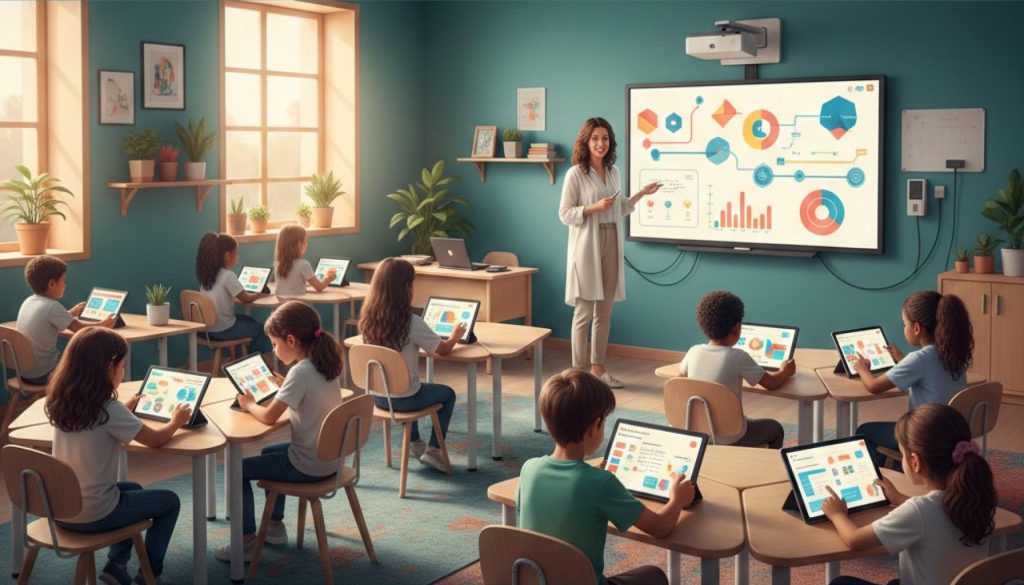
Adaptive learning platforms use AI algorithms to personalize instruction for each student in real time. The core mechanism is straightforward: the system presents material, assesses the student’s response, identifies knowledge gaps, and adjusts the difficulty and sequence of subsequent content accordingly. It is the digital equivalent of a private tutor who knows exactly where each student struggles.
Globally, the technology has matured significantly. Khan Academy’s Khanmigo, powered by GPT-4, provides personalized tutoring in math and writing — guiding students through problems rather than simply giving answers, much like a virtual Socratic tutor. It is free for educators and available to learners for $4 per month. Duolingo’s Birdbrain AI engine optimizes language learning paths for hundreds of millions of users. Century Tech in the UK uses neuroscience-informed AI to map student knowledge states and recommend lessons. China’s Squirrel AI has deployed adaptive learning across thousands of learning centers, claiming significant improvements in student exam performance.
The evidence base is growing. Research on adaptive learning systems consistently shows measurable improvements in student outcomes compared to traditional instruction — roughly equivalent to moving an average student from the 50th to the 64th percentile. For a system like Algeria’s, where the baseline is constrained by large class sizes, even modest gains could be meaningful at scale.
Advertisement
Algeria’s Digital Classroom Initiatives and the Bilingual Content Gap
Algeria has not ignored technology in education. The Ministry of National Education has launched several digital initiatives, including e-learning portals and ICT integration programs aimed at bringing technology into classrooms. The COVID-19 pandemic accelerated these efforts, with the Ministry deploying remote learning platforms — though uptake was limited by connectivity issues and low digital literacy among both teachers and students.
The more fundamental challenge is content. Algeria’s education system operates in Arabic (primary and secondary instruction), with French used heavily in scientific and technical disciplines at the university level. This Arabic-French bilingual structure means that most global adaptive learning platforms — built primarily in English — cannot be deployed without significant localization. Even Arabic-language platforms tend to support Modern Standard Arabic (MSA), which differs from the Algerian Arabic (Darija) that many students speak at home.
Building or adapting content for Algeria would require a substantial effort: digitizing the national curriculum across all grade levels and subjects, creating assessment items aligned with Algerian pedagogical standards, and developing content in both Arabic and French. Algeria’s EdTech ecosystem is nascent — a handful of startups are building education-focused platforms, but the scale of what is needed — thousands of hours of curriculum-aligned adaptive content — far exceeds what any single startup can produce. This is a market gap waiting for public-private collaboration to fill.
What a Realistic Deployment Looks Like
A realistic AI-in-education deployment for Algeria must contend with three infrastructure constraints: connectivity, devices, and teacher readiness. Mobile internet penetration stands at approximately 70%, driven by 4G expansion, but fixed broadband remains limited. This means any platform designed for Algerian students would likely need to function on smartphones with intermittent connectivity, supporting offline modes and low-bandwidth content delivery.
Device access varies dramatically by region and income level. Urban middle-class families increasingly have smartphones and tablets, but students in rural and low-income households may share a single device among multiple family members. A pragmatic approach might focus on school-based computer labs rather than individual device ownership, with adaptive learning sessions integrated into the existing school day.
Teacher readiness is perhaps the most critical factor. Adaptive learning platforms do not replace teachers — they augment them by providing data on individual student progress and recommending differentiated instruction strategies. But this requires teachers who are comfortable interpreting learning analytics dashboards and adjusting their pedagogy accordingly. Algeria’s teacher training programs would need to incorporate digital pedagogy modules, and in-service training would need to reach the existing workforce of 510,000 teachers. Without teacher buy-in, even the best platform becomes shelfware.
Advertisement
🧭 Decision Radar
| Dimension | Assessment |
|---|---|
| Relevance for Algeria | Very High — 12M+ students, overcrowded classrooms, and regional disparities create a strong case for personalized learning at scale |
| Infrastructure Ready? | Partial — Mobile internet penetration reasonable (70%) but fixed broadband is limited; school computer labs are inconsistent |
| Skills Available? | Limited — Teacher digital literacy is a major bottleneck; Algerian EdTech developer talent exists but is small |
| Action Timeline | 3–5 years for meaningful deployment — requires curriculum digitization, platform localization, teacher training, and pilot programs |
| Key Stakeholders | Ministry of National Education, Algeria Télécom, Algerian EdTech startups, international platform providers, teacher training institutes |
| Decision Type | Strategic |
| Priority Level | High |
Quick Take: Algeria’s education system has the scale and the pain points where AI adaptive learning could make a measurable difference. But the path from here to there runs through Arabic/French content localization, teacher training, and connectivity infrastructure — none of which are quick fixes. A phased approach starting with pilot programs in a few wilayas, focused on math and science where content is more universal, would be the pragmatic starting point.
Sources & Further Reading
- Back to School 2024–2025: Nearly 12 Million Students — DzairTube
- BAC 2024: Success Rate of 58.28% — AlgeriaNewsGate
- BAC 2025: Over 860,000 Candidates — DzairTube
- Khanmigo: Khan Academy’s AI Tutor — Khan Academy
- Century Tech Adaptive Learning — Century Tech
- Education in Algeria Statistics — Statista
- Algeria Telecom and Digital Statistics — ARPCE





Advertisement