In April 2025, Shopify CEO Tobi Lutke declared in an internal memo — which leaked almost immediately — that “reflexive AI usage” was now a baseline expectation for every employee. The company had already restructured its engineering workflows around AI: developers were merging 33% more pull requests per person, with 75% of PRs flowing through AI-assisted review via Graphite. Human reviewers increasingly focused only on pull requests flagged as architecturally significant, security-sensitive, or ambiguous. It triggered a fierce debate inside the company about what engineering culture looks like when machines handle the gatekeeping.
Shopify is not alone. Across the industry, engineering teams are discovering that integrating AI into development workflows is not a matter of adding a new tool to the existing process. It requires rethinking the process itself — from how code is planned and written to how it is tested, reviewed, and deployed. The teams that treat AI as an add-on to their existing CI/CD pipeline are seeing modest gains. The teams that restructure their workflows around AI capabilities are seeing transformations that would have been unthinkable two years ago.
The Three Integration Patterns
After studying dozens of enterprise AI adoption stories, a clear taxonomy has emerged. Teams integrate AI into their development workflows in one of three patterns, each with different implications for productivity, quality, and organizational structure.
Pattern 1: AI as Autocomplete
The simplest integration pattern treats AI as an enhanced autocomplete engine. Developers write code as they always have, but an AI coding assistant suggests completions, fills boilerplate, and generates routine implementations inline. GitHub Copilot pioneered this pattern, and it remains the most widely adopted approach. JetBrains’ 2025 Developer Ecosystem Survey found that 85% of developers regularly use AI tools, with 62% relying on at least one AI coding assistant — and inline suggestions remain the most common entry point.
The productivity gains are real but bounded. A large-scale study by researchers at Microsoft, MIT, Princeton, and the University of Pennsylvania — covering 4,867 developers — found that those using AI coding tools completed routine tasks 26% faster but showed no measurable improvement on tasks involving complex architecture decisions, debugging novel issues, or cross-system integration. The tool accelerates typing; it does not accelerate thinking.
Most teams adopting this pattern make minimal changes to their existing workflow. The CI/CD pipeline stays the same. Code review stays the same. The AI just makes individual developers faster at the mechanical parts of coding.
Pattern 2: AI as Pair Programmer
The second pattern gives AI a more active role. Instead of suggesting completions, the AI participates in the development process as a collaborative partner — generating entire functions from natural language descriptions, refactoring code across files, and proposing architectural alternatives. Tools like Cursor, Windsurf, and Claude Code operate in this mode, with deep codebase understanding and multi-file editing capabilities.
This pattern demands workflow changes. Teams using Cursor’s agent mode report that their pull requests look fundamentally different — larger in scope, touching more files, but with clearer separation between specification (the prompt) and implementation (the generated code). The traditional model of small, incremental commits gives way to larger, specification-driven changes.
Stripe’s engineering team adopted a version of this pattern in late 2025. Engineers write detailed specifications as structured documents before touching any code. The AI generates the implementation. Human engineers then review the specification and the test results rather than line-by-line code. The process resembles architecture review more than traditional code review — and it surfaces design problems earlier than the old approach.
Pattern 3: AI as Pipeline Orchestrator
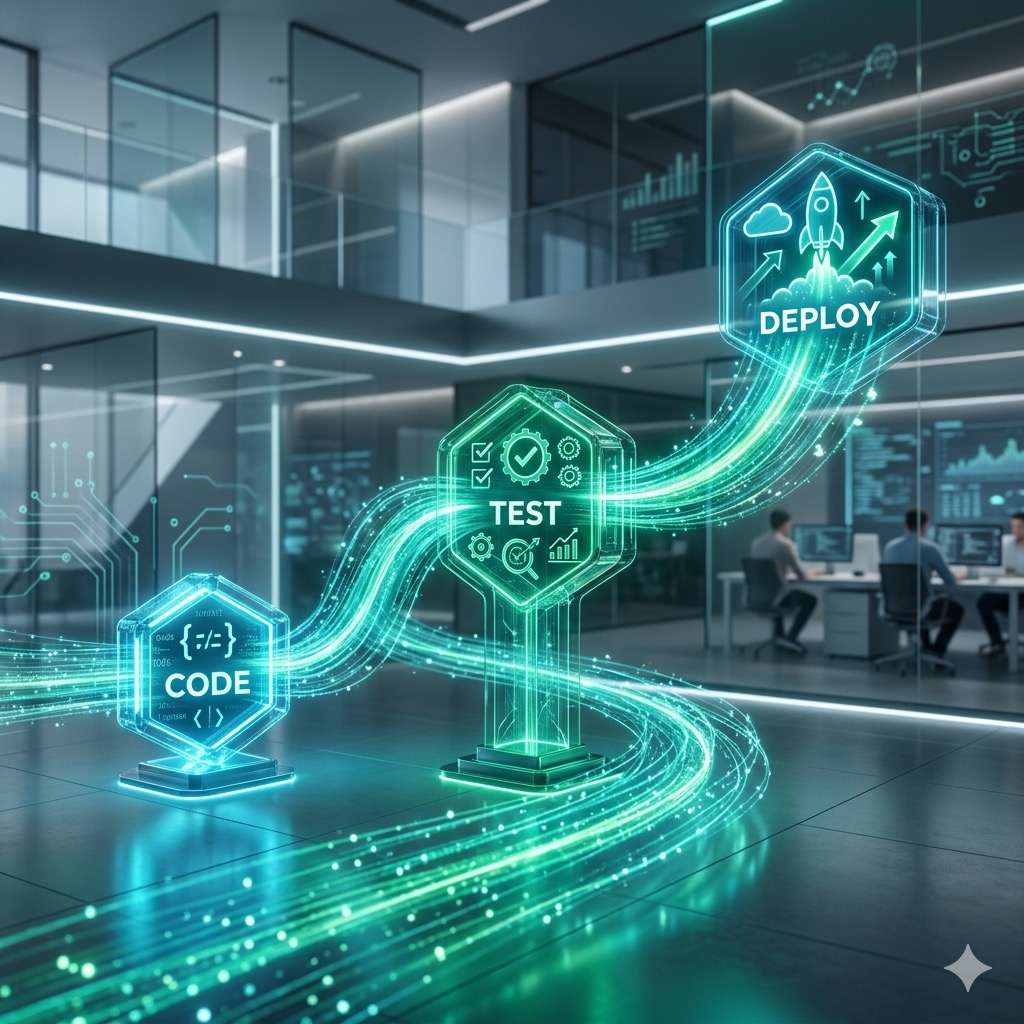
The most aggressive pattern embeds AI into the CI/CD pipeline itself, not as a tool that developers use but as an autonomous participant in the software delivery process. AI systems generate tests, perform security audits, write documentation, suggest deployment strategies, and even triage production incidents — all without human initiation.
Companies like Vercel and Netlify have built AI-powered deployment pipelines that run security scans against known vulnerability databases, provide AI-assisted code review on pull requests, and produce human-readable diagnostics when builds fail. The developer’s role shifts from executing these tasks to reviewing AI-generated outputs and making judgment calls on edge cases.
This is the pattern that most directly threatens existing development culture. When the pipeline handles testing, documentation, and security scanning autonomously, the developer’s job becomes less about execution and more about specification, supervision, and judgment. It is a fundamentally different skill set — and many experienced engineers find the transition uncomfortable.
Code Review Reimagined
Perhaps no part of the development workflow has been more disrupted than code review. Traditional code review serves multiple purposes: catching bugs, ensuring consistency, spreading knowledge, and mentoring junior developers. AI is reshaping each of these functions differently.
Bug detection is increasingly automated. Static analysis tools enhanced with LLMs can catch not just syntax errors and known vulnerability patterns but also logical inconsistencies, race conditions, and API misuse that would escape traditional linters. AI-powered code review tools from multiple vendors now combine static analysis with foundation model capabilities to detect issues that rule-based linters miss entirely.
Consistency enforcement is becoming a configuration problem rather than a cultural one. Instead of relying on reviewers to maintain coding standards, teams encode their standards as prompts and let AI enforce them automatically. Spotify’s platform engineering team has embraced this approach at scale, with its “Honk” background coding agent managing 8.8 million lines of code and over 1,500 AI-generated pull requests merged — freeing senior engineers from standards-related review work.
But knowledge sharing and mentoring — the human functions of code review — remain stubbornly resistant to automation. Junior developers who never see their code scrutinized by senior colleagues miss crucial learning opportunities. Several companies, including Atlassian and GitLab, have experimented with “AI-augmented review” workflows that use AI for the first pass (style, bugs, tests) and reserve human review for architectural decisions and mentoring conversations.
The teams that master AI-integrated code review treat it as a routing problem: which reviews need human eyes, and which can be handled by machines? Getting the routing wrong in either direction — too much human review wastes time, too little erodes quality and learning — is the central challenge.
Advertisement
The CI/CD Pipeline Transforms
Beyond code review, AI is reshaping every stage of the continuous integration and delivery pipeline.
Test generation has moved from experimental to mainstream. Tools like Diffblue Cover (for Java) and CodiumAI’s Cover-Agent generate unit tests from existing code, achieving 60-80% coverage on well-structured codebases. The more interesting development is AI-generated integration tests that simulate user workflows based on natural language descriptions of expected behavior. Teams at Datadog report that AI-generated integration tests caught 23% of production incidents that manual tests missed.
Deployment decisions are increasingly AI-informed. Instead of rigid deployment schedules or manual canary analysis, AI systems monitor deployment metrics in real time and recommend rollback, proceed, or expand decisions. LaunchDarkly’s AI-powered feature management platform analyzes error rates, latency distributions, and business metrics during gradual rollouts, flagging anomalies that human operators might not notice until they become incidents.
Incident triage closes the loop. When production issues arise, AI systems correlate logs, traces, and deployment history to identify probable root causes, draft incident summaries, and suggest remediation steps. PagerDuty’s AI agent suite, launched in 2025, helped early-adopter customers resolve incidents up to 50% faster according to the company’s own data.
The cumulative effect is a pipeline that is more intelligent, faster, and more consistent than any manually operated process — but also more opaque. When AI makes a deployment decision, understanding why it made that decision becomes critical. The teams building the most effective AI-augmented pipelines invest heavily in explainability and audit trails.
What the Best Teams Do Differently
After observing dozens of AI workflow transformations, a pattern emerges in the teams that succeed versus those that struggle.
Successful teams separate specification from implementation. They invest more time in writing clear, testable specifications and less time in manual coding. The specification becomes the durable artifact; the code becomes regenerable output. This is the core insight behind vibe coding and disposable software — and it is reshaping how teams think about the future of software development.
Successful teams measure differently. Lines of code and commit frequency — traditional productivity proxies — become meaningless when AI can generate thousands of lines in seconds. Instead, leading teams track specification quality (how often AI-generated code passes tests on the first attempt), review cycle time, and production incident rates. These metrics correlate with actual engineering effectiveness rather than output volume.
Successful teams invest in governance. As developers gain mastery of AI tools — learning to work at multiple levels of sophistication — the risk of ungoverned AI-generated code entering production grows. The best teams establish clear policies about which types of code require human review, which can be AI-reviewed, and which can be generated and deployed autonomously. Without these policies, organizations end up with shadow AI development — engineers using AI tools without oversight, producing code that nobody fully understands.
The Uncomfortable Question
The deepest tension in AI-integrated development workflows is not technical. It is cultural. Software engineering has historically been a craft discipline, and many engineers derive professional identity from their ability to write elegant, efficient code. When AI handles the writing, what is left?
The answer, emerging from the teams furthest along this transition, is judgment. The ability to define the right problem, write the right specification, evaluate the right tradeoffs, and make the right decision when the AI presents multiple valid options. These are higher-order skills — and they are harder to teach than coding syntax.
For engineering leaders, the implication is clear: the development workflow of 2027 will look nothing like the workflow of 2024. The teams that start restructuring now — moving from code-centric to specification-centric processes, from manual review to AI-augmented review, from rigid pipelines to intelligent pipelines — will have a significant head start. The teams that bolt AI onto their existing processes and hope for the best will find themselves outpaced by competitors who rebuilt from first principles.
Frequently Asked Questions
What is ai development workflows?
AI Development Workflows: How Teams Integrate AI Into Every Stage of Software covers the essential aspects of this topic, examining current trends, key players, and practical implications for professionals and organizations in 2026.
Why does ai development workflows matter?
This topic matters because it directly impacts how organizations plan their technology strategy, allocate resources, and position themselves in a rapidly evolving landscape. The article provides actionable analysis to help decision-makers navigate these changes.
How does code review reimagined work?
The article examines this through the lens of code review reimagined, providing detailed analysis of the mechanisms, trade-offs, and practical implications for stakeholders.
Sources & Further Reading
- GitHub Research: Quantifying Copilot’s Impact on Developer Productivity
- JetBrains Developer Ecosystem Survey 2025
- Stack Overflow Developer Survey 2025 — AI-Assisted Development
- McKinsey: Unleashing Developer Productivity with Generative AI
- Google Research: Measuring the Impact of AI on Developer Productivity
🔗 Related Intelligence

AI Dev Workflows: How Engineering Teams Actually Ship Software with AI in 2026

AI Operations Engineers: The New Role Keeping AI Systems Alive
AI Software Development

AI in Software Development: How AI Is Transforming the Industry