Billions in Trade, Still Fighting Clearance Delays
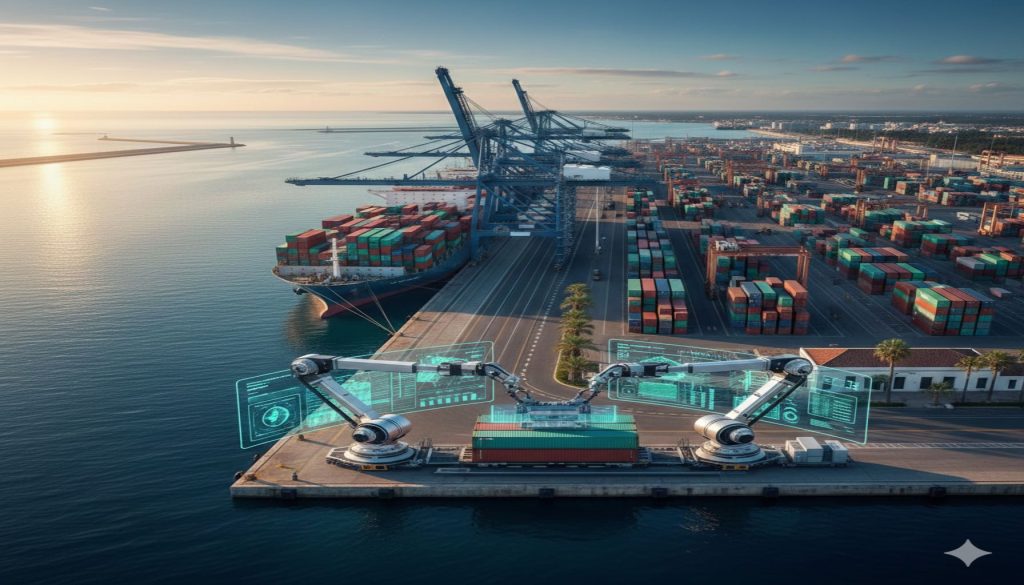
Algeria’s ports and land borders process enormous trade volumes. In 2024, the country’s ten main ports collectively handled approximately 130 million tonnes of cargo. The Port of Algiers alone handles 10–12 million tonnes annually with throughput capacity of 500,000–600,000 TEUs. Total imports reached approximately $42 billion in 2023, while exports — dominated by hydrocarbons — topped $47 billion in 2024. Yet for decades, much of the customs clearance process relied on manual document review, physical inspections of a high percentage of containers, and paper-based declarations that could take days to process.
The cost of this friction is enormous. World Bank data shows that Algeria’s import border compliance times have averaged 9 to 14 days, compared to significantly shorter clearance windows in Morocco and the UAE. For a country actively trying to diversify its economy away from hydrocarbons, trade facilitation is not a bureaucratic nicety — it is an economic imperative.
Algeria’s customs authority (Direction Générale des Douanes) has been quietly building a digital infrastructure. The SIGAD (Système d’Information et de Gestion Automatisée des Douanes) platform, developed in-house by Algerian customs since 1995, along with the planned national single-window trade system, represents one of the largest operational digitization projects in Algerian government. The next phase — integrating AI for risk profiling, automated document classification, and predictive analytics — is where the real transformation begins.
SIGAD and the Digital Foundation Already in Place
SIGAD is Algeria’s indigenous customs management information system, one of the few in the MENA region developed entirely in-house rather than adopting UNCTAD’s ASYCUDA framework used by over 100 countries. The system handles electronic customs declarations, tariff classification, duty calculation, and cargo tracking. Declarants can submit detailed declarations remotely via SIGAD, and the system has progressively replaced the manual processes in use since the 1990s. More recently, Algeria introduced ALCES, a complementary electronic system providing remote-access digital services for currency declaration, customs passes for vehicles crossing borders, and other traveler-facing functions.
The single-window platform, which Algeria has been developing in phases through the Ministry of Foreign Trade and Export Promotion, aims to allow importers and exporters to submit all required documentation — customs declarations, phytosanitary certificates, conformity assessments, banking documents — through a single digital portal. Morocco’s PortNet system and Egypt’s Nafeza platform are the regional benchmarks that Algeria is working toward. The implementation has been slower but is progressing, with electronic declarations now accounting for the majority of commercial import processing through SIGAD.
What SIGAD provides is the data foundation. Every declaration, every tariff classification, every inspection result is digitized. This creates the training data that AI systems need. The transition from rule-based automation (if cargo from country X in category Y, then inspect) to machine-learning-based risk profiling (analyzing hundreds of variables to predict the probability of non-compliance) is technically feasible with the data SIGAD has accumulated over three decades.
Advertisement
Where AI Changes the Game: Risk Profiling and Document Intelligence
Traditional customs risk management uses rule-based selectivity: predetermined criteria (country of origin, commodity type, importer history, declared value thresholds) determine whether a shipment gets a green channel (release), yellow channel (document review), or red channel (physical inspection). Algeria’s physical inspection rates have historically been among the highest in the region, a legacy of manual risk assessment that errs heavily on the side of caution — adding days to clearance times and straining port throughput.
AI-powered risk profiling fundamentally changes this calculus. Machine learning models trained on historical declarations, inspection outcomes, global trade intelligence, and even shipping route anomalies can assign risk scores with far greater precision. The UK’s HMRC, the Netherlands’ customs administration, and South Korea’s Korea Customs Service have deployed such systems, reducing physical inspection rates while actually increasing interception of illicit goods. The WCO’s Smart Customs Project, which released a detailed report on AI/ML adoption in customs in 2025, documents how AI-based risk management improves targeting accuracy, reduces repetitive workloads, and accelerates clearance times.
Document classification is another high-impact application. Customs officers currently review invoices, packing lists, certificates of origin, and bills of lading — often in multiple languages. AI-based document processing (using OCR combined with natural language processing) can extract key fields, cross-reference them against the declaration, and flag discrepancies automatically. This does not eliminate human review but dramatically reduces the time per declaration.
Container inspection technology adds a physical-world AI layer. Non-intrusive inspection (NII) systems — X-ray and gamma-ray scanners — are deployed at some Algerian ports. The next step is AI-assisted image analysis, where algorithms trained on thousands of scan images can identify anomalies (hidden compartments, density mismatches, undeclared goods) faster and more consistently than human operators. International vendors including Nuctech and Smiths Detection offer AI-augmented scanning solutions that are widely deployed across MENA and African ports.
Implementation Realities and the Path Forward
The Direction Générale des Douanes has institutional momentum. Algeria’s customs service has historically been one of the more technically capable government agencies, partly because of the revenue imperative — customs duties represent a significant portion of non-hydrocarbon government revenue. The political will to modernize exists because faster trade processing directly increases government revenue and reduces smuggling.
However, several challenges remain. Data quality is the first: AI models are only as good as their training data, and historical customs data may contain inconsistencies, misclassifications, and gaps accumulated over SIGAD’s three-decade lifespan. A data cleaning and standardization effort would need to precede any machine learning deployment. Interoperability is the second: customs data must integrate with port community systems, banking platforms, and the various ministries that issue permits and certificates. Algeria’s inter-ministerial coordination has historically been a bottleneck, and the single-window platform remains under development.
International partnerships are likely the fastest path. The World Customs Organization (WCO) has technical assistance programs specifically for AI in customs, including study missions and capacity-building workshops held across Africa and Asia. The EU’s border cooperation programs have worked with North African partners. Chinese firms, already embedded in Algerian port operations through the $4.7 billion Cherchell El Hamdania mega-port project led by China State Construction Engineering Corporation (CSCEC), could bundle AI customs solutions with infrastructure deployment.
The Cherchell mega-port, designed to handle up to 6.5 million TEU and 26 million tonnes of goods annually, will be a greenfield opportunity to deploy AI-native customs and logistics systems from day one — a rare chance to leapfrog rather than retrofit.
Advertisement
🧭 Decision Radar
| Dimension | Assessment |
|---|---|
| Relevance for Algeria | High — Directly impacts $42B+ in imports and government revenue collection |
| Infrastructure Ready? | Partial — SIGAD provides a 30-year digital backbone, but data quality and interoperability gaps remain |
| Skills Available? | Partial — Customs IT staff exist, but ML/AI-specific expertise would need to be recruited or contracted |
| Action Timeline | 6–12 months for pilot risk-profiling model on import declarations; 2–3 years for full deployment |
| Key Stakeholders | Direction Générale des Douanes, Ministry of Finance, port authorities (Algiers, Oran, Bejaia), Cherchell mega-port developers (CSCEC) |
| Decision Type | Strategic |
| Priority Level | High |
Quick Take: Algeria’s customs digitization is further along than most observers realize. The priority should be launching a pilot AI risk-profiling model at the Port of Algiers using existing SIGAD data, with WCO technical assistance. The Cherchell mega-port is a once-in-a-generation opportunity to build AI-native customs from scratch.
Sources & Further Reading
- Algeria Launches New Customs Information System — WCO News
- Algerian Ports Handled 130M Tonnes in 2024 — PortsEurope
- Algeria and China Revive $4.7B El-Hamdania Mega-Port — PortsEurope
- WCO Smart Customs Project: AI/ML Adoption Report — World Customs Organization
- Algeria Doing Business Indicators — World Bank
- SIGAD Customs Management System — Direction Générale des Douanes
- ASYCUDA Programme — UNCTAD
- Morocco PortNet Single Window Platform — PortNet
- Egypt Nafeza Single Window — Egyptian Customs Authority





Advertisement