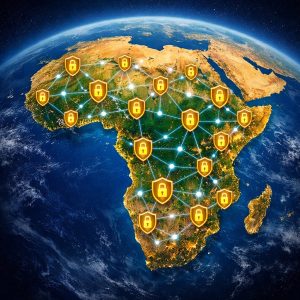
A Continent Under Siege
The numbers are stark. Check Point Research’s African Perspectives on Cybersecurity Report 2025 found that African organizations endure an average of 3,153 cyberattacks per week, a rate 60% higher than the global average of 1,968 attacks per organization. Nigeria alone recorded the highest weekly attack count at 4,200, while Ethiopia ranked as the most targeted nation overall.
Globally, organizations experienced an average of 1,968 cyberattacks per week in 2025, representing a 70% increase since 2023. Africa is not just keeping pace with this escalation — it is running ahead of it, driven by rapid digitization, underfunded security programs, and a cybersecurity talent deficit that spans the continent.
INTERPOL’s Africa Cyberthreat Assessment Report 2025 confirmed the trend: suspected scam notifications rose by up to 3,000% in some African countries, and cyber-related crimes accounted for 30% of all reported crimes in Western and Eastern Africa.
For Algeria, which blocked over 70 million cyberattacks in 2024 and ranks 17th globally among most-targeted nations, the continental pattern is both a warning and a call to accelerate.
Where the Attacks Are Landing
The threat landscape across Africa is not uniform, but certain patterns dominate.
Ransomware has evolved from encryption-focused extortion to data-leak blackmail, where criminals threaten public exposure rather than system lockout. South Africa and Egypt bore the heaviest ransomware burden in 2024, recording 17,849 and 12,281 incidents respectively, followed by Nigeria (3,459) and Kenya (3,030).
Identity-led intrusions surged across finance, energy, telecoms, and government, as attackers exploit stolen credentials and misconfigured access controls rather than technical vulnerabilities.
AI-generated phishing campaigns now produce linguistically convincing messages in local languages, bypassing traditional email filters trained on English-language patterns. This is particularly effective across multilingual African environments where security awareness programs have not yet caught up.
Mobile-first attack vectors exploit the continent’s overwhelmingly mobile internet landscape. With smartphone penetration outpacing desktop computing across sub-Saharan Africa, attackers target mobile banking apps, SMS-based authentication, and poorly secured mobile device management.
Operation Serengeti: Cross-Border Enforcement Gains Ground
The enforcement response is evolving. INTERPOL coordinated two major operations that demonstrated Africa’s growing capacity for cross-border cybercrime response.
Operation Serengeti (September-October 2024) resulted in 1,006 arrests and the dismantling of 134,089 malicious infrastructures across 19 countries. Operation Red Card (November 2024 – February 2025) added 306 arrests — together totalling more than 1,300 arrests and over 135,000 dismantled malicious infrastructures across the continent.
Operation Serengeti 2.0 (June-August 2025) expanded the model, bringing together investigators from 18 African countries and the United Kingdom to target ransomware, online scams, and business email compromise operations.
These operations prove that African law enforcement agencies can coordinate at scale. But they also reveal the gap between operational capability and sustained capacity: most participating countries still lack permanent, fully staffed cybercrime units.
Advertisement
Legal Frameworks Are Catching Up
Several African nations moved decisively on cybersecurity legislation in 2025-2026, creating the regulatory pressure that drives organizational investment.
Algeria adopted the most comprehensive framework with Presidential Decree 25-321 (December 2025) establishing the National Cybersecurity Strategy 2025-2029, followed by Decree 26-07 (January 2026) mandating dedicated cybersecurity units in every public institution.
Nigeria continued strengthening its position through the National Information Technology Development Agency (NITDA) and the Economic and Financial Crimes Commission (EFCC), deepening cooperation with international partners under the African Union’s cybersecurity framework.
Multiple African member countries harmonized their cybersecurity laws with international standards, invested in specialized cybercrime units, and expanded digital forensics infrastructure.
INTERPOL proposed six strategic recommendations for the continent: improving regional and international cooperation, expanding prevention and public awareness, leveraging emerging technologies for defense, harmonizing legal frameworks across borders, building cyber capacity in law enforcement, and strengthening public-private partnerships.
Building Resilience: What Is Working
Despite the scale of the threat, concrete progress is visible across the continent.
Managed security service adoption is accelerating. Rather than attempting to build expensive in-house SOCs, many African organizations are partnering with managed security service providers (MSSPs) to bridge the talent gap. This model aligns particularly well with Algeria’s 2025-2029 strategy, which explicitly encourages international MSSP partnerships.
Threat intelligence sharing is improving through regional CERTs and sector-specific information sharing and analysis centers (ISACs). Algeria’s ASSI (Agence de Securite des Systemes d’Information) is playing an increasingly active role in national threat coordination.
Workforce development programs are expanding. Algeria’s strategy aligns cybersecurity training with 285,000 new vocational training places, while accelerated government-funded certifications target existing IT staff.
International cooperation arrangements now embed foreign expert advisors in national cybersecurity programs and facilitate targeted recruitment from the diaspora community — a model Algeria is actively pursuing.
Algeria’s Position in the Continental Picture
Algeria occupies a distinctive position in Africa’s cybersecurity landscape. The country’s high attack rate (70 million blocked attacks in 2024) reflects both the scale of the threat and the maturity of detection systems that actually count and block those attempts. Many African nations lack the monitoring infrastructure to even measure their exposure accurately.
The 2025-2029 strategy positions Algeria among the handful of African countries — alongside Nigeria, South Africa, Kenya, and Morocco — that are moving from reactive defense to proactive resilience. The five-pillar approach mandates security audits for critical infrastructure, sector-specific regulations for banking, healthcare, and energy, and structured international cooperation.
But the challenge remains one of speed. At 3,153 attacks per week, African organizations do not have the luxury of multi-year implementation timelines. Every month of delayed deployment is a month of unmonitored exposure.
The Path Forward for African Cyber Resilience
The continental trend points toward three priorities:
- Accelerate MSSP partnerships. Most African organizations will not build adequate in-house SOCs within the next two years. Managed services are the bridge.
- Harmonize legal frameworks regionally. Cybercriminals operate across borders; defense must follow. The African Union’s cybersecurity framework needs teeth, not just agreements.
- Invest in AI-augmented detection. With attack volumes 60% above the global average, rule-based security tools cannot scale. AI-driven triage and automated response are not optional for the African context.
Frequently Asked Questions
How does Africa’s cyberattack rate compare to the global average?
African organizations face an average of 3,153 cyberattacks per week, which is 60% higher than the global average of 1,968 attacks per week. Nigeria records the highest weekly count at 4,200, while Ethiopia is the most targeted nation overall. The disparity is driven by rapid digitization outpacing security investment across the continent.
What is Algeria doing to address its cybersecurity exposure?
Algeria adopted Presidential Decree 25-321 establishing the National Cybersecurity Strategy 2025-2029, followed by Decree 26-07 mandating dedicated cybersecurity units in every public institution. The country blocked over 70 million cyberattacks in 2024, and its strategy includes 285,000 new vocational training places with cybersecurity certification tracks and structured MSSP partnerships.
Why are managed security service providers critical for African organizations?
Most African organizations cannot build adequate in-house Security Operations Centers within the next two years due to the 4.8 million global cybersecurity talent gap and limited local expertise. MSSPs bridge this gap by providing 24/7 monitoring, incident response, and threat intelligence at a fraction of the cost of building internal capabilities — a model explicitly encouraged by Algeria’s 2025-2029 strategy.
Sources & Further Reading
- Check Point Software’s 2026 Cyber Security Report — GlobeNewsWire
- 8 Key Trends Defining Africa’s Cybersecurity Landscape in 2026 — Intelligent CIO Africa
- INTERPOL Africa Cyberthreat Assessment Report 2025 — INTERPOL
- 574 Arrests in Coordinated Cybercrime Operation Across Africa — INTERPOL
- On the Front Lines of Cybercrime — Africa Defense Forum
- Algeria Cybersecurity Strategy 2025-2029 — AlgeriaTech
🔗 Related Intelligence

Algeria Under Siege: 70 Million Cyber Attacks and the New National Defense Framework

Phishing Epidemic: 13 Million Attacks Expose Algeria’s Digital Blind Spot

Algeria’s National Cybersecurity Strategy 2025–2029: A Deep-Dive Analysis

The Global Cybersecurity Skills Crisis: What Algeria Must Teach Now