The $100 Billion Announcement
When Gautam Adani took the stage at the India AI Impact Summit on February 17, 2026, and announced that the Adani Group would invest $100 billion by 2035 in AI data center infrastructure across India, the reaction split neatly into two camps. Skeptics pointed to the scale. Believers pointed to the math.
Both were partly right. The figure is aspirational and phased over nearly a decade. But the underlying strategy — India as the non-aligned world’s AI infrastructure backbone — is neither fantasy nor foolish. It is a calculated bet that the geography of AI compute is about to be redrawn.
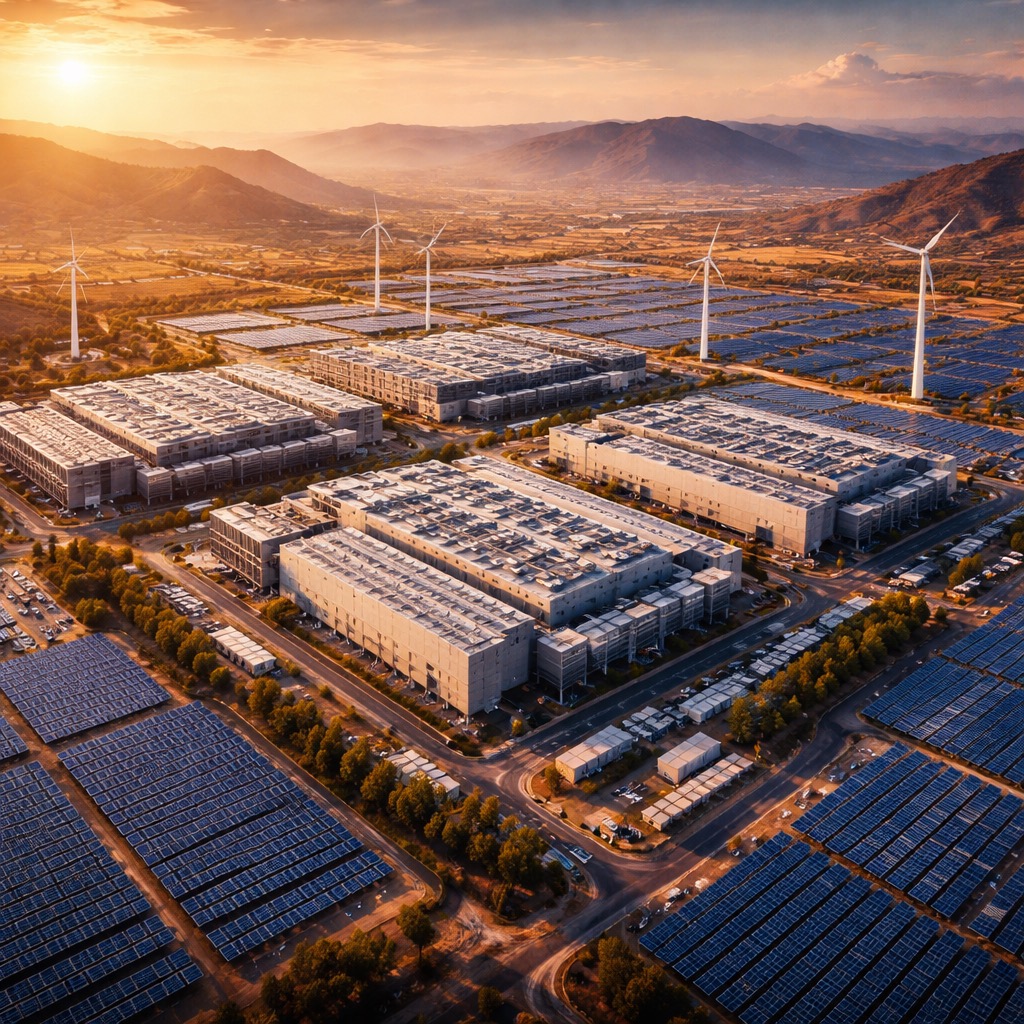
The Adani Group already operates data centers through AdaniConneX, a 50:50 joint venture with US-based EdgeConneX that has developed approximately 2 GW of data center capacity across India. The $100 billion plan would scale this dramatically to 5 gigawatts of AI-ready data center capacity across campuses in four Indian cities: Visakhapatnam (submarine cable connectivity to Southeast Asia), Noida (government AI workloads near Delhi), Hyderabad (enterprise AI in India’s tech hub), and Pune (industrial AI applications).
Powering the Vision: $55 Billion in Renewables
The most strategically significant component was not the data centers themselves but the $55 billion commitment to renewable energy and storage dedicated to powering AI infrastructure. Adani Green Energy Limited (AGEL), with approximately 18 GW of operational renewable capacity and a target of 50 GW by 2030, would build solar farms, wind installations, and battery storage purpose-built for the 5 GW data center portfolio.
India’s geographic advantage is substantial. Solar electricity from utility-scale installations costs as little as $0.02-0.03 per kWh in India’s best auction rates — roughly half the equivalent cost in the United States. Combined with 11 nuclear reactors under construction providing baseload power, India can offer 24/7 data center operations at costs significantly below US, European, and Japanese competitors.
For context, US data center grid-power demand reached approximately 62 GW in 2025 and is projected to nearly triple by 2030. The global hunger for AI compute creates an opening for any country that can deliver reliable, affordable power at scale.
A $240 Billion Ecosystem Takes Shape
Adani was not alone. The India AI Impact Summit — attended by over 600,000 people with delegations from 100+ countries — catalyzed more than $240 billion in combined AI investment pledges:
- Reliance Industries pledged $110 billion over seven years for gigawatt-scale AI data centers and edge computing, with 120 MW coming online in late 2026.
- Google committed $15 billion over five years for an AI hub in Visakhapatnam featuring gigawatt-scale compute and a new international subsea cable gateway.
- OpenAI partnered with Tata Group for 100 MW of AI data center capacity, with plans to scale to 1 GW. India already has over 100 million weekly ChatGPT users.
- NVIDIA partnered with L&T to build India’s largest gigawatt-scale AI factory and is working with Infosys, TCS, Tech Mahindra, and Wipro to upskill 500,000 developers.
- General Catalyst pledged $5 billion and Lightspeed Venture Partners pledged $10 billion over five years.
Advertisement
Why India, Why Now
India’s bid rests on five structural advantages. First, power abundance and cost: cheap solar, growing nuclear, and large-scale battery storage create a portfolio that can support 24/7 operations at a fraction of Western costs. Second, talent: India produces approximately 1.5 million engineering graduates per year and has an IT services industry employing over 4 million technology professionals. Third, domestic demand: India’s 1.4 billion people represent a massive market already leading the world in digital payments — UPI processed over 21 billion transactions monthly by late 2025.
Fourth, geopolitical positioning: India occupies a unique space — aligned with the US on technology policy through the Quad, but maintaining non-aligned relationships that make it attractive for Middle Eastern, Southeast Asian, African, and Latin American customers seeking alternatives to US or Chinese dependence. Fifth, government support: the India AI Mission with approximately $1.25 billion in allocation, data localization policies, and Prime Minister Modi’s personal engagement all signal AI infrastructure as a top-of-government priority.
The Adani Question and Real Risks
Any assessment must address the Adani Group itself. In November 2024, US prosecutors indicted Gautam Adani and others on charges related to an alleged $250 million bribery scheme involving Indian solar energy contracts. The group denied all charges and legal proceedings are ongoing. Notably, Google’s $15 billion and NVIDIA’s expanded partnerships were announced after the indictment.
The operational questions matter more for this project: Can Adani build world-class data centers? The group has hired aggressively from hyperscale operators and has demonstrated massive infrastructure execution across ports, airports, and power networks. Can AGEL deliver the renewable power? Its track record of building 18 GW of operational capacity suggests this is the most proven component.
Beyond Adani-specific risks, the project faces execution challenges ($10 billion per year sustained investment), power delivery complexity (integrating intermittent solar with 99.999% uptime requirements), India’s regulatory environment (land acquisition, environmental clearances), demand uncertainty (assumes exponential AI compute growth for a decade), and geopolitical risk (US export controls could restrict India’s access to advanced AI chips if relations deteriorate).
The Competition
India is not alone. The Gulf States — Saudi Arabia, UAE, Qatar — are investing heavily but face water scarcity and smaller talent pools. Singapore leads in Southeast Asia but has limited geography. Japan offers stability but high electricity costs. Indonesia and Malaysia are emerging as lower-cost alternatives. The United States remains dominant but faces permitting delays and power constraints. India’s advantage is the combination of scale, cost, talent, and domestic demand — no other country outside the US and China matches all four.
What Success Looks Like
If this bet pays off, India becomes the third pillar of global AI compute alongside the US and China, giving the rest of the world a credible alternative. Indian AI startups gain a domestic compute advantage. The renewable-powered AI model gets its largest test case. And India adds AI compute to an IT services export industry already worth over $210 billion annually.
The decade ahead will determine whether this is visionary foresight or cautionary overreach. What is already clear: the India AI Impact Summit put India squarely on the map of global AI infrastructure — and that alone changes the conversation.
Frequently Asked Questions
Why would companies host AI workloads in India instead of the US or Europe?
Three primary reasons: cost, talent, and geopolitical diversification. India offers some of the world’s cheapest renewable electricity ($0.02-0.03/kWh for utility-scale solar), a deep talent pool of over 4 million technology professionals, and a geopolitically non-aligned position appealing to companies seeking alternatives to full US or Chinese infrastructure dependence. India’s massive domestic market of 1.4 billion people also provides local demand that makes data centers viable independent of international customers.
Can India actually build 5 GW of data center capacity by 2035?
The engineering is feasible. AdaniConneX has already built 2 GW of capacity, and AGEL operates 18 GW of renewable energy — the power delivery component is the most proven element. The challenges are logistical: securing sufficient AI hardware (GPUs, high-bandwidth memory), integrating intermittent solar with 99.999% uptime requirements, and navigating India’s complex regulatory environment for land acquisition and environmental clearances. Sustained investment of $10 billion per year over a decade is ambitious but not implausible given the breadth of commitments from Adani, Reliance, and global tech partners.
How does this affect the global AI infrastructure landscape?
If India delivers even a fraction of the $240 billion in pledged investment, it becomes the third major pillar of global AI compute alongside the US and China. This matters because the current bipolar concentration creates geopolitical risk for every other country. India offers a non-aligned alternative with access to cutting-edge chips (unlike China, which faces US export controls on advanced NVIDIA GPUs). For the Global South, India’s success would provide a template for building sovereign AI infrastructure powered by renewable energy — a model directly relevant to countries like Algeria with abundant solar resources.
Sources & Further Reading
- Adani pledges $100B to build AI data centers as India seeks bigger role in global AI race — TechCrunch
- Google’s First AI Hub in India, Powered by $15 Billion Investment — Google Blog
- OpenAI taps Tata for 100MW AI data center capacity in India — TechCrunch
- India AI Impact Summit 2026: Landmark Global Declaration — PIB India
- Reliance unveils $110B AI investment plan — TechCrunch
- Data center grid-power demand to rise 22% in 2025, nearly triple by 2030 — S&P Global
- L&T Teaming with NVIDIA to Build India’s Largest Gigawatt-Scale AI Factory — L&T
- Nuclear Power in India — World Nuclear Association
🔗 Related Intelligence
AI Data Centers: The Architecture Behind the AI Revolution

National AI Strategies in 2026: Who Is Leading, Who Is Falling Behind, and What Works
AI Infrastructure: The Physical Foundation of Artificial Intelligence

AI That Clicks Buttons: Computer-Use Agents and GUI Automation