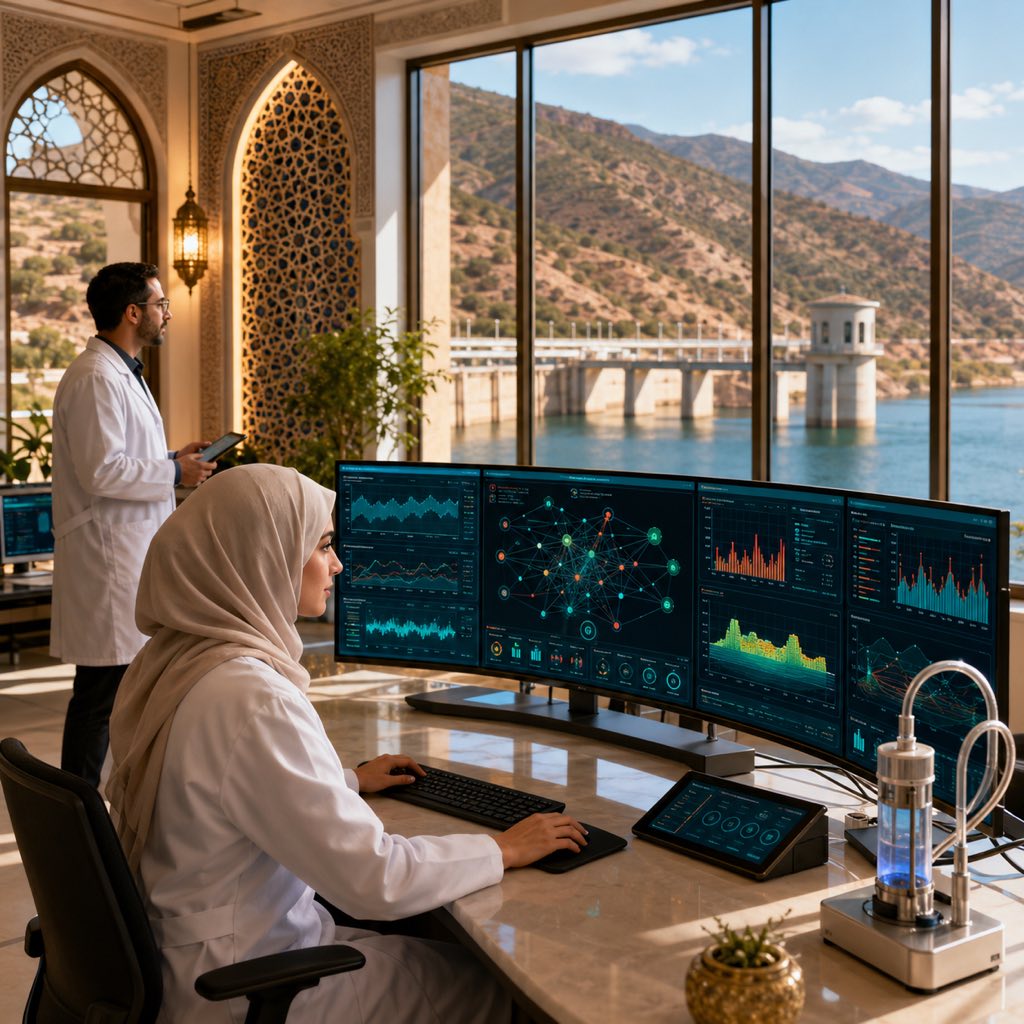
A Dam That Feeds a Million People, Monitored One Lab Sample at a Time
The Cheffia dam in El Tarf wilaya is not a minor reservoir. Built in 1965 with a regulable volume of roughly 95 million cubic metres, it supplies drinking water to the Annaba region — a population approaching one million — alongside irrigation for the Bounamoussa perimeters and process water for the El-Hadjar steel complex. Its water quality has come under pressure in recent years from agricultural fertiliser runoff and industrial discharge, which makes regular monitoring a public-health necessity, not a research luxury.
That monitoring is expensive. Determining whether dam water is safe means measuring a long list of physical, chemical, and biological parameters in a laboratory, then condensing them into a single Water Quality Index (WQI) — a 0-to-100 score that tells operators, at a glance, how clean the water is. Each parameter requires reagents, instruments, technician time, and sample transport. International cost studies have found that sample transport and labour alone account for roughly 75% of the marginal cost of drinking-water quality monitoring in developing countries. Cut the number of parameters you have to measure, and you cut most of the bill.
That is exactly what a new study set out to test — and the result is one of the more concrete examples yet of machine learning delivering a cost lever for an Algerian public utility.
What the Algerian Study Actually Found
The research, published 15 May 2026 in Frontiers in Earth Science, was led by Fahim Bordjihene with co-authors Salah Eddine Tachi, Hamza Bouguerra, and Jazia Arrar. It is a joint effort between the Water Science Research Laboratory at the National Polytechnic School in Algiers and the Water Resources and Sustainable Development Laboratory at Badji Mokhtar-Annaba University, one of Algeria’s largest research institutions with 89 laboratories.
The team trained and compared eight machine-learning algorithms — XGBoost, AdaBoost, CatBoost, Decision Tree, Random Forest, Multiple Linear Regression, Support Vector Machine, and a Stacking Voting ensemble — on Cheffia dam data, testing different combinations of input parameters to see how few measurements could still reproduce the full WQI. The standout was XGBoost, a gradient-boosting model widely used in structured-data prediction tasks, which reached R²=0.987 with RMSE=0.0181 and MAE=0.0111.
The crucial detail is which inputs delivered that score. The best combination used only three parameters: nitrite (NO₂), phosphate (PO₄), and ammonium (NH₄). In other words, the model reconstructs a full multi-parameter quality index from three nutrient measurements that happen to be the chemical fingerprints of exactly the fertiliser and effluent pollution Cheffia faces. The study’s own framing is explicit: the approach “reduce[s] the number of analyses required in the laboratory, thereby decreasing monitoring costs.”
A clarification worth making for non-specialist readers: R²=0.987 is a measure of how closely the model’s predictions track the real index — not a literal “98.7% of samples are safe” figure. It means the model explains 98.7% of the variation in the index. For an operational monitoring tool, that is the metric that matters.
Advertisement
Why This Matters for Algeria’s Water Authorities
Algeria operates dozens of dams under chronic drought stress, and the people who run them face the same arithmetic everywhere: more sampling points and more frequent sampling improve safety, but both cost money the sector does not have in surplus. A model that infers the full quality picture from three cheap nutrient measurements changes that trade-off. The same budget could cover more sampling locations, or more frequent checks at the same locations, or free up technician time for the parameters that genuinely cannot be inferred.
This is also a rare case where the research subject and the beneficiary are the same country. The dataset is Algerian, the dam is Algerian, the pollution sources are Algerian, and the institutions are Algerian. A WQI model trained on Cheffia will not transfer perfectly to a dam with a different pollution profile — but the method is portable, and the two laboratories that built it are domestic. That matters for water-quality work across North-East Algeria, where similar WQI-and-PCA studies are already mapping the region’s reservoirs.
What Algeria’s Water Authorities Should Do
1. Pilot the three-parameter model on one dam before scaling, not after
Pick a single reservoir with a known pollution profile — ideally one where nutrient runoff dominates, like Cheffia — and run the XGBoost approach in parallel with full laboratory testing for one full hydrological year. The point is to measure where the model’s predictions diverge from lab truth across seasons, including high-flow events when concentrations spike. Do not roll the method out network-wide on the strength of a single published R² score; a model that explains 98.7% of variance can still miss the 1.3% that includes a contamination event. Validate first, then decide which sampling rounds can safely drop to three parameters.
2. Match the input parameters to each dam’s actual pollution sources
The Cheffia model works because nitrite, phosphate, and ammonium are the chemical signatures of fertiliser and effluent — the dominant threats to that specific reservoir. A dam fed by a watershed with heavy-metal mining discharge or saline intrusion needs a different input set, because the three nutrients will not capture those risks. Before adopting the method elsewhere, commission a short feature-selection study per dam to identify which two-to-four parameters best reconstruct that reservoir’s index. Treat the three-parameter result as a template for the method, not a universal recipe.
3. Keep laboratory capacity for calibration and exceptions, never eliminate it
The goal is to reduce routine analyses, not to dismantle the lab. Models drift as pollution patterns change — a new industrial discharge, a shift in agricultural practice, or a drought-driven concentration spike can all break the relationship the model learned. Retain enough laboratory throughput to re-calibrate the model on a fixed schedule (at minimum quarterly) and to run full-panel confirmation whenever the model flags a borderline or declining index. The lab moves from doing every test to doing the tests that teach and check the model.
4. Build the skills in-house using the domestic research base
This work was done by Algerian university laboratories, which means the expertise to operationalise it exists inside the country. Water authorities should second technical staff into short collaborations with the National Polytechnic School and Badji Mokhtar-Annaba teams rather than buying a black-box product from an external vendor. The same applies to the broader machine-learning-for-water-monitoring field, which is moving fast globally — owning the model and the code, not renting it, is what keeps the cost saving durable and the data sovereign.
Where This Fits in Algeria’s 2026 Water Strategy
Algeria’s water sector is already absorbing AI in several places — precision irrigation, leak detection, and desalination optimisation among them. Quality monitoring is a quieter but arguably higher-leverage application, because it sits at the intersection of public health and tight budgets. The Cheffia study does not promise a revolution; it demonstrates a specific, measurable efficiency on one reservoir, built by two domestic laboratories, using a model anyone can audit.
The honest framing is that this is a proof of concept with a clear path to value, not a deployed system. Its strength is exactly what makes it credible: a narrow claim, a public dataset, a reproducible method, and a result that points at a cost line — laboratory analysis — that genuinely dominates monitoring budgets. If Algeria’s water authorities treat it as a template to validate dam by dam rather than a switch to flip nationwide, it becomes one of the more grounded AI opportunities in the country’s environmental toolkit. The next step is a funded pilot, not another paper.
Frequently Asked Questions
How accurate is the XGBoost model at predicting Cheffia dam water quality?
The XGBoost model reached R²=0.987 with an RMSE of 0.0181 and MAE of 0.0111, the best of eight algorithms the researchers tested. R²=0.987 means the model explains 98.7% of the variation in the Water Quality Index — it is a measure of predictive fit, not a literal share of safe samples. For routine operational monitoring, that level of fit is strong.
Which water parameters does the model need to predict the quality index?
The best-performing combination used just three chemical parameters: nitrite (NO₂), phosphate (PO₄), and ammonium (NH₄). These three are the chemical signatures of agricultural fertiliser runoff and effluent — the dominant pollution sources at Cheffia. Because the model reconstructs the full index from these three, it can reduce the number of laboratory analyses needed for routine checks.
Can this approach be used on other Algerian dams?
The method is portable, but the specific three-parameter recipe is not universal. A model trained on Cheffia is tuned to that reservoir’s nutrient-driven pollution; a dam facing heavy-metal or saline contamination would need a different input set. Water authorities should run a short feature-selection study per dam and validate against full lab testing before adopting it elsewhere.
Sources & Further Reading
- Further Reading
- Machine learning approaches for predicting the Water Quality Index of the Cheffia dam — Frontiers in Earth Science
- Badji Mokhtar-Annaba University — Wikipedia
- Assessing water quality in North-East Algeria using WQI and PCA — Water Practice & Technology, IWA Publishing
- Comparison and Cost Analysis of Drinking Water Quality Monitoring in Seven Developing Countries — PMC
- Automated machine learning for water quality prediction with reduced parameters — Scientific Reports
- A review of machine learning and IoT on water quality assessment — ScienceDirect