The Procurement Door That Most Algerian Startups Don’t Know Is Open
Algerian tech founders typically treat public-sector contracts as a different market entirely — one requiring years of track record, political connections, and the patience to navigate tender specifications written for large integrators. That assumption is increasingly obsolete.
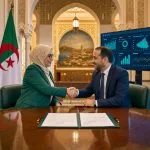
According to the U.S. Commercial Service’s Algeria Digital Economy guide, Algeria’s enacted public procurement law now provides “a more adaptable process for public entities to engage with startups through direct negotiation.” The explicit policy goal is to “channel a greater portion of public expenditure into startups and innovation” — which means the framework is not a bureaucratic loophole but a deliberate policy instrument.
This matters for the full range of Algeria’s labeled startups — the roughly 1,200+ enterprises that have received the official startup label from the Startup Algeria program — because label holders are the primary eligible class for this provision. A labeled startup working on enterprise software, digital services, cybersecurity tools, or data analytics now has a legal pathway to approach an SOE procurement office and propose a direct engagement.
What the Direct Negotiation Pathway Actually Allows
The conventional public procurement process in Algeria follows the standard competitive tender model: a public entity issues a specification (cahier des charges), potential suppliers respond, a commission evaluates bids on defined criteria, and the lowest compliant bidder typically wins. This process is designed for commodity procurement — it systematically disadvantages innovative solutions that are hard to specify in advance and startups that cannot compete on price with established integrators.
The direct negotiation provision creates a parallel pathway. Under it, a public entity or SOE can identify a startup with a relevant capability and negotiate a contract directly without publishing a general tender. The provision is not unlimited: it applies to innovation-type engagements where the startup brings a capability the SOE cannot easily specify in advance or source from established suppliers. The Prime Minister’s startup ecosystem development program frames this as part of a broader mandate to embed innovative enterprise solutions into public-sector digital transformation. The Algeria Numerique 2030 program specifically targets increased digital spending through startups as a mechanism for building domestic technology capacity rather than defaulting to imported solutions from established system integrators.
The 2026 Finance Law further reinforces this direction by “simplifying tax and administrative procedures for entrepreneurs and investors” and positioning entrepreneurship “at the centre of national economic transformation.” The combination of the procurement pathway and the fiscal simplification creates a policy environment where an Algerian startup’s first large contract can realistically come from the public sector rather than exclusively from private enterprise.
Advertisement
What Algerian Tech Founders Should Do to Enter This Market
1. Secure or Confirm Your Startup Label Before Approaching Any SOE
The direct negotiation pathway is not available to every SME — it is specifically tied to entities recognized under Algeria’s startup labeling framework managed by the Ministry in charge of startups (currently the High Commissioner for the Knowledge Economy, Startups, and Micro-Enterprises). If you are operating as a SARL or SPA without the startup label, you have no preferential access to this pathway and must compete through standard tender processes. The labeling application requires a technology or innovation component, a business plan validated by a national committee, and registration in the national startup database. Founders who have not yet applied should treat this as a prerequisite — not because the label itself is the goal, but because it is the legal key that unlocks the procurement pathway. Processing timelines have historically been 60–120 days; plan accordingly.
2. Build a Pipeline of SOE Decision-Makers Before Any RFP Is Published
Direct negotiation contracts are initiated by the public entity, not by the startup — but that does not mean founders should wait passively. The pathway works when an SOE decision-maker already knows a labeled startup has a relevant capability. This means your business development activity must happen upstream of any formal procurement process: industry events where SOE digital transformation directors are present, working groups within the Algeria Numerique 2030 program, and sectoral innovation challenges run by large SOEs like Sonatrach, Sonelgaz, and Air Algérie. The SOE officer who champions a direct negotiation contract needs to be able to justify it internally — your job is to give them the evidence (a proof of concept, a pilot result, a reference case from a private-sector client) that makes that justification straightforward.
3. Structure Your Proposal Around the SOE’s Transformation Mandate, Not Your Product Features
SOE procurement offices evaluate innovation engagements through a transformation lens: what problem does this solve, how does it align with our digital transition program, and what is the risk level of the engagement? Startup pitches that lead with technology features fail this test. A proposal structured around the SOE’s specific pain point — field data collection for energy infrastructure, predictive maintenance for industrial equipment, compliance reporting automation for banking subsidiaries — with a defined pilot scope, timeline, and measurable output converts the abstract direct negotiation pathway into a concrete procurement decision. The ARMP (Autorité de Régulation des Marchés Publics) recommends that direct negotiation contracts for innovation be structured in two phases: a paid feasibility study (typically 3–6 months) followed by a full deployment contract. Founders who propose this structure proactively reduce the SOE’s perceived risk and accelerate the decision process.
4. Engage the ARMP’s Innovation Procurement Guidance Before Signing
The ARMP has published guidance on innovation-based procurement that sets out the documentation requirements for a valid direct negotiation contract — including the justification memo the SOE must file, the ceiling values below which simplified procedures apply, and the oversight requirements during execution. Founders who ignore this documentation layer create legal risk for their SOE contact: if the contract is later challenged as improperly awarded, the SOE officer bears the liability, not the startup. Before any direct negotiation contract is signed, a session with a procurement lawyer familiar with ARMP guidance is not optional. The cost is typically 50,000–150,000 DZD for a document review, which is negligible relative to the contract value and the relationship risk.
The Bigger Picture: Public Expenditure as an Algerian Startup Growth Driver
The direct negotiation provision represents a policy bet: that channeling public expenditure toward labeled startups produces better technology outcomes than forcing innovation procurement through lowest-price tenders that large integrators always win. This is not a uniquely Algerian idea — Singapore’s GovTech model, France’s Programme Accélération des Startups de l’État, and Morocco’s Maroc Numeric Startups initiative all use variants of the same mechanism.
What makes Algeria’s version distinctive is the breadth of the SOE market it opens. Algeria has over 400 public enterprises across energy, telecommunications, transport, water, banking, and construction. Even if only 10–15% of those entities actively engage the direct negotiation pathway for innovation procurement over the next three years, the addressable market for labeled Algerian tech startups expands dramatically beyond what the private sector alone can absorb.
The constraint is not the legal framework — it now exists. The constraint is awareness and preparation. Founders who understand the mechanism, hold the label, have built SOE relationships, and can structure a risk-acceptable proposal will capture a disproportionate share of this opening. Those who wait for public tenders written for them will continue competing on price against integrators they cannot beat.
Frequently Asked Questions
Is the direct negotiation pathway (gré-à-gré) only available to startups with the official label, or can any technology SME use it?
The preferential direct negotiation provision is specifically tied to entities recognized under Algeria’s startup labeling framework. A standard SARL or SPA without the label must compete through the conventional tender process. However, there are also direct negotiation provisions for single-source procurement in cases of emergency or unique capability — those are available to any supplier but require a stronger justification and are subject to stricter ARMP oversight.
What contract values can a startup realistically target through direct negotiation with an SOE?
Based on the ARMP’s innovation procurement guidance, direct negotiation contracts for innovation engagements typically begin at the feasibility phase — contracts in the range of 3 to 10 million DZD for a 3–6 month study, with full deployment contracts that can reach 50–200 million DZD depending on the SOE’s scale and the solution’s scope. Energy sector SOEs (Sonatrach, Sonelgaz) tend to have the largest digital transformation budgets.
How long does a typical direct negotiation contract cycle take from first contact to signature?
Based on available procurement benchmarks, a well-prepared direct negotiation cycle — from initial SOE introduction to signed contract — typically takes 4 to 9 months. The longest stages are internal SOE approval (the responsible director must file a justification memo with their supervisory ministry) and the ARMP notification requirement. Founders who prepare the justification documentation proactively, rather than waiting for the SOE to draft it independently, significantly compress this timeline.
Sources & Further Reading
🔗 Related Intelligence
Algeria’s GovTech Wave: How Startups Are Winning Public-Sector Contracts in 2026
Algeria E-Procurement Portal: Digital Tender Access for Startups and SMEs in 2026

Algeria LegalTech: Startups Automating Contracts, Compliance, and Business Registration

Algeria National IP Policy: How Startups Can Commercialize University Research