The Capital Stack Has a Missing Floor
Since 2020, Algeria’s startup support system has been impressively constructed at the base. The Startup Label validates early-stage companies. The Algerian Startup Fund (ASF) deploys pre-seed capital of up to 150 million DZD (~$1.1M) across a portfolio that now exceeds 130 companies in 41 wilayas. Algeria Venture provides acceleration resources backed by a Sonatrach-Ministry partnership. The startup.dz platform registers over 7,800 companies.
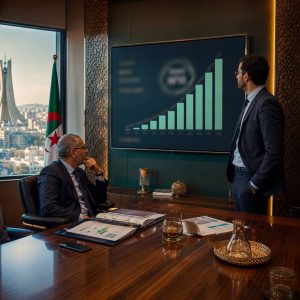
But a structural floor is missing between ASF-level pre-seed capital and the foreign investor circuit that Algerian companies rarely access. The gap — what practitioners elsewhere call the “Series A gap” — is the stage at which a startup has proven product-market fit in Algeria, is generating revenue, and needs $1M–$5M in equity capital to hire senior talent, build enterprise sales infrastructure, or fund geographic expansion. At this stage, the ASF has already deployed its maximum. The company is too large and too profitable for most incubator grants, and too unproven — with no comparable exit history — for most foreign VC funds watching Africa from London or San Francisco.
VOLZ’s $5M round in December 2025, led by Tell Group and GIBA rather than by a foreign VC, illustrated that this capital can exist in Algeria — but only because the company was exceptional enough to attract strategic corporate investors on its own. Most Series A-stage Algerian startups will not have that profile.
The FCPR framework is designed to institutionalize what VOLZ accomplished with bespoke corporate relationships. With COSOB’s Regulation No. 24-02 creating the legal structure for private venture funds, and Afiya Investments’ approval as the first FCPR operationalizing it, a second cohort of fund applicants is now forming according to ecosystem observers at Magstartup. The gap is about to get institutional attention — but only for founders who are prepared.
What “Prepared for Private VC” Means in Algeria’s Context
The structural differences between ASF capital and FCPR capital are not just legal — they require a different kind of founder readiness.
The ASF is an instrument of industrial policy. It processes applications through eligibility criteria, deploys capital in tranches between 3 million and 20 million DZD per tranche, and is accountable to the Ministry of Knowledge Economy. An ASF applicant needs a valid Startup Label, a viable business plan, and willingness to navigate public sector processes. The oversight is real, but so is the institutional patience: ASF does not require quarterly board meetings, investor updates with KPI dashboards, or a defined exit timeline.
An FCPR fund is different in every meaningful way. It is a private investment vehicle accountable to its LP unitholders, who provided capital expecting a fiduciary return. A portfolio company entering an FCPR portfolio needs to demonstrate metrics, maintain corporate governance records, accept board representation, and understand that the fund has a 5-10 year life after which it needs to return capital through a sale, secondary transaction, or other liquidity event. Algerian founders with no prior institutional investor experience frequently underestimate how much operational complexity this introduces — and how much preparation is required before a pitch conversation is productive.
The aventure.dz ecosystem has begun providing support for this transition, but the supply of founder-preparation resources remains well below what the second wave of FCPR applicants will require.
Advertisement
What Founders Should Do About the Incoming Second Wave
1. Build the Financial Infrastructure Before You Need It
The single most common rejection by institutional investors — not just in Algeria, but globally — is not a weak product. It is the absence of clean financial records. FCPR fund managers doing due diligence on an Algerian startup need audited accounts, a clean cap table (who owns what, in what class), a board resolution authorizing the financing, and evidence that the company’s equity ownership structure is compatible with the type of instrument the fund invests through.
Most Algerian startups currently operate with a single founder or co-founder share split documented in the initial commercial registration, with nothing more formal since. Before approaching any FCPR fund — and ideally 12 months before — founders should engage a chartered accountant familiar with startup cap tables, document their current ownership, and determine whether the legal structure they incorporated under supports equity investment or requires restructuring. Algeria’s SPA (Société Par Actions) structure is the most compatible with VC investment; startups incorporated as SARL structures may need conversion before institutional equity is feasible.
2. Define Your Exit Narrative — Even If You Have No Intention of Exiting Soon
FCPR funds are not grants. They are equity investments made by fiduciary managers who have committed to return capital to LP unitholders within the fund’s life. A fund manager meeting an Algerian Series A candidate will ask, at some point: “Who could buy this company, or where would it list, in a 5-7 year horizon?” This question is not rhetorical — it is a screening question that eliminates most candidates who have not thought about it.
Algerian founders should prepare a genuine answer. The most credible exit narratives in Algeria’s context in 2026 are: (a) acquisition by a regional strategic buyer — a telecom operator, a bank, or a large conglomerate that wants the startup’s product capability; (b) secondary sale to a larger regional fund as the company scales into multiple African markets; or (c) a potential public listing on the regional stock exchange if regulatory access improves. None of these is guaranteed — but having a reasoned view of which path is most plausible for your specific business signals that you understand the investor’s constraint.
3. Treat the ASF Portfolio as Your First Reference Network
The ASF has invested in over 130 companies. Afiya Investments, as the first FCPR, is already aware of this portfolio — it represents the most qualified cohort of potential investment targets in Algeria’s ecosystem. Founders who are already in the ASF portfolio should be actively cultivating relationships with Afiya’s team and with any second-wave FCPR applicant funds now, not when those funds close and begin deal sourcing.
The best institutional investors everywhere — and Algeria will be no different — fill their first funds with portfolio companies they met 12-18 months before the fund closed. Being the company the fund manager knows well when the fund closes is dramatically better than being the company that submits a cold pitch after the fund is capitalized. Use the network that the ASF has built as a warm introduction channel to the private VC layer forming above it.
Where This Fits in Algeria’s 2026 Capital Stack
The incoming second FCPR wave does not replace the ASF or eliminate the need for foreign capital at scale. It fills one specific gap — the $500K–$5M equity ticket that follows ASF pre-seed capital — and it does so with investors who understand Algeria’s regulatory environment, accept dinar-denominated companies, and have local operational relationships.
What it does not solve is the $10M+ growth round gap that will matter to companies like VOLZ in three to four years as they scale across multiple African markets. That tier of capital still requires either a domestic institutional investor of a scale that does not yet exist in Algeria — a pension fund, a sovereign fund, or a very large corporate venture arm — or a foreign investor convinced enough by an Algerian company’s fundamentals to write a large check. Building the precedent case for that tier is exactly what VOLZ’s 3.35x exit and the first FCPR generation are collectively doing.
The second FCPR wave is not the end of Algeria’s capital stack construction. It is the next floor in a building that is still missing several stories. But for founders currently in the $500K–$5M window, it is the floor they have been waiting for — and preparation starts now, not when the funds announce they are open for applications.
Frequently Asked Questions
What is the difference between the ASF and an FCPR fund for Algerian startup founders?
The Algerian Startup Fund (ASF) is a public instrument of industrial policy: it deploys capital up to 150 million DZD per startup through an application process, prioritizes company creation and job generation, and does not primarily focus on financial returns. An FCPR is a private investment vehicle with LP unitholders expecting a financial return within the fund’s lifespan. FCPR portfolio companies face board representation, quarterly reporting, governance requirements, and a defined exit expectation — none of which the ASF formally imposes.
How much capital could a second-wave FCPR provide compared to the ASF?
The FCPR framework sets a minimum fund size of 50 million DZD (~$370K), but individual funds can be much larger — Afiya Investments and its second-wave peers are targeting pools that allow individual ticket sizes in the 50 million–500 million DZD range per investment, well above the ASF’s 150 million DZD per-company ceiling. This positions FCPR funds to lead genuine Series A rounds for Algerian startups with proven revenue.
What corporate legal structure do Algerian startups need to receive FCPR investment?
The SPA (Société Par Actions) structure is the most compatible with equity investment in Algeria, as it supports share classes, board governance, and transferability required by institutional investors. Most early-stage Algerian startups incorporate as SARLs (Société à Responsabilité Limitée), which have limitations on equity transferability and investor governance. Founders planning to raise from FCPR funds should evaluate whether an SPA conversion is necessary and engage a commercial lawyer experienced in startup structuring before approaching investors.
—
Sources & Further Reading
- Startup Algeria — Pour les Startups (ASF, FCPR framework overview)
- Algeria’s Public Startup Fund Scores First Exit as Travel-Tech Völz Raises $5M — Launch Base Africa
- Algeria Venture — État de l’écosystème startup
- 10 Startups Algériennes à Suivre en 2026 — Magstartup
- Algeria FCPR Framework: How Afiya Investments and the New Private VC Law Reshape Startup Funding — AlgeriaTech
🔗 Related Intelligence
Algeria’s First FCPR: How the New Venture Capital Vehicle Reshapes Startup Funding

Algeria FCPR Framework: How Afiya Investments and the New Private VC Law Reshape Startup Funding

Algeria’s Startup Fund: 100+ Investments and the Case for a Second, Larger Vehicle
ASF + FCPR Co-Investment: Bridging Algeria’s Series A Funding Gap in 2026