From $23 Billion Private Round to $26 Billion Public Pricing
Cerebras Systems’ path to its May 2026 IPO is itself a case study in how quickly AI infrastructure valuations are moving. The company raised $1 billion in a Series H round at a $23 billion valuation in February 2026 — then filed a new S-1 in April 2026 at a $26.6 billion target, a $3.6 billion step-up in three months. The 2024 IPO attempt was withdrawn after a Committee on Foreign Investment in the United States (CFIUS) review of the company’s relationship with Abu Dhabi-based G42. With CFIUS clearance granted in March 2025 and G42 no longer listed among Cerebras’ investors, the regulatory obstacle is resolved.
The offering structure — 28 million shares at $115–$125 per share, with an additional 4 million shares available for underwriters — targets $3.5 billion in gross proceeds. At the top end, Cerebras would enter the public market as a company worth more than three times the valuation it carried as recently as October 2025, when it closed a $1.1 billion Series G at an $8.1 billion valuation.
That trajectory is remarkable even by 2026 AI standards. The question public market investors are now answering is whether $26.6 billion is a fair price for a company that generated $290 million in revenue in 2025 — roughly a 92x revenue multiple — or whether AI infrastructure premium pricing has reached a level that will reward early buyers and punish later-stage holders.
What Makes Cerebras Different from Every Other AI Chip Company
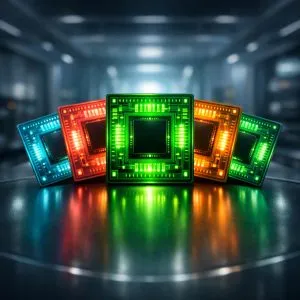
The WSE-3 chip is genuinely architecturally distinctive, and that distinction matters for understanding why the IPO is attracting the demand it is. While Nvidia’s GPU-based approach to AI compute dominates the training market, the shift toward AI inference — running trained models at scale for real-time applications — exposes structural limitations in the GPU architecture.
LLM inference is memory-bandwidth-bound: each token generated requires reading the model’s parameters from external memory, and GPUs stall waiting for that data. The WSE-3 carries 44 gigabytes of on-chip SRAM — enough to hold entire models without external memory access — and 900,000 AI-optimized cores across a processor the size of a dinner plate. Cerebras claims the CS-3 system delivers performance equivalent to 21x faster inference than Nvidia’s DGX B200 for Llama 3 70B workloads. Independent benchmarks from Artificial Analysis measured 2,522 tokens per second for Llama 4 Maverick on Cerebras versus 1,038 tokens per second on Blackwell — a 2.4x advantage on that specific benchmark.
For the public market narrative, the chip’s architecture serves a dual purpose: it validates the $26.6 billion valuation by demonstrating genuine technical differentiation (not a commodity GPU-cloud play), and it creates a defensible competitive moat because wafer-scale manufacturing is extremely difficult to replicate. Every WSE-3 is an entire silicon wafer used as a single processor — a manufacturing approach that Cerebras alone has mastered at commercial scale.
Advertisement
What Three Numbers Tell Us About the IPO
1. $3.5 billion raised against $10 billion in orders changes the IPO risk profile
A 2.9x oversubscription on a $3.5 billion offering is not typical even for high-demand tech IPOs. It signals that institutional investors — the pension funds, mutual funds, and hedge funds that determine post-IPO price stability — are competing for allocation rather than waiting to buy in the aftermarket. This demand structure typically produces stronger first-day performance and lower post-IPO volatility than offerings that price at the maximum and rely on retail buying for support.
For the AI infrastructure IPO wave building behind Cerebras — SpaceX, OpenAI, Anthropic are all watching — a successful Cerebras debut validates the public market’s appetite for pre-profitability (and now profitability) AI hardware at headline valuations. A stumbling debut would not kill those plans but would increase the scrutiny applied to revenue quality, customer concentration, and governance.
2. The OpenAI partnership is the valuation anchor, and that creates concentration risk
The reported $10 billion multi-year OpenAI deal — providing 2 gigawatts of computing capacity through 2030 — is the commercial validation that makes $26.6 billion plausible. Without it, Cerebras is a technically distinctive hardware company with $290 million in revenue and a premium valuation; with it, Cerebras is a contracted infrastructure provider to the world’s most commercially prominent AI company, with visibility into multi-year cash flows.
But customer concentration risk is the mirror image of that strength. Public market investors apply valuation discounts when more than 30-40% of revenue is tied to a single customer. If OpenAI’s share of Cerebras revenue is as large as the contract implies, analysts will model scenarios where OpenAI diversifies to Nvidia, AWS Trainium, or its own custom silicon — and the resulting discount will be priced into the forward P/E from day one. The S-1 risk factor section on customer concentration will be closely read.
3. $87.9 million profit changes the story from “AI hope” to “AI earnings”
Most of the AI infrastructure companies that went public in 2024-2025 — CoreWeave, Lambda Labs, Vast Data — remained pre-profitability at IPO. Cerebras’ reported $87.9 million GAAP net income in 2025 (versus a $485 million loss in 2024) is a narrative-changing development. It means that Cerebras is not selling a future promise; it is selling a profitable business with 76% revenue growth and a hardware product that commands premium margins.
The caveat — emphasized by the $75.7 million non-GAAP net loss that excludes one-time items — is that GAAP profitability may reflect one-time gains (from the OpenAI deal structure, prepayments, or accounting items) rather than underlying operating leverage. The GAAP versus non-GAAP divergence is the line item that short sellers and skeptical analysts will probe most aggressively in the post-IPO period.
The Broader Stakes: Why Cerebras Is a Benchmark, Not Just an IPO
The AI hardware IPO market in 2026 has no established comparable. CoreWeave (GPU cloud) went public in March 2025 and has risen 123% since. But CoreWeave is infrastructure rental, not proprietary chip design. Cerebras is the first company with custom AI silicon to attempt a public offering at this scale since Nvidia itself went public in 1999.
If Cerebras trades at or above its IPO price through the first 90 days, it sets a pricing benchmark for every AI infrastructure startup currently held in VC portfolios: wafer-scale or custom-silicon companies can be public-market-ready at 80-100x revenue multiples, and institutional investors will underwrite that valuation. If it trades down significantly — driven by customer concentration discounts, competition from Nvidia’s CUDA moat, or manufacturing yield concerns — it signals that the AI hardware premium has a ceiling and that the remaining IPO pipeline should price more conservatively.
For founders, engineers, and investors across the AI infrastructure stack, the Cerebras IPO is effectively a real-time stress test of the market’s conviction in AI hardware differentiation. The result will set expectations not just for chip companies, but for the entire wave of specialized AI infrastructure startups — model-serving platforms, inference optimization tools, and memory-compute integration companies — that are watching from the private market.
What Comes Next: The IPO Pipeline Behind Cerebras
Cerebras’ public debut creates a datapoint that every AI infrastructure company planning a 2026 or 2027 IPO will use to calibrate timing and pricing. The companies most likely to benefit from a Cerebras success are those with similar profiles: contractual revenue from hyperscalers or frontier AI labs, GAAP path to profitability, and genuine hardware or infrastructure differentiation.
SambaNova (reconfigurable dataflow chips, ~$1.49 billion raised including a $350 million Series E in February 2026) and Tenstorrent (RISC-V + AI cores, $800 million raised, licensing model with Samsung, LG, Hyundai) are the most likely next-wave hardware IPO candidates. ElevenLabs — voice AI infrastructure at an $11 billion valuation — and Sierra AI ($950 million raised for enterprise AI agents) represent the software-infrastructure layer.
The Cerebras IPO is the gate that opens or narrows this entire pipeline. Watch the first 30 trading days.
Frequently Asked Questions
Why was Cerebras’ 2024 IPO attempt withdrawn, and what changed?
The 2024 IPO was withdrawn after a CFIUS (Committee on Foreign Investment in the United States) review of Cerebras’ relationship with Abu Dhabi-based Group 42 (G42), which was a major investor and customer. CFIUS granted clearance in March 2025. By October 2025, Cerebras also withdrew the original filing because the financial data had become stale (the 2024 financials no longer reflected a company now valued at $8-23 billion). For the May 2026 IPO, G42 is no longer listed as an investor, and the S-1 reflects 2025 financials showing $290 million revenue and GAAP profitability.
How does the OpenAI relationship affect Cerebras’ IPO risk?
OpenAI is Cerebras’ most significant customer, with a multi-year deal reportedly worth over $10 billion that provides up to 2 gigawatts of compute capacity through 2030. OpenAI also provided a $1 billion secured loan with warrants allowing purchase of 33+ million shares, and Sam Altman and Greg Brockman invested as angels. This relationship provides revenue visibility but creates customer concentration risk: if OpenAI reduces its Cerebras allocation — by expanding to AWS Trainium, Google TPUs, or its own custom silicon — Cerebras’ revenue base would be significantly impacted. Public market investors will scrutinize the customer concentration disclosure in the S-1 closely.
What does a successful Cerebras IPO mean for other AI startup founders?
A successful debut — trading at or above the $115-$125 IPO range through the first 90 days — validates several things for founders: that custom AI hardware can be public-market-ready at scale, that 76% revenue growth at $290 million in revenue commands 80-100x revenue multiples, and that institutional investors will underwrite hardware differentiation stories. Practically, it is likely to compress the IPO timelines for other AI infrastructure companies currently in late-stage private funding and may enable SambaNova, Tenstorrent, and AI software infrastructure companies to file S-1s in Q3-Q4 2026.
Sources & Further Reading
- OpenAI’s Cozy Partner Cerebras Is on Track for a Blockbuster IPO — TechCrunch
- AI Chip Provider Cerebras Seeks to Raise $3.5B at $26.6B Valuation — SiliconAngle
- AI Chip Startup Cerebras Files for IPO — TechCrunch
- Cerebras Systems Eyes $3.5B in Largest Tech IPO of 2026 — The AI Insider
- CNBC: Cerebras IPO — AI Chipmaker