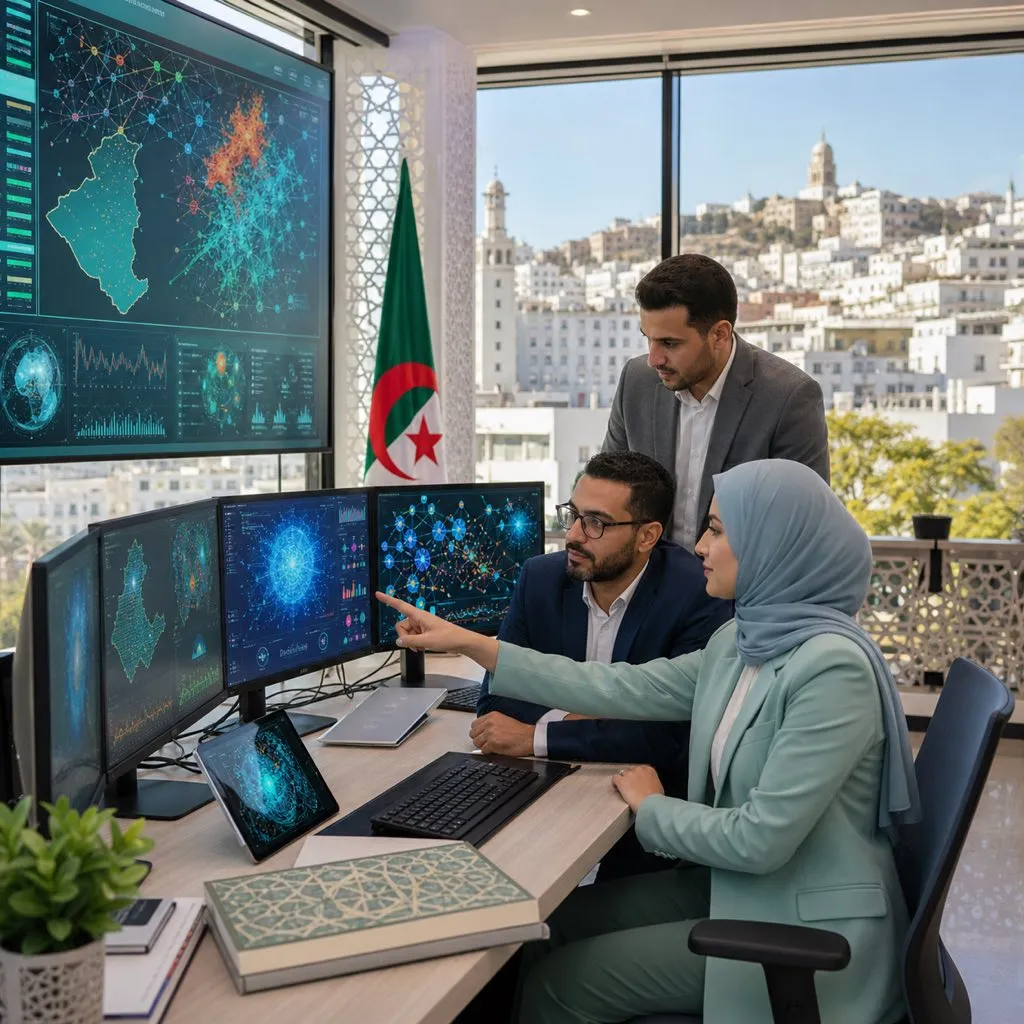
The Six Pillars, Unpacked
Algeria’s national AI strategy is not a single programme but a framework of six interdependent pillars, each targeting a distinct systemic constraint that has historically limited the country’s digital output. Understanding the six pillars together — rather than individually — is the prerequisite for anyone trying to position a business, a research lab, or a career around the national direction.
Pillar 1: Scientific Research and Innovation. The strategy commits to expanding AI research capacity inside Algerian universities. This includes deepening mathematics and AI curricula and building links between university labs and industry demand. Algeria currently has 57,702 students enrolled across 74 AI master’s programmes in 52 universities — a significant base that the strategy aims to convert from academic output into applied research with commercial applications.
Pillar 2: Talent Development. This pillar operationalises the human capital investment discussed above. It encompasses the 12-week vocational AI programme launched April 27, 2026; the Scale Centers network running AI, cloud, and cybersecurity tracks across major Algerian cities; and the Huawei ICT Academy partnerships. The target — 500,000 trained ICT specialists — is the single most ambitious deliverable in the entire strategy.
Pillar 3: Hardware and Infrastructure. Minister Zerrouki announced the launch of Algeria’s first high-performance computing (HPC) centre dedicated to AI, located in وهران (Oran). The country has already installed 265,000 kilometres of fiber optic cable and connected 1,400 sites with 4G technology, with plans to deploy 7,000 new 4G stations by 2025. AventureCloudz, the sovereign developer cloud launched April 30, 2026, contributes to this layer at the application infrastructure level.
Pillar 4: Investment Promotion and Ecosystem Building. Algérie Télécom has committed a 1.5 billion dinar ($11 million) fund targeting AI, cybersecurity, and robotics startups. The broader goal includes creating 20,000 startups within the ecosystem — a figure that provides context for the startup.dz registry’s current 7,800+ entities. The Algerian Startup Fund, backed by six public banks since 2021, operates alongside this.
Pillar 5: Data Protection and Regulatory Framework. This pillar acknowledges that AI deployment at scale requires clear rules on data use, liability, and algorithmic accountability. Law 18-07 on personal data protection is the current foundation; the national AI strategy signals intent to build a specific AI governance layer on top of it. This matters for enterprises: regulatory clarity on training data and inference outputs is a prerequisite for procurement decisions, particularly in healthcare and financial services.
Pillar 6: Sector-Specific AI Deployment. The strategy targets three verticals explicitly: agriculture (where precision AI aims for 20-25% yield increases worth $800 million to $1.2 billion by 2030), oil and gas (potential annual cost reductions of $200-300 million through AI-optimised operations), and healthcare and cybersecurity. These are not aspirational clusters — they are sectors where Algeria has existing data assets, institutional capacity, and measurable business cases.
The Numbers Behind the Strategy
The 7% GDP target sits inside a set of market projections that make the strategy’s ambitions legible. Algeria’s AI market is projected to grow from $498.9 million in 2025 to $1.69 billion by 2030 — a 27.67% compound annual growth rate. This is not the fastest AI market growth rate in Africa or the Middle East, but it is structurally meaningful: it represents a market transition from AI as a research topic to AI as an economic sector with measurable revenue.
The infrastructure investment numbers tell the same story: $550-850 million estimated for human capital development alone; over 500 digital transformation projects planned for 2025-2026; 265,000 km of fiber optic already deployed. These are not ambitions on paper — they are investments already made or formally committed, against which the 7% GDP target can be tracked.
The agriculture vertical provides the most concrete business case: precision agriculture enabled by AI is projected to generate $800 million to $1.2 billion in yield value by 2030. Algeria’s agricultural sector contributes 12.4% of GDP — meaning AI-driven productivity improvements in agriculture alone could shift national accounts in measurable ways before 2030.
Advertisement
Where Algeria Sits in the North Africa AI Race
Algeria enters this race with structural advantages that regional comparisons (excluding other country benchmarks per our editorial policy) tend to undercount. The combination of a 47-million-person domestic market, significant hydrocarbon-derived capital for technology investment, existing university AI infrastructure (57,702 students, 74 master’s programmes, 52 universities), and a growing labeled startup ecosystem (2,300+) is not replicated at scale elsewhere in the region.
The Oran HPC centre is particularly significant: national AI development requires compute that local researchers can access without dollar-denominated cloud bills or export-control restrictions on foreign infrastructure. An on-shore HPC centre removes both constraints simultaneously and positions Algerian university researchers to run the large-scale training experiments that are otherwise prohibitively expensive.
The non-hydrocarbon export target is the long-run strategic logic: Algeria currently earns approximately $5.1 billion in non-hydrocarbon exports. The strategy explicitly targets doubling this figure through digital services optimisation. This is where AI becomes a foreign exchange generator rather than just a productivity tool — and where the stakes of the strategy exceed what a 7% GDP number alone conveys.
What Algerian Businesses and Innovators Should Do Now
1. Map Your Sector Against the Six-Pillar Alignment Grid
Every Algerian enterprise — startup or large company — should produce a one-page alignment map that answers: which of the six pillars is my business directly positioned to benefit from, and what is the timing? For example: a fintech startup benefits from Pillar 4 (investment ecosystem) and Pillar 5 (regulatory clarity), with a 6-12 month horizon. A precision agriculture company benefits from Pillar 3 (compute) and Pillar 6 (sector deployment targets), with an immediate horizon.
This exercise is not performative. The government procurement pipeline for SNTN-2030’s 500+ digital projects will prioritise vendors whose offers directly address a named pillar. Businesses that cannot articulate their pillar alignment will be systematically disadvantaged in public tender processes over the next 24-36 months.
2. Access the Algérie Télécom AI Fund Before the First Cohort Closes
The 1.5 billion dinar ($11 million) Algérie Télécom fund is the most accessible institutional capital specifically targeting AI, cybersecurity, and robotics startups. Unlike commercial bank financing, which requires revenue history and collateral, innovation-focused funds of this type typically evaluate technology readiness level (TRL) and team capability — criteria that early-stage AI startups are more likely to meet.
Founders should not wait for the fund to become widely known before applying. Government-backed innovation funds in markets at this stage of development typically deploy capital to the first wave of credible applicants and then adjust criteria for subsequent waves. First-mover applicants receive more direct engagement from fund managers, which translates into better-structured deal terms and faster decisions.
3. Build for the Agriculture, Oil and Gas, and Healthcare Verticals First
The strategy’s sector deployment pillar (Pillar 6) is not a wish list — it is a procurement signal. Government AI adoption in Algeria will follow the vertical priorities stated in the strategy: agriculture, oil and gas, healthcare, cybersecurity. Startups and solution providers who orient their product development toward at least one of these verticals are building toward an accessible institutional market, not an abstract enterprise buyer.
For the agriculture vertical: the $800 million to $1.2 billion yield optimisation opportunity by 2030 translates to precision irrigation, satellite-based crop monitoring, and AI-driven soil quality analysis. For oil and gas: the $200-300 million annual cost reduction target means AI for predictive maintenance, pipeline monitoring, and logistics optimisation. Build products that speak the ROI language of these sectors, and your procurement conversations will be substantively easier.
The Correction Scenario
Every national AI strategy of this scale faces a standard set of failure modes. Algeria’s six-pillar strategy is not immune. The three most realistic correction scenarios are worth naming explicitly.
The talent bottleneck: 500,000 ICT specialists is an ambitious target that requires scaling the instructor pipeline (the January 2026 train-the-trainers programme), the institutional capacity (Scale Centers, university programmes), and the private-sector absorption rate simultaneously. If any one of these three scales slower than the others, the pipeline backs up. The most likely chokepoint is private-sector absorption — Algerian enterprises historically hire cautiously, and an oversupply of certified AI practitioners without corresponding private-sector demand would stall momentum.
The compute concentration risk: the Oran HPC centre is a single facility. A single national HPC node creates concentration risk: if it is underspecified, over-subscribed, or experiences procurement delays, the research and startup communities that depend on it lose their primary compute advantage. Singapore addressed this risk by distributing compute across multiple facilities and combining public with commercial cloud procurement — a model worth benchmarking.
The regulatory lag: the strategy flags Pillar 5 (regulatory framework) as a component, but the detailed AI governance rules have not yet been published as law. Until they are, enterprises in regulated verticals (healthcare, financial services) cannot commit to AI deployment at scale because they cannot be certain of the legal environment in which their systems will operate. Closing this regulatory gap by late 2026 is a prerequisite for the healthcare and fintech AI adoption that the strategy envisions.
Frequently Asked Questions
What exactly is Algeria’s 7% GDP AI target and when was it announced?
Algeria’s Minister of Post and Telecommunications Sid Ali Zerrouki announced the target — that AI should contribute 7% of GDP by 2027 — at the third edition of the CTO Forum Algeria on February 17, 2026. The target is supported by projections showing Algeria’s AI market growing from $498.9 million in 2025 to $1.69 billion by 2030 at a 27.67% annual growth rate.
What is the Algérie Télécom AI fund and how can startups access it?
Algérie Télécom has committed 1.5 billion dinars (approximately $11 million) to an investment fund specifically targeting AI, cybersecurity, and robotics startups. The fund is part of Pillar 4 of the national AI strategy (Investment Promotion and Ecosystem Building). Startups in these verticals should contact Algérie Télécom directly to understand the application criteria and timeline for the first deployment cohort.
How does the Oran HPC centre fit into Algeria’s AI strategy?
The Oran high-performance computing centre — officially launched by Minister Zerrouki — is Algeria’s first dedicated AI compute facility. It is the hardware foundation for Pillar 3 (Infrastructure), providing Algerian researchers and enterprises with on-shore compute that avoids dollar-denominated cloud costs and foreign export-control restrictions. This is particularly significant for university AI research and large-scale machine learning training runs that would otherwise be prohibitively expensive on foreign cloud infrastructure.
—
Sources & Further Reading
- Why Algeria Is Positioned to Become North Africa’s AI Leader — New Lines Institute
- Algeria Targets 7% GDP from AI by 2027 with Investment and Infrastructure Plans — We Are Tech Africa
- AI in Algeria: Insights and Practical Implementation Strategy — TechaHub
- Algeria Launches National AI Training Program to Build Digital Skills — EcofinAgency
- Algeria Launches First AI and Cybersecurity Startup Cluster to Drive Digital Economy — Innovation Village