Why 85% COD Is a Structural Problem, Not a Cultural Preference
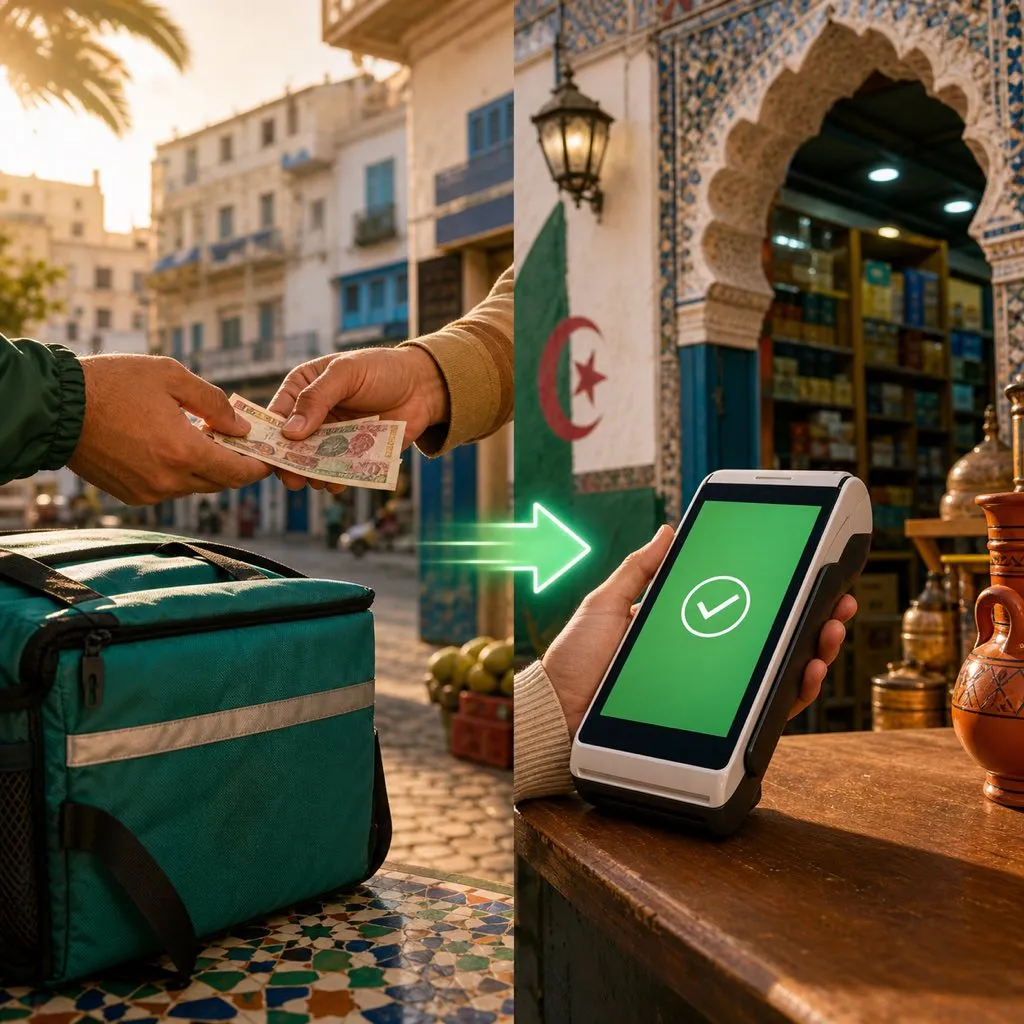
Cash-on-delivery dominance in Algerian e-commerce is not simply a consumer preference — it is a merchant infrastructure problem. When a business cannot accept CIB or Edahabia cards online, it has no choice but to default to COD. The result is a compounding loss cycle: merchants absorb return-to-sender (RTS) rates of 25–45% on undelivered COD orders, pay logistics fees twice (outbound dispatch plus returned package), and carry receivables tied up in transit for 4–7 days on average.
The data from GIE Monétique for full-year 2025 reveals the scale of the gap. Online payment transactions grew 179%, reaching 145 billion DZD across more than 27 million operations. The average online transaction value has climbed from 1,180 DZD in 2020 to 5,400 DZD in 2025 — proof that Algerian digital buyers are not just transacting more often but spending more per session. Yet only 644 web merchants were certified by end-2025, a 26.27% year-on-year increase that is real progress but still leaves millions of card-holders with nowhere to pay digitally.
The Algerian government has set a formal cashless target for 2028. For SMEs in the September 2026–December 2027 window, that target translates into a specific competitive deadline: adopt digital payment rails before the 2028 enforcement wave or cede customers who have already moved.
The Four-Step Conversion Framework
1. Register as a Web Merchant via CNRC — Before Applying for Any Payment Gateway
The legally required first step is obtaining e-commerce authorization from the Centre National du Registre de Commerce (CNRC). Without this authorization, no Algerian payment gateway provider can legally onboard a merchant for online card acceptance. The CNRC process requires: a valid commercial register (RC), a verified business address, a declaration of the product or service category, and a functional e-commerce website URL.
Processing time is typically 15–30 business days. Merchants who skip this step and attempt to accept digital payments through informal workarounds risk account suspension and regulatory exposure under Algeria’s e-commerce Law 18-05. CNRC authorization is not a bureaucratic formality — it is the legal prerequisite that unlocks the entire payment gateway ecosystem.
2. Choose Between the Two Proven Gateway Tiers: Bank-Anchored vs. Specialist Fintech
Once CNRC-authorized, an Algerian SME faces a gateway choice that determines integration effort, settlement speed, and fee structure.
Bank-anchored gateways (CIB-SATIM switch, SATIM-connected bank portals) offer the most conservative path. Settlement occurs within 24–48 hours directly to the merchant’s existing bank account. Integration requires a pre-existing bank relationship and a SATIM-connected merchant ID. Fees are standardized at approximately 1% per transaction under the SATIM interbank framework. The limitation is limited API documentation and slower onboarding timelines (4–8 weeks for full activation).
Specialist fintech gateways — specifically Chargily Pay and Sofizpay — offer faster onboarding (5–10 business days after CNRC authorization), richer API documentation, installable plugins for WooCommerce and PrestaShop, and broader wallet coverage including both CIB and Edahabia. Sofizpay crossed the 10,000-active-merchant threshold in early 2026, making it the single largest private acceptance network for Edahabia cards in Algeria. Chargily Pay is the dominant choice among developer-led startups for its REST API and sandbox testing environment.
Neither tier is universally better. SMEs with existing bank relationships and high average order values (AOV above 10,000 DZD) typically benefit from bank-anchored settlement certainty. SMEs with software-driven storefronts and lower AOV benefit from fintech gateway speed-to-market.
3. Configure DZ Mob Pay for In-Store and Mobile Acceptance
Digital payment conversion is not limited to website checkout. Algeria’s interbank mobile payment system, DZ Mob Pay, serves as the bridge for merchants who sell primarily in-person or via social commerce (Instagram DMs, Facebook shop inquiries). By December 2025, DZ Mob Pay had reached 95,014 personal accounts and 14,283 merchant accounts across 7 pilot banks, completing over 57,000 transactions in its inaugural operational year.
Configuring DZ Mob Pay requires the merchant to hold an account at one of the 7 pilot banks (the expansion to remaining licensed banks is scheduled for 2026–2027). Once enrolled, merchants generate dynamic QR codes per transaction that customers scan with their own bank application. Settlement is near-real-time to the merchant’s bank account. The system handles both CIB and Edahabia-linked wallet transfers, covering the two dominant card types among Algerian consumers.
For mobile-first SMEs — the segment that has historically relied on WhatsApp invoice confirmations and COD for delivery — DZ Mob Pay is the fastest path to first digital transaction, bypassing the full CNRC/gateway onboarding cycle for in-person acceptance.
4. Restructure Delivery SLAs and Return-Handling Policy Around Digital-First Incentives
The final step is often overlooked: COD conversion fails when logistics partners still treat “digital payment confirmed” orders identically to COD orders in priority routing and SLA guarantees. Best-practice Algerian SMEs using platforms like Yalidine and Maystro now negotiate tiered SLA agreements — digital-payment orders receive 24-hour dispatch priority versus 48-hour for COD, and return-handling fees are waived on digital orders where fraud is not involved.
This logistics-layer incentive creates a self-reinforcing loop: customers who pay digitally receive faster delivery, generating higher repeat purchase rates, reducing the absolute number of COD transactions without requiring the SME to ban COD entirely. According to the Digital Algeria 2025-2030 strategy published by the Ministry of Post and Telecommunications, the government’s 2028 cashless target includes merchant acceptance density as a tracked KPI — meaning the CNRC certification queue is expected to grow sharply from late 2026 onward. Moving early means less administrative backlog, faster approval, and first-mover SEO authority on category keywords.
Advertisement
What the Conversion Economics Look Like
The standard objection to digital payment conversion is cost: a 1% processing fee appears to reduce margin relative to COD, which has no per-transaction fee. This framing ignores the total cost of COD ownership. A COD transaction that results in a failed delivery (conservatively 25% of COD orders in Algeria, per Ecommaps 2026 research) costs the merchant the original shipping fee plus return shipping fee plus repacking cost — typically 800–1,400 DZD per failed order. At an average AOV of 5,400 DZD, a 25% failure rate costs the merchant approximately 5.6–9.6% of COD-channeled revenue in logistics waste alone.
By comparison, a digital payment transaction at 1% fee with near-zero return rate costs 1% with no return overhead. The net economics favor digital conversion for any SME with an AOV above approximately 3,000 DZD and a COD failure rate above 15%. For SMEs at these thresholds — which covers the majority of Algerian e-commerce operators by transaction profile — digital conversion is not a policy compliance exercise. It is a margin improvement.
The Bigger Picture: The 2028 Deadline as a Strategic Forcing Function
Algeria’s cashless strategy is not aspirational — it has infrastructure and regulatory teeth. The national switch (SATIM) now processes P2P transfers valued at 647.4 billion DZD per year, up 31% in 2025. The POS terminal fleet grew by over 10,000 units in 2025 alone, reaching 78,774 devices. The December 2025 single-month record of 65.27 billion DZD in online transactions demonstrates that consumer readiness has outpaced merchant adoption.
The 2028 cashless deadline creates a predictable crowding effect: as the government enforcement wave approaches, CNRC certification queues, bank merchant onboarding queues, and fintech gateway onboarding capacity will all compress. SMEs that complete conversion in 2026 avoid that bottleneck and begin accumulating digital transaction history — which, under the emerging AI-credit-scoring frameworks being piloted by Algerian banks, becomes a formal creditworthiness signal. Digital payment conversion is not just an operations upgrade. It is the earliest-possible entry into Algeria’s developing merchant credit scoring infrastructure.
Frequently Asked Questions
What is the minimum requirement for an Algerian SME to accept CIB/Edahabia payments online?
The minimum legal requirement is CNRC e-commerce authorization under Law 18-05, a valid commercial register (RC), and a signed agreement with a SATIM-connected payment gateway or a PSP licensed under Bank of Algeria Instruction 06-2025. A functional website with an SSL certificate is also required by most gateway providers. The process typically takes 6–10 weeks from first application to first live transaction.
How does DZ Mob Pay differ from Chargily Pay or Sofizpay for Algerian merchants?
DZ Mob Pay is an interbank mobile payment system operated through licensed banks — merchants enroll via their bank and receive settlement directly to their bank account using QR-code-based transactions. It covers in-person and social-commerce scenarios. Chargily Pay and Sofizpay are specialist payment gateways designed for online checkout integration; they support REST APIs, CMS plugins (WooCommerce, PrestaShop), and both CIB and Edahabia card types. For SMEs that sell online, gateway integration provides a complete checkout experience that DZ Mob Pay cannot replicate.
What is the real cost comparison between COD and digital payment for an Algerian SME?
A COD order with a 25% failure rate (industry average per Ecommaps 2026 data) costs the merchant approximately 5.6–9.6% of COD revenue in return logistics fees, at an average transaction value of 5,400 DZD. A digital payment transaction via gateway costs approximately 1% in processing fees with near-zero return rate. For SMEs with AOV above 3,000 DZD and COD failure rates above 15%, digital conversion produces positive net economics immediately — no scale requirement is needed to justify the switch.
—
Sources & Further Reading
- Electronic Payments in Algeria Surge by 46% in 2025 — DzairTube
- Algerian E-Commerce Research 2026 — Ecommaps
- Algeria Fintech Ecosystem in 2026: Building Momentum — The Fintech Times
- Exploring Local Payment Methods and Digital Finance in Algeria — TransFi
- Algeria Digital Economy — U.S. Commercial Service