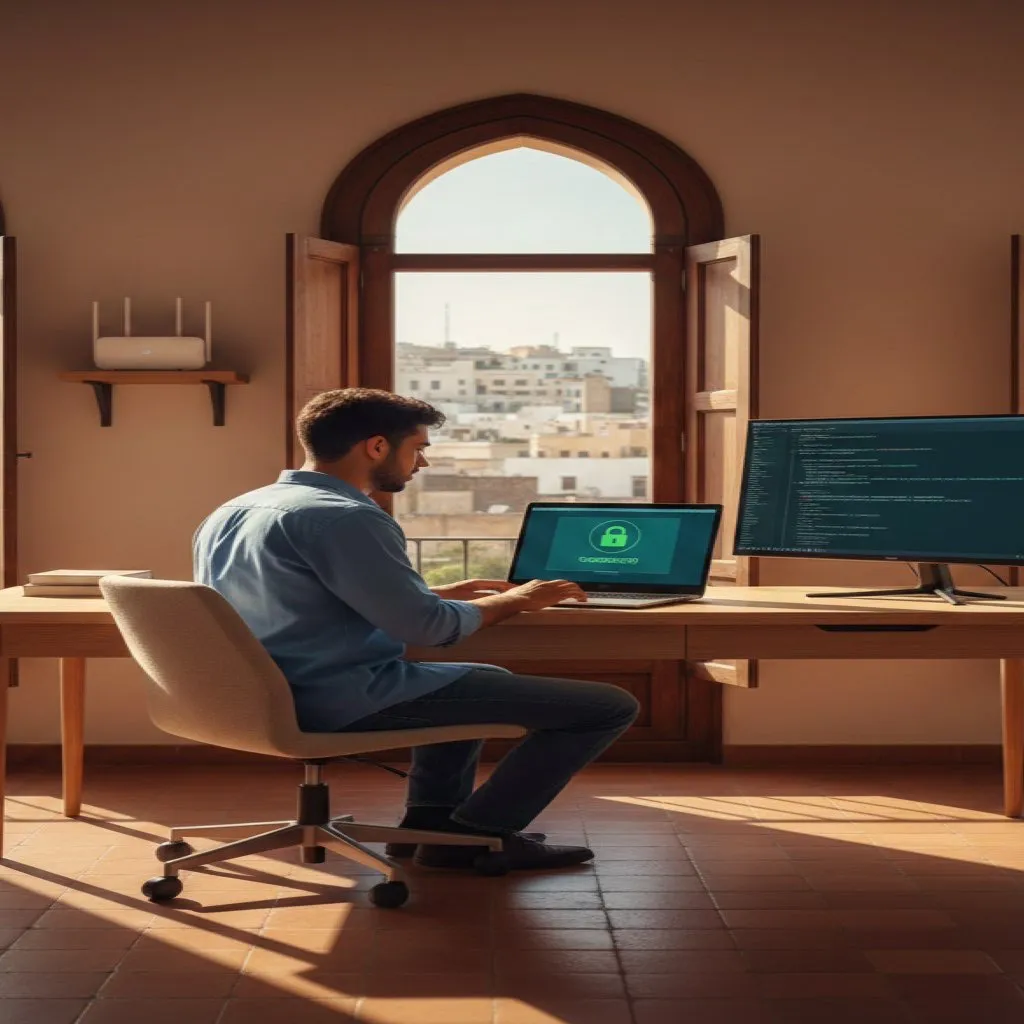
The Remote Work Reality in Algeria
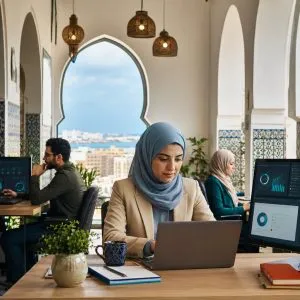
Remote work in Algeria has evolved from an emergency response during COVID-19 into a structural feature of the labor market, particularly in the technology sector. According to the State of Algeria Dev survey, 16% of tech job offers in Algeria are fully remote, 34% hybrid, and 50% still require in-person presence — confirming that remote work is a real and growing mode of employment, even if not yet the majority. A significant number of Algerian software developers, designers, data analysts, and IT support professionals now work remotely — some for Algerian companies that adopted flexible work policies, many for international clients through freelancing platforms like Upwork, Fiverr, and Freelancer.com, or direct contracts with European and North American companies. The Algerian tech diaspora has also normalized remote collaboration, with distributed teams spanning Algiers, Paris, Montreal, and Dubai.
This shift has created a security landscape that few Algerian organizations are equipped to manage. Traditional network security assumes a perimeter — a corporate network protected by firewalls, intrusion detection systems, and managed endpoints. Remote work dissolves this perimeter. When an employee accesses corporate systems from a personal laptop on a home WiFi network in Bab Ezzouar, the security perimeter effectively extends to that apartment. The attack surface expands to include every device, network, and application the employee uses.
The challenge is particularly acute in Algeria because of compounding factors: limited enterprise security budgets, widespread BYOD (Bring Your Own Device) practices, inconsistent internet connectivity that makes always-on VPN connections impractical, and a cultural norm of using personal devices and accounts for professional work. Algeria also lacks dedicated telework legislation — remote work is governed by the broader labor code, leaving a regulatory gap around employer security obligations for distributed workers. These are not insurmountable problems, but they require deliberate solutions rather than the default approach of hoping nothing goes wrong.
The Threat Landscape: What Can Go Wrong
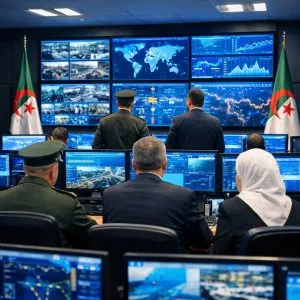
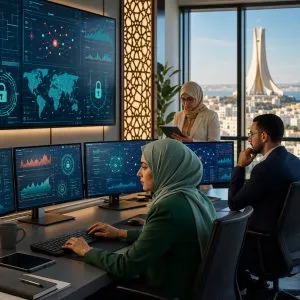
Algeria’s cybersecurity threat environment is intensifying rapidly. The country faced over 70 million cyberattacks in 2024 alone, underscoring that Algerian digital infrastructure is actively targeted. For remote workers operating outside corporate network protections, the exposure is even greater.
Network security is the first concern. Algeria’s internet infrastructure has improved significantly — Algerie Telecom reached 2.5 million fiber (FTTH) subscribers by September 2025, with government plans to extend fiber to all neighborhoods by 2026 and phase out copper by 2027. The country now has 37.8 million internet users (79.5% penetration) and 55.6 million cellular mobile connections. All three operators — Mobilis, Djezzy, and Ooredoo — launched 5G services in December 2025, marking a major connectivity milestone. Yet home internet connections — whether Algerie Telecom ADSL/fiber or 4G/5G mobile data — are typically not configured with enterprise-grade security. Default router passwords, unencrypted WiFi (or WPA2 with simple passwords), and the absence of network monitoring mean that man-in-the-middle attacks, DNS hijacking at the router level, and traffic interception remain technically feasible, particularly on shared networks in co-working spaces or cafes.
VPN (Virtual Private Network) usage among Algerian professionals exists but remains inconsistent and often misunderstood. Africa as a continent has among the lowest VPN adoption rates globally, with no African country in the top 50 for VPN usage. Many Algerian users who do employ consumer VPN services (NordVPN, ExpressVPN, Proton VPN) use them primarily for accessing geo-restricted content rather than for security. Corporate VPN solutions — which encrypt traffic between the employee’s device and the company’s network infrastructure — are deployed by larger organizations but often face usability challenges with Algeria’s internet speeds and latency, leading employees to disconnect the VPN for bandwidth-intensive tasks like video calls. Split tunneling (routing only corporate traffic through the VPN while allowing other traffic to flow directly) is a compromise that many organizations fail to configure properly, leaving gaps in traffic protection.
Endpoint security on personal devices is the most critical vulnerability. BYOD means that corporate data — source code, client documents, credentials, API keys — resides on devices that the organization does not control. Globally, 92% of remote workers use personal devices for work tasks, and 80-90% of successful ransomware attacks originate from unmanaged devices. In Algeria, these devices may run outdated operating systems (Windows 10 without recent patches), lack antivirus or endpoint detection and response (EDR) software, share the device with family members, and store corporate credentials in browser password managers alongside personal accounts. Research shows that 71% of workers store sensitive work passwords on personal phones, while 36% delay applying security updates on personal devices. The compromise of a single remote worker’s laptop — through malware, phishing, or physical theft — can provide an attacker with access to the entire corporate environment.
Advertisement
Shadow IT and Cloud Account Sprawl
Remote work accelerates the shadow IT problem — the use of unapproved applications and services for work purposes. Studies show that 65% of SaaS applications in organizations are not approved by IT, and 69% of IT executives consider shadow IT a major concern. Between 30% and 40% of organizations have suffered data breaches linked to shadow IT. Algerian remote workers commonly use personal Google Drive, Dropbox, or Mega accounts to store and share work files, personal WhatsApp or Telegram for work communications, and personal email addresses for professional correspondence. Each of these creates an unmonitored data channel outside the organization’s security controls.
An emerging extension of this problem is “shadow AI” — employees using unapproved AI tools (ChatGPT, Claude, Gemini, or local LLMs) for work tasks, potentially feeding sensitive corporate data into external services without organizational oversight. As AI adoption accelerates in 2026, shadow AI is becoming a new attack surface that most organizations have not yet addressed.
The security implications are significant. Work documents stored on personal cloud accounts are not covered by corporate backup or data loss prevention (DLP) policies. A freelance developer who stores a client’s proprietary source code on a personal GitHub repository (even private) has created a data exfiltration vector that the client cannot monitor or control. Communications over personal messaging apps bypass corporate logging and compliance requirements — relevant for organizations handling regulated data. With 38% of workers reporting that their employer has no BYOD policies or that existing policies are ignored, these risks remain largely unmanaged.
For Algerian freelancers working with international clients, the shadow IT risk is bidirectional. The freelancer may have access to the client’s cloud infrastructure (AWS, Azure, GCP), source code repositories (GitHub, GitLab), project management tools (Jira, Asana), and communication platforms (Slack, Teams) through credentials stored on a personal, unmanaged device. If that device is compromised, the blast radius extends to every client whose credentials are accessible. International clients increasingly require freelancers to meet minimum security standards — two-factor authentication on all accounts, full-disk encryption on work devices, and endpoint protection software. Algerian freelancers who cannot demonstrate compliance risk losing contracts to competitors from countries where these practices are standard.
Practical Solutions at Every Budget Level
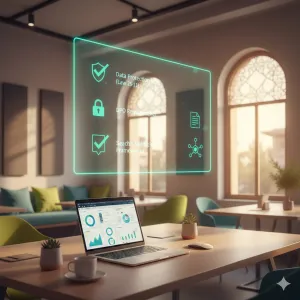
Securing remote work in Algeria does not require enterprise budgets. A layered approach scaled to organizational size and resources can dramatically reduce risk. For individual freelancers and micro-teams (zero to minimal budget): enable full-disk encryption (BitLocker on Windows, FileVault on macOS — both built-in and free), use a password manager (Bitwarden is free and open-source), enable two-factor authentication on every account (Google Authenticator, Authy — both free), keep operating systems and applications updated, and use a reputable DNS resolver (Cloudflare 1.1.1.1 or Google 8.8.8.8) instead of the ISP default.
For small to medium organizations (moderate budget, DZD 50,000-500,000/year): deploy a corporate VPN service (WireGuard is free and open-source; Tailscale offers a free tier for personal use and starts at approximately $18/user/month for business plans), implement a mobile device management (MDM) solution for BYOD devices (Microsoft Intune Plan 1 is included with Microsoft 365 Business Premium licenses), enforce security policies through endpoint management (minimum OS version, disk encryption required, screen lock timeout), and centralize file sharing on a managed platform (Google Workspace or Microsoft 365 with DLP policies enabled).
For larger organizations (enterprise budget): adopt a zero trust architecture where every access request is verified regardless of network location, deploy EDR (Endpoint Detection and Response) solutions like CrowdStrike Falcon or Microsoft Defender for Endpoint on all work devices, implement SASE (Secure Access Service Edge) platforms like Zscaler or Cloudflare Access that combine network security functions with WAN capabilities, and establish a formal BYOD policy with minimum device security requirements, regular compliance checks, and the ability to remotely wipe corporate data from personal devices upon employment termination. The investment scales with risk — but even the free tier measures eliminate the most common attack vectors facing Algerian remote workers today.
Frequently Asked Questions
What is securing remote work in algeria?
Securing Remote Work in Algeria: VPN Usage, Endpoint Protection, and BYOD Challenges covers the essential aspects of this topic, examining current trends, key players, and practical implications for professionals and organizations in 2026.
Why is securing remote work in algeria important for Algeria?
This topic is significant for Algeria because it intersects with the country’s digital transformation goals, economic diversification strategy, and growing technology ecosystem. The article provides specific context for Algerian stakeholders.
How does the threat landscape: what can go wrong work?
The article examines this through the lens of the threat landscape: what can go wrong, providing detailed analysis of the mechanisms, trade-offs, and practical implications for stakeholders.
Sources & Further Reading
- DataReportal Digital 2026 Algeria — Internet & Mobile Statistics
- State of Algeria Dev — Remote Working Survey
- TechAfrica News — Algerie Telecom Reaches 2.5 Million FTTH Subscribers
- TechAfrica News — Algeria Strengthens Cybersecurity Framework (Jan 2026)
- NIST SP 800-46 — Guide to Enterprise Telework Security
- Microsoft Intune Licensing — Business Premium Inclusion
- Venn — BYOD Security Best Practices 2025
- CrowdStrike — Zero Trust vs SASE Architecture
- WireGuard — Open Source VPN Protocol
- Cloudflare Zero Trust Access