Quick Take: Algeria’s heritage sites are world-class but digitally invisible. AI offers three specific value propositions: preserving fragile sites through digital documentation and predictive monitoring, making Algeria discoverable through recommendation engines and structured data, and enhancing visitor experience through multilingual assistants and virtual tours. The lowest-cost, highest-impact starting point is a systematic 3D documentation program for UNESCO sites.
Algeria’s Tourism Paradox
Algeria possesses one of the richest cultural and natural heritage portfolios in the Mediterranean basin. Seven UNESCO World Heritage Sites — the Roman ruins of Djemila and Timgad, the prehistoric rock art of Tassili n’Ajjer, the Ottoman-era Kasbah of Algiers, the M’zab Valley, the Beni Hammad fortress, and the Tipasa archaeological complex — represent thousands of years of civilization. The Sahara, the world’s largest hot desert, offers landscapes that rival anything in tourism-heavy neighbors Morocco and Tunisia. Algeria’s Mediterranean coastline stretches approximately 1,200 kilometers.
Yet tourism contributes roughly 1% of Algeria’s GDP in direct terms, compared to approximately 7% for Morocco and 8% for Tunisia. In 2019, Algeria received approximately 2.4 million international visitors according to World Bank data — most of them diaspora returning to visit family rather than leisure tourists. Morocco, by comparison, welcomed 13 million that same year. The gap has begun to narrow: Algeria welcomed 3.5 million tourists in 2024 and targets 4 million in 2025, with a long-term ambition of 14 million by 2035. The introduction of visa-on-arrival for foreign tourists since 2022 has helped, but the gap is not primarily about attractions. It is about infrastructure, digital visibility, and the tools that modern travelers expect.
This is where AI intersects with tourism and heritage. Not as a silver bullet, but as a set of specific technologies that could help Algeria present its heritage to the world, personalize visitor experiences, protect fragile sites, and build the digital infrastructure that modern tourism marketing requires.
Virtual Heritage: 3D Reconstruction and Digital Preservation
Algeria’s archaeological sites face a dual threat: natural deterioration from weather, seismic activity, and vegetation growth, and human neglect from insufficient conservation budgets. Timgad, one of the best-preserved examples of Roman grid city planning, has sections where columns are visibly degrading. The Kasbah of Algiers, inscribed as a UNESCO World Heritage Site in 1992, has suffered severe deterioration — buildings have collapsed from lack of maintenance, and successive UNESCO state of conservation reports have documented the urgent need for intervention.
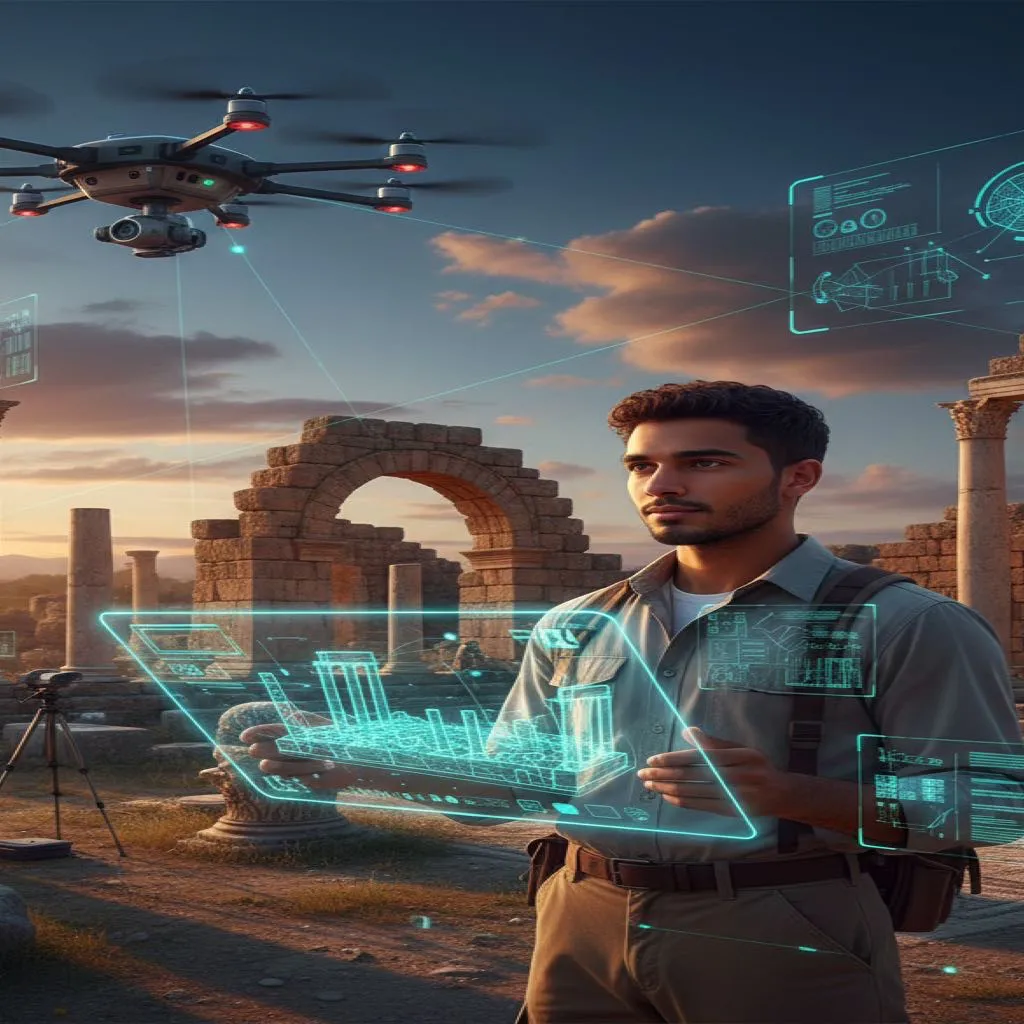
AI-powered 3D reconstruction technology can create high-fidelity digital twins of heritage sites from photographs and drone footage. Photogrammetry — the process of creating 3D models from overlapping 2D images — combined with Neural Radiance Fields (NeRF) can produce photorealistic virtual tours that allow anyone with an internet connection to explore Djemila’s forum or Tassili’s rock art panels. NeRF has been shown in peer-reviewed research to outperform traditional photogrammetry for heritage documentation, particularly for reflective surfaces and fine architectural details. Google’s Heritage on the Edge project, a collaboration with ICOMOS and CyArk launched in 2020, applied similar techniques to five at-risk World Heritage Sites globally. CyArk, a nonprofit dedicated to digital heritage preservation, has digitally documented over 200 sites across seven continents and more than 40 countries.
For Algeria, digital preservation serves multiple purposes. It creates a permanent record of sites in their current state — invaluable if further deterioration occurs. It provides virtual access to sites that are difficult to reach physically (Tassili n’Ajjer requires a multi-day expedition into the Sahara). And it serves as marketing content: immersive virtual tours can inspire potential visitors to make the trip in person. Modern commercial photogrammetry and drone survey tools have made comprehensive 3D documentation of archaeological sites increasingly affordable, though costs vary significantly depending on site size and required resolution.
Advertisement
AI-Powered Tourism Recommendation and Marketing
Modern tourism depends on digital discovery. Travelers research, plan, and book through platforms — Google Maps, TripAdvisor, Booking.com, Instagram — where AI algorithms determine what content surfaces. Algeria is largely invisible on these platforms. A Google search for “best historical sites in North Africa” returns results dominated by Morocco and Egypt. TripAdvisor has limited coverage of Algerian sites, with few reviews and outdated information.
AI recommendation engines, the technology that powers Netflix’s suggestions and Spotify’s playlists, can be applied to tourism. A visitor expressing interest in Roman history should be recommended Djemila and Timgad alongside Pompeii and Ephesus. A nature photographer searching for desert landscapes should see Tassili n’Ajjer alongside Namibia’s Sossusvlei. Building this requires structured data about Algerian attractions — geotagged, categorized, and richly described — that can feed into recommendation algorithms on major platforms and on Algeria’s own tourism portals.
Natural language processing (NLP) can power multilingual chatbot assistants for tourists: answering questions about visa requirements, hotel options, site opening hours, and transportation in Arabic, French, English, and other languages. The Singapore Tourism Board signed a first-of-its-kind memorandum of understanding with OpenAI in July 2025, becoming the first national tourism organization in Asia to formally adopt AI technology for enhancing visitor experiences and industry productivity. The UAE’s Smart Dubai initiative uses real-time citizen and visitor satisfaction analytics powered by NLP. Algeria’s Ministry of Tourism could integrate similar AI-powered tools using current LLM technology for a fraction of the cost of staffing multilingual call centers.
Predictive Conservation and Site Monitoring
The most sophisticated AI application for heritage preservation is predictive conservation: using computer vision and sensor data to detect structural deterioration before it becomes visible to the human eye. High-resolution imagery captured by drones at regular intervals can be analyzed by AI to detect millimeter-scale changes in stone surfaces — cracking, erosion, biological growth, water damage — and prioritize conservation interventions based on risk.
The European Union’s HYPERION project, funded under Horizon 2020, has demonstrated this approach for European cultural heritage sites threatened by climate change. The project deployed sensors, drones, satellite imagery, and AI-powered analysis across four pilot sites: Rhodes (Greece), Venice (Italy), Toensberg (Norway), and Granada (Spain). Separately, Italy has invested heavily in AI-driven conservation at Pompeii, where the Great Pompeii Project uses partnerships with the University of Salerno to deploy sensors, infrared monitoring, and satellite technology to guard against climate change damage. The Colosseum in Rome has developed its own high-tech monitoring system. These systems reduce the cost of preservation by focusing limited budgets on the highest-risk areas rather than spreading resources thinly across entire sites.
For Algeria’s heritage sites, where conservation budgets are constrained, AI-prioritized maintenance could stretch available funds further. A drone survey of Djemila conducted twice yearly, with AI analysis comparing sequential imagery, could create a deterioration map that guides conservation teams directly to the areas needing attention. The technology does not require permanent infrastructure — each survey is a discrete operation — making it feasible even with intermittent funding. Partnerships with international conservation organizations (UNESCO, ICOMOS, the World Monuments Fund) could subsidize the technology while building local capacity.
Building the Ecosystem: Data, Skills, and Strategy
Realizing AI’s potential for Algerian tourism requires three foundational elements that do not yet exist at sufficient scale. First, data: Algeria’s heritage sites, tourist accommodations, restaurants, transportation options, and experiences need to be comprehensively digitized and made available in structured formats. This means not just websites but APIs, schema.org markup, Google Business listings, and content in multiple languages. Without this data layer, no AI system can recommend what it cannot find.
Second, skills: the intersection of AI technology and cultural heritage is a specialized domain. Algeria needs professionals who understand both computer vision and archaeological conservation, both NLP and tourism marketing. University programs in digital humanities — emerging globally at institutions like UCL, MIT, and the Sorbonne — could be adapted for Algerian institutions. Short-term, international partnerships (with CyArk, Google Arts & Culture, or European Digital Heritage initiatives) could transfer knowledge while producing tangible outputs.
Third, strategy: AI tourism tools must be part of a broader tourism development plan that addresses visa accessibility, hotel infrastructure, domestic transportation, and safety perceptions. Technology cannot compensate for a visitor who cannot find a direct flight or adequate accommodation. Algeria’s visa-on-arrival policy introduced since 2022 was a significant step, and the government’s target of 14 million visitors by 2035 signals ambition. But the tourism strategy needs specific AI implementation plans. The most impactful near-term action would be a digital heritage preservation program — partnering with international organizations to create 3D scans and virtual tours of all seven UNESCO sites — which would simultaneously protect heritage and generate the marketing content needed to put Algeria on the global tourism map.
Frequently Asked Questions
What is ai for algerian tourism and heritage?
AI for Algerian Tourism and Heritage: Virtual Tours, Recommendation Engines covers the essential aspects of this topic, examining current trends, key players, and practical implications for professionals and organizations in 2026.
Why is ai for algerian tourism and heritage important for Algeria?
This topic is significant for Algeria because it intersects with the country’s digital transformation goals, economic diversification strategy, and growing technology ecosystem. The article provides specific context for Algerian stakeholders.
How does virtual heritage: 3d reconstruction and digital preservation work?
The article examines this through the lens of virtual heritage: 3d reconstruction and digital preservation, providing detailed analysis of the mechanisms, trade-offs, and practical implications for stakeholders.
Sources & Further Reading
- UNESCO World Heritage Sites in Algeria — UNESCO World Heritage Centre
- Algeria Tourism Statistics — World Bank Data
- Algeria Targets 4 Million Visitors in 2025 — Africa News Agency
- CyArk Digital Heritage Preservation — CyArk
- Google Heritage on the Edge — Google Arts & Culture
- HYPERION EU Heritage Conservation Project — European Commission CORDIS
- Neural Radiance Fields for Cultural Heritage — ISPRS Archives
- STB and OpenAI MoU for Tourism AI — Singapore Tourism Board
- Morocco Tourism Statistics 2019 — Morocco World News
- Pompeii Conservation Technology — Pompeii Sites