The New Space Race Is a Regulatory Vacuum
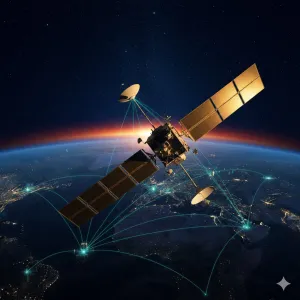
SpaceX’s Starlink constellation has grown to approximately 9,800 satellites in orbit as of early 2026, with roughly 7,000 operational, serving over 10 million customers across more than 110 countries and territories. In January 2026, SpaceX announced it would lower approximately 4,400 satellites from 550 km to 480 km altitude over the course of the year to improve space safety and accelerate natural deorbit of defunct spacecraft. OneWeb, now part of the Eutelsat Group following their September 2023 merger, operates over 600 satellites in 12 orbital planes at 1,200 km altitude, providing backhaul and enterprise connectivity. In January 2026, Eutelsat ordered 340 additional OneWeb satellites from Airbus, on top of 100 ordered in December 2024. Amazon’s satellite internet service, rebranded from Project Kuiper to Amazon Leo in November 2025, launched its first 27 production satellites in April 2025 and had over 200 in orbit by the end of that year. Amazon’s FCC license authorizes 3,236 satellites, with half required to be operational by July 2026 — a deadline the company has asked to extend. China’s Guowang constellation — the state-backed response to Starlink — filed for 12,992 satellites with the ITU and has exceeded 100 satellites in orbit as of late 2025. In December 2025, Chinese entities filed ITU paperwork for additional mega-constellations totaling nearly 200,000 satellites, dwarfing all previous filings. In total, the approximately 12,000 active satellites currently in orbit represent a fraction of what has been proposed through regulatory filings worldwide.
The regulatory framework governing this unprecedented expansion of orbital infrastructure was designed for a different era. The Outer Space Treaty of 1967, the foundational document of space law, establishes that space is the “province of all mankind” and that nations bear international responsibility for their space activities. The Registration Convention of 1975 requires states to register launched objects. The Liability Convention of 1972 establishes that launching states are liable for damage caused by their space objects. These treaties predate commercial spaceflight, satellite mega-constellations, and orbital debris as a systemic risk. They assign responsibility to states, not companies — meaning SpaceX’s regulatory obligations flow through the US government, not through any international body that SpaceX answers to directly.
The result is a governance gap that grows wider with every launch. No international body has the authority to limit the number of satellites a nation or company can deploy. No enforcement mechanism exists for orbital debris mitigation guidelines. Spectrum coordination through the ITU operates on a first-come, first-served basis that advantages well-resourced nations and corporations over developing countries. The rules of space are being written in real time by the entities most capable of ignoring them.
Spectrum: The Invisible Battlefield
Satellite internet requires radio spectrum — specific frequency bands to communicate between ground stations, user terminals, and satellites. The ITU, a UN agency, coordinates global spectrum allocation through its Radio Regulations, updated at World Radiocommunication Conferences (WRC) held every four years. The most recent WRC (WRC-23, held in Dubai) addressed several satellite-relevant agenda items, including Ka-band sharing between satellite and terrestrial services and regulatory conditions for non-geostationary (NGSO) constellations like Starlink.
The core problem is interference. Starlink operates primarily in Ku-band (10.7-12.7 GHz downlink, 14.0-14.5 GHz uplink) and Ka-band (17.8-20.2 GHz downlink, 27.5-30.0 GHz uplink). OneWeb uses Ku-band. Amazon Leo plans to use Ka-band. When multiple constellations operate in the same frequency bands, the risk of interference — signal degradation that reduces throughput and reliability — increases dramatically. The ITU’s coordination process, which requires operators to negotiate spectrum sharing arrangements bilaterally, was designed for a handful of geostationary satellites with predictable coverage footprints. It is poorly suited to constellations of thousands of fast-moving LEO (Low Earth Orbit) satellites whose coverage patterns shift continuously.
SpaceX and OneWeb have engaged in public disputes over spectrum interference, with OneWeb filing interference complaints with the ITU and national regulators in 2023-2024. The FCC’s January 2026 decision to authorize a second tranche of 7,500 Starlink Gen2 satellites — bringing the total Gen2 authorization to 15,000 — drew objections from spectrum users who argued that interference modeling was inadequate. The original 7,500 Gen2 authorization in December 2022 had already faced opposition from Dish Network, Amazon, and others. At the international level, developing nations — many of which have not yet deployed their own satellite services — risk finding the most commercially valuable spectrum bands occupied by constellations from the US, Europe, and China before they have the technical capacity to claim their allocations. The ITU’s “first-come, first-served” principle, intended to encourage efficient spectrum use, functions in practice as an advantage for nations that can deploy satellites fastest.
Advertisement
Orbital Debris: An Unregulated Commons Tragedy
According to ESA’s 2025 Space Environment Report, space surveillance networks now track approximately 40,000 objects in Earth orbit, of which about 11,000 are active payloads. ESA estimates over 1.2 million objects larger than 1 cm and more than 50,000 larger than 10 cm. Any of these objects can damage or destroy operational satellites — a fragment as small as 1 cm carries the kinetic energy of a hand grenade at orbital velocities (7-8 km/s in LEO). The risk is not hypothetical: collision avoidance maneuvers are now routine, with Starlink satellites performing approximately 300,000 maneuvers in 2025 alone to avoid tracked debris and other satellites, according to SpaceX’s FCC filings. Between December 2024 and May 2025, SpaceX logged over 144,000 such maneuvers. At the current growth rate, SpaceX could be performing close to one million maneuvers annually by 2027.
The Kessler Syndrome — a theoretical cascade where collisions generate debris that causes further collisions, eventually rendering orbital bands unusable — is no longer purely theoretical. The 2007 Chinese anti-satellite test (which destroyed the Fengyun-1C satellite at 865 km altitude) created over 3,400 catalogued debris fragments, many of which remain in orbit due to their high altitude. Russia’s 2021 ASAT test against Cosmos 1408 added at least 1,500 trackable fragments. These deliberate destructions, combined with accidental break-ups and the sheer increase in orbital population, have pushed debris density in certain altitude ranges toward levels that some models predict could trigger cascading collisions within decades if mitigation measures are not implemented. ESA’s 2025 report noted that at ~550 km altitude — the heart of Starlink’s constellation — the density of threatening debris objects now approaches the same order of magnitude as active satellites.
The regulatory response remains inadequate. The UN Committee on the Peaceful Uses of Outer Space (COPUOS) issued Space Debris Mitigation Guidelines in 2007, recommending that satellites be deorbited within 25 years of mission end. These guidelines are voluntary — no enforcement mechanism exists. The US FCC shortened its recommended deorbit timeline to 5 years in 2022, but this applies only to US-licensed satellites. ESA’s Zero Debris Charter, unveiled at the ESA Space Summit in Seville in November 2023, commits signatories to debris neutrality by 2030. As of early 2026, over 20 countries and 200 companies and institutions have signed the charter, including non-European nations such as New Zealand and Mexico — but participation remains voluntary. Active debris removal (ADR) technology is being developed by companies like Astroscale (Japan) and ClearSpace (Switzerland/ESA-contracted), both of which are competing for a UK Space Agency contract to remove defunct satellites from orbit in 2026. However, no ADR mission has yet removed a piece of uncooperative debris from orbit. The fundamental problem is a classic tragedy of the commons: space is a shared resource, but no entity has the authority to enforce responsible use.
Developing Nations, Satellite Internet, and the Algeria Lens
Satellite internet holds transformative potential for developing nations with inadequate terrestrial infrastructure — and Algeria is a textbook case. Algeria’s landmass of 2.38 million km2 (the largest in Africa) includes vast Saharan regions where fiber deployment is economically unviable and mobile tower coverage is sparse. Algeria Telecom’s terrestrial network reaches major cities and towns, but rural broadband penetration in southern wilayas (Tamanrasset, Illizi, Tindouf, Adrar) remains limited. Satellite internet could bridge this gap: Starlink’s standard terminal kit costs approximately $299-349 depending on the market, and its service delivers typical download speeds of 50-200 Mbps at latencies of 25-50 ms — performance that exceeds most terrestrial broadband options available in southern Algeria.
However, Starlink is not authorized to operate in Algeria. Algeria’s regulatory framework requires telecom operators to obtain licensing from ARPCE, and no satellite internet provider has received authorization as of February 2026. The reasons are partly regulatory (spectrum coordination, customs clearance for terminals), partly economic (protecting Algeria Telecom’s broadband position), and partly political (concerns about foreign-controlled communication infrastructure operating over Algerian territory). Algeria is not alone in this position — Starlink faces licensing barriers or outright bans in countries including Russia, China, Iran, Myanmar, and several African nations.
The policy challenge for Algeria and similar nations is genuine: how to capture the connectivity benefits of satellite internet while maintaining sovereign control over communications infrastructure, ensuring spectrum compatibility with existing services, and addressing security concerns. A pragmatic approach would involve licensing satellite internet providers under ARPCE oversight, requiring data routing through Algerian ground stations (or at minimum, Algerian-controlled gateways), imposing quality-of-service and coverage obligations, and using satellite as a complement to — not replacement for — terrestrial infrastructure investment. The alternative — maintaining a blanket prohibition while neighboring Sahel nations gain satellite connectivity through Starlink licenses (Niger authorized Starlink in March 2025; Chad granted a license in late 2024) — risks creating a connectivity gap that undermines Algeria’s digital development ambitions.
Frequently Asked Questions
What is space tech regulation?
Space Tech Regulation: How Satellite Internet, Debris covers the essential aspects of this topic, examining current trends, key players, and practical implications for professionals and organizations in 2026.
Why does space tech regulation matter?
This topic matters because it directly impacts how organizations plan their technology strategy, allocate resources, and position themselves in a rapidly evolving landscape. The article provides actionable analysis to help decision-makers navigate these changes.
How does spectrum: the invisible battlefield work?
The article examines this through the lens of spectrum: the invisible battlefield, providing detailed analysis of the mechanisms, trade-offs, and practical implications for stakeholders.
Sources & Further Reading
- SpaceX Starlink Statistics — Jonathan McDowell’s Space Report
- ESA Space Environment Report 2025
- FCC Authorizes 7,500 Additional Starlink Gen2 Satellites — SpaceNews
- Amazon Leo Mission Updates — About Amazon
- China Files ITU Paperwork for Mega-Constellations — SpaceNews
- ESA Zero Debris Charter
- FCC 5-Year Deorbit Rule — Report and Order 2022
- ITU Radio Regulations and WRC-23 Outcomes
- UN COPUOS Space Debris Mitigation Guidelines — UNOOSA
- Outer Space Treaty 1967 — UNOOSA