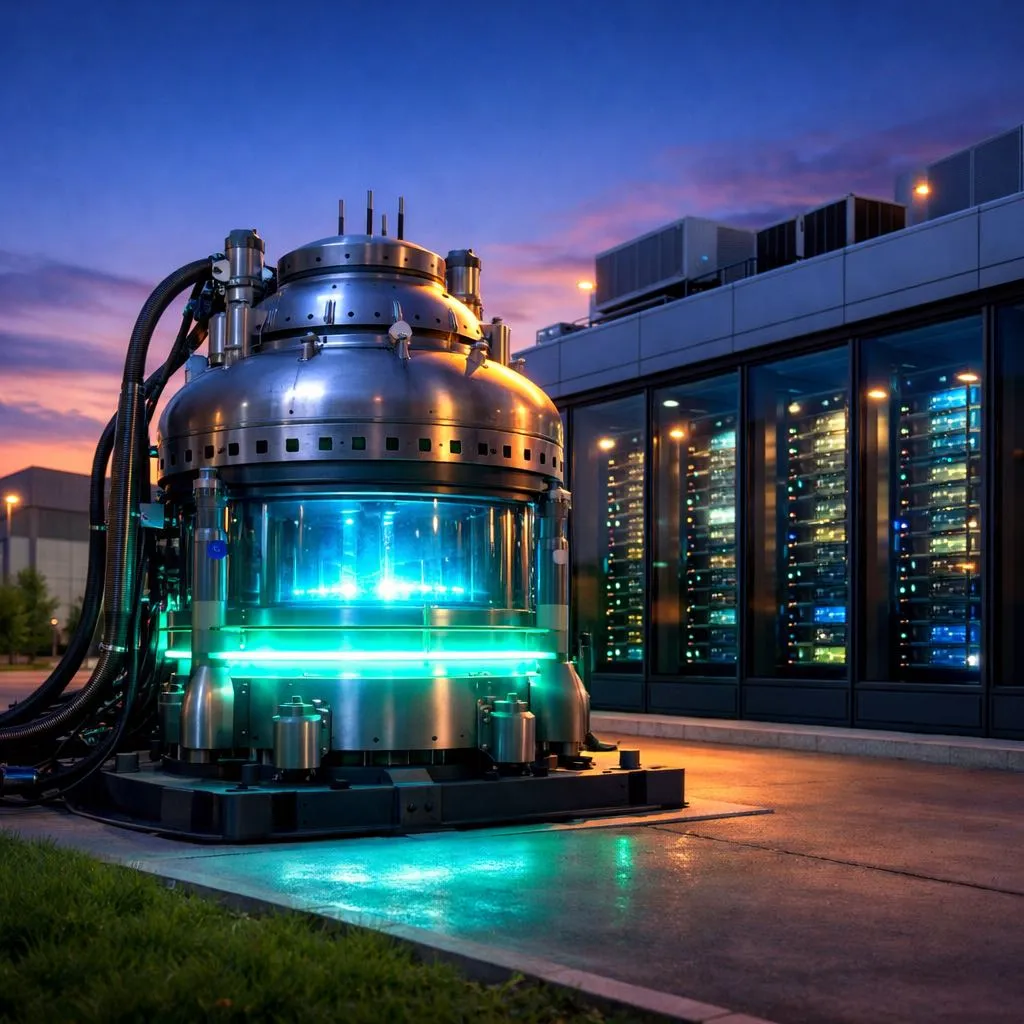
The AI industry has an energy problem, and Valar Atomics just raised $450 million to solve it.
The Los Angeles-based startup closed its massive funding round in February 2026, comprising $340 million in equity and $110 million in debt, landing barely five months after a $130 million Series A that valued the company at a fraction of its current price. The meteoric valuation jump to $2 billion reflects a market conviction that nuclear power is not just viable for AI data centers but necessary.
The timing is no accident. The International Energy Agency projects that data center power consumption will double by 2026, and Goldman Sachs estimates that 85 to 90 gigawatts of new nuclear capacity will eventually be needed to fill the gap. Solar and wind alone cannot provide the 24/7 baseload power that AI training clusters require.
The Criticality Milestone
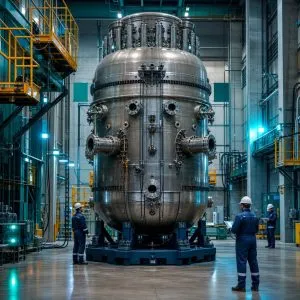
What separates Valar Atomics from the dozens of nuclear startups chasing venture capital is a tangible achievement: in November 2025, the company’s NOVA Core achieved zero-power criticality at Los Alamos National Laboratory’s National Criticality Experiments Research Center.
The Breakthrough Institute described this as the first company to reach that milestone under the US Department of Energy’s Nuclear Reactor Pilot Programme. In nuclear engineering, achieving criticality, the point at which a nuclear chain reaction becomes self-sustaining, is the fundamental proof point that separates theoretical designs from physical reality.
This achievement puts Valar Atomics meaningfully ahead of competitors who remain in the design and simulation phase. The company is now preparing its Ward250 reactor, a 100-kilowatt thermal high-temperature gas-cooled unit, for power operations at the Utah San Rafael Energy Research Center, targeting operational status before July 4, 2026, the deadline the DOE set for three reactors in its pilot program.
The Investor Thesis
The investor roster reveals where the smart money sees the AI energy nexus heading.
Palmer Luckey, the Anduril Industries founder known for contrarian technology bets, is an investor. So is Shyam Sankar, the CTO of Palantir Technologies. Their involvement signals that the defense and national security establishment sees nuclear-powered AI as a strategic capability, not just a commercial opportunity.
The $340 million equity component attracted institutional capital seeking exposure to the AI-energy convergence, while the $110 million in debt financing suggests that lenders see sufficient near-term revenue visibility to underwrite the company’s capital-intensive buildout phase.
The 15x valuation jump from Series A ($130 million round) to this round ($2 billion valuation) in just five months is extraordinary even by venture capital standards. It reflects the market’s assessment that achieving criticality dramatically de-risks the technology bet.
Why Nuclear for AI
The case for nuclear-powered AI data centers rests on several converging factors:
Baseload reliability. AI training clusters require consistent, uninterrupted power for months at a time. Solar and wind provide intermittent generation, and battery storage at the scale needed for 100+ MW data centers remains prohibitively expensive. Nuclear provides 24/7 baseload power with 90%+ capacity factors.
Power density. A small modular reactor can deliver 100-300 MW of power from a footprint that would be impossible for an equivalent solar installation. In land-constrained locations near fiber networks and population centers, power density matters.
Carbon footprint. As AI companies face growing pressure to demonstrate environmental responsibility, nuclear offers near-zero carbon generation. Microsoft, Google, and Amazon have all signed nuclear power agreements for their data centers, validating the approach at the hyperscaler level.
Grid independence. On-site nuclear generation allows data centers to operate independently of increasingly strained electrical grids. This is particularly valuable in regions where grid capacity additions lag behind data center construction timelines.
Advertisement
The Competitive Landscape
Valar Atomics operates in an increasingly crowded field of nuclear startups targeting the AI energy market:
NuScale Power received the first-ever small modular reactor design certification from the US Nuclear Regulatory Commission but faced setbacks when its Carbon Free Power Project in Idaho was cancelled due to cost overruns.
Kairos Power is building a demonstration reactor in Tennessee and has agreements with Google for nuclear-powered data centers.
TerraPower, backed by Bill Gates, is constructing its Natrium reactor demonstration plant in Wyoming, though this targets grid-scale power rather than dedicated data center supply.
X-energy has partnerships with Dow Chemical for industrial heat applications and is exploring data center power.
Valar Atomics’ advantage is speed. By achieving criticality first under the DOE program, the company has demonstrated execution capability that investors and potential customers, the hyperscalers building AI data centers, prioritize above all else.
Challenges and Risks
The path from criticality to commercial deployment is neither short nor guaranteed:
Regulatory timeline. Even with DOE program support, licensing a commercial reactor requires extensive Nuclear Regulatory Commission review. The timeline from demonstration to commercial deployment typically spans years, potentially straining investor patience.
Cost escalation. Nuclear projects have a notorious history of cost overruns. While small modular designs aim to reduce this risk through factory fabrication and standardization, the construction track record of the nuclear industry weighs on projections.
Public perception. Nuclear energy faces public acceptance challenges in many markets despite its safety record. Community opposition can delay or derail projects regardless of technical merit.
Scaling manufacturing. Moving from a single demonstration reactor to the factory-produced units needed for widespread deployment requires establishing an entirely new manufacturing supply chain.
What This Means for the AI Industry
Valar Atomics’ raise is a signal that the AI industry is preparing for an energy-constrained future and that nuclear power is the consensus long-term answer among major players.
The immediate implications:
For hyperscalers: Expect to see more nuclear power purchase agreements as AWS, Google, Microsoft, and Meta secure long-term energy supply for their expanding AI infrastructure.
For grid operators: The proliferation of on-site nuclear generation could reduce data center demand on existing grids, but also complicates grid planning and nuclear waste management logistics.
For policymakers: Regulatory frameworks designed for large, centralized nuclear plants will need modernization to accommodate small modular reactors deployed at data center sites.
For competing energy sources: Nuclear’s emergence does not eliminate the role of solar, wind, and battery storage in the AI energy mix, but it repositions them as supplementary rather than primary sources for baseload AI compute.
Frequently Asked Questions
What makes Valar Atomics different from other nuclear startups?
Valar Atomics is the first company to achieve nuclear criticality under the US Department of Energy’s Nuclear Reactor Pilot Programme, reaching the milestone in November 2025 at Los Alamos National Laboratory. This physical proof point separates it from competitors still in the design phase. The company’s Ward250 reactor targets operational status by July 2026.
Can small nuclear reactors actually power AI data centers cost-effectively?
The economics are evolving but increasingly favorable. A single small modular reactor can deliver 100-300 MW of continuous, carbon-free power at 90%+ capacity factors, something solar and wind cannot match without massive battery storage. Goldman Sachs estimates 85-90 GW of new nuclear capacity will be needed for data centers. The key cost variable is whether factory-built SMRs can avoid the cost overruns that plagued traditional nuclear construction.
How soon could nuclear-powered AI data centers become operational?
Valar Atomics targets July 2026 for power operations at its Utah facility. However, moving from demonstration to commercial deployment typically requires additional years for NRC licensing and manufacturing scale-up. Realistic timelines for the first commercially operational nuclear-powered AI data center cluster range from 2028-2030, depending on regulatory speed.