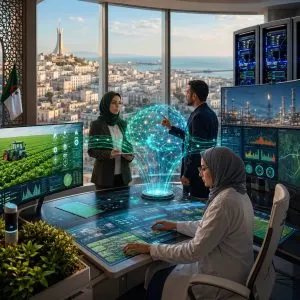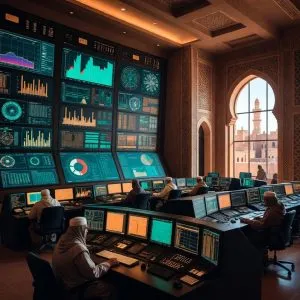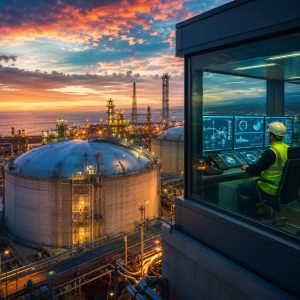
Algeria’s hydrocarbon sector stands at an inflection point. The country sits on the world’s 10th-largest proven natural gas reserves and has vast unexplored acreage across the Saharan basins. In February 2026, Sonatrach CEO Noureddine Daoudi confirmed that exploration and production will consume 75% of the national oil company’s development investment through 2030, with a program covering 66% of the national hydrocarbon domain. The scale of ambition — roughly 500 exploration wells alongside massive 3D and 2D seismic acquisition campaigns — demands technology that can compress decades of geological interpretation into months. That technology is deep learning.
Seismic Interpretation at Machine Speed
Traditional seismic interpretation is a bottleneck. Geoscientists spend months manually analyzing seismic volumes, identifying faults, mapping horizons, and delineating potential reservoir boundaries. In frontier basins with limited well control — precisely the conditions in much of Algeria’s unexplored territory — this manual process is both slow and uncertain.
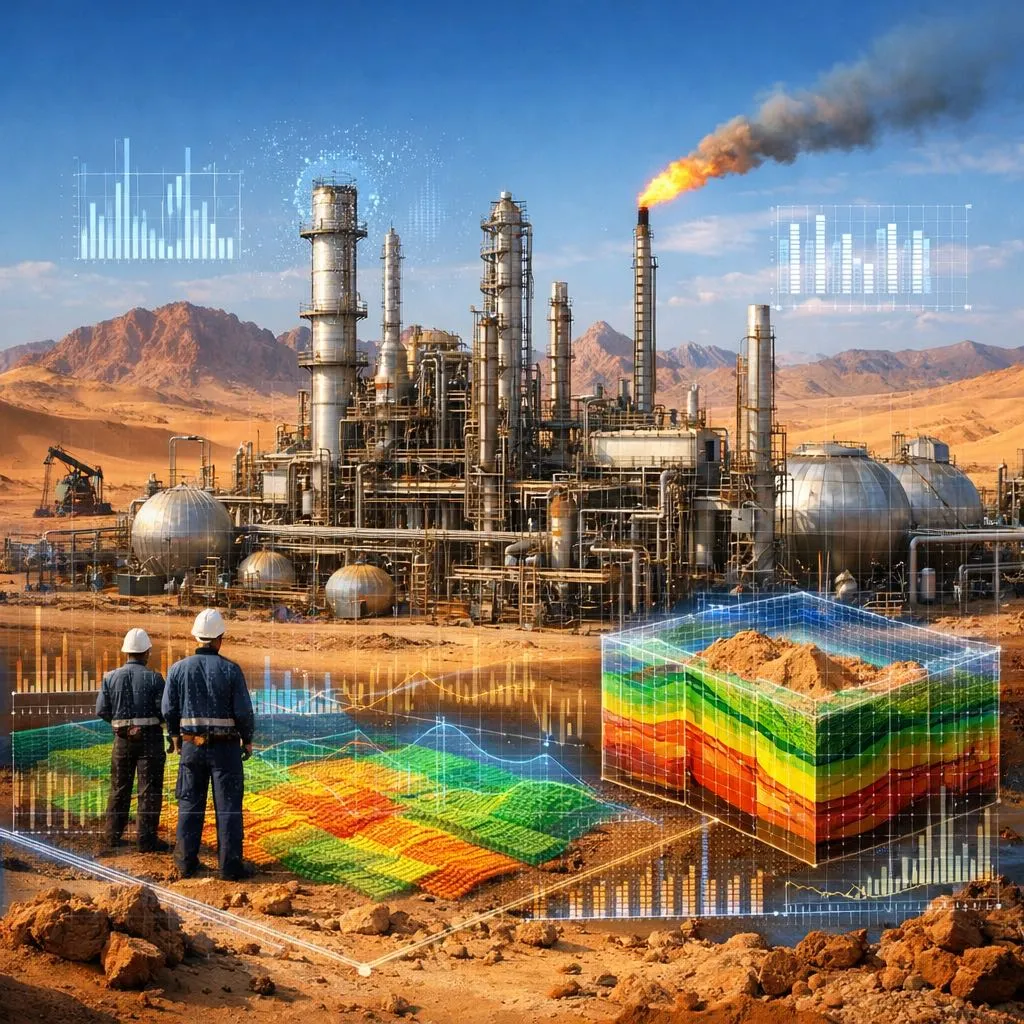
Deep learning changes the equation. Convolutional neural networks (CNNs) trained on thousands of seismic datasets can detect faults, classify lithologies, and identify hydrocarbon indicators across entire seismic volumes in minutes rather than months. These models recognize patterns that human interpreters might miss, particularly subtle stratigraphic traps and thin-bed reservoirs that are common in Algeria’s Saharan basins.
Sonatrach’s January 2026 R&D agreement with GNPC (Ghana National Petroleum Corporation) explicitly includes artificial intelligence-enabled interpretation alongside advanced seismic technologies, 4D seismic monitoring, and real-time reservoir modeling. This partnership signals that Sonatrach views AI not as experimental but as operational technology for its exploration program.
Predictive Maintenance and Production Optimization
Beyond exploration, deep learning is transforming how Algeria maintains and optimizes its existing production infrastructure. The country’s aging well stock and pipeline network — some facilities dating to the 1960s — present significant maintenance challenges. Traditional time-based maintenance schedules result in either unnecessary interventions or unexpected failures, both of which are costly.
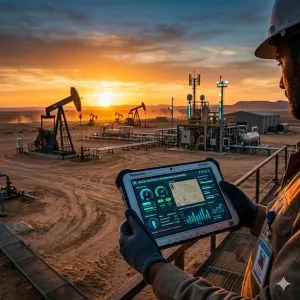
AI-powered predictive maintenance systems analyze real-time sensor data — pressure, temperature, vibration, flow rates — to predict equipment failures before they occur. Industry benchmarks suggest these systems can reduce maintenance costs by up to 25% while improving asset availability. For Sonatrach, which operates thousands of wells and extensive gathering systems across the Saharan desert, the economic impact could be measured in billions of dinars annually.
SLB (formerly Schlumberger), one of Sonatrach’s key technology partners, has emphasized the role of automation and digital solutions in optimizing Algeria’s production operations. The company’s North Africa operations increasingly deploy digital subsurface analysis tools that combine machine learning with traditional physics-based reservoir models.
Advertisement
The Talent and Infrastructure Challenge
Deploying deep learning in Algeria’s oil and gas sector faces a specific constraint: the intersection of AI expertise and petroleum engineering knowledge is extremely narrow. Building effective seismic interpretation models requires professionals who understand both convolutional neural networks and sedimentary geology — a combination that barely exists in Algeria’s current workforce.
Sonatrach’s partnership approach — collaborating with international service companies and research institutions — is pragmatic, but long-term competitiveness requires domestic capability. The 17 oil and gas discoveries Sonatrach made in 2025 demonstrate the geological prospectivity of Algeria’s basins; the question is whether AI can accelerate the pace of discovery while reducing dry-well risk.
Data infrastructure presents another challenge. Deep learning models require large, well-labeled training datasets. Algeria’s seismic data archive — accumulated over six decades of exploration — is a potential goldmine, but much of it exists in legacy formats that require significant preprocessing before it can train neural networks. A systematic digitization and labeling effort could transform this historical data into Algeria’s most valuable AI training asset.
Global Context: AI Spending Surges in Energy
Algeria’s AI adoption in energy does not happen in isolation. Global AI spending in oil and gas is projected to grow from an estimated $4 billion in 2025 to $13.4 billion by 2029 — a 235% increase. The 2026 AI in Oil and Gas Conference highlighted key developments including autonomous drilling systems, high-fidelity digital twins for entire fields, and next-generation generative AI models for production forecasting.
The competitive pressure is real. National oil companies in the Gulf are investing billions in AI-first exploration strategies. If Algeria’s adoption lags, the cost differential between AI-optimized and traditional exploration will widen, potentially making some of the country’s more challenging prospects uneconomic.
What Success Looks Like
For Algeria, the successful integration of deep learning into the energy sector would manifest in several concrete ways: a higher exploration success rate (reducing the current industry average of roughly one commercial discovery per five exploration wells), faster time from seismic acquisition to drilling decision, lower per-well exploration costs, and improved recovery rates from existing fields through AI-optimized production strategies.
The stakes are significant. Hydrocarbon revenues remain the backbone of Algeria’s economy, funding social programs, infrastructure investment, and the emerging digital transformation agenda. Every percentage point improvement in exploration efficiency translates directly into national revenue — making AI in oil and gas not just a technology story but an economic sovereignty imperative.
Sources & Further Reading
- Algeria Targets Frontier, Unconventional Resources to Maximize Production — African Energy Week
- Sonatrach, GNPC Expand Upstream Innovation Through New R&D Agreement — World Oil
- From the Well to the Neural Network: The Future of Oil and Gas with AI in 2026 — Usetech
- Algeria’s $50B Hydrocarbon Drive: Projects to Watch in 2025 — Energy Capital & Power
- Oil and Gas Industry Looks to Data Science and AI in 2026 — ToolHunt
Frequently Asked Questions
How does deep learning improve seismic interpretation?
Convolutional neural networks (CNNs) analyze seismic volumes to detect faults, classify rock types, and identify hydrocarbon indicators in minutes rather than the months required by manual interpretation. These models can recognize subtle patterns — like thin-bed reservoirs or stratigraphic traps — that human interpreters might miss, improving exploration accuracy.
Is Sonatrach already using AI in its operations?
Yes, but deployment is still in early stages. Sonatrach’s January 2026 R&D agreement with GNPC includes AI-enabled interpretation, and partnerships with international service companies like SLB incorporate digital subsurface analysis tools. The company’s 2026-2030 exploration program, covering 66% of the national hydrocarbon domain, is expected to accelerate AI adoption.
What is the biggest barrier to AI adoption in Algeria’s energy sector?
Talent. The intersection of deep learning expertise and petroleum engineering knowledge is extremely narrow globally and nearly nonexistent in Algeria. Building this interdisciplinary workforce — through university programs, international partnerships, and Sonatrach’s own training initiatives — is the critical bottleneck.