The Inconvenient Numbers
The tech industry has cultivated a green image — paperless offices, video calls replacing flights, efficient cloud computing replacing energy-hungry on-premises servers. The reality is more complicated, and getting worse. Google’s 2024 Environmental Report disclosed that its greenhouse gas emissions increased 48% between 2019 and 2023, reaching 14.3 million metric tons of CO2 equivalent. The company attributed the increase primarily to data center energy consumption driven by AI workload growth. Google’s 2025 report, covering 2024 data, showed total emissions of 11.5 million metric tons — still 51% above 2019 levels, though a partial decrease from the 2023 peak, driven by 2.5 gigawatts of new clean energy projects coming online. Microsoft’s emissions rose 29.1% from its 2020 baseline, reaching 15.4 million metric tons in fiscal year 2023, despite the company’s pledge to become carbon negative by 2030. Microsoft’s FY2024 report showed a modest 1.8% year-over-year decrease, but total emissions remain approximately 23% above the 2020 baseline, with Scope 3 supply chain emissions still growing.
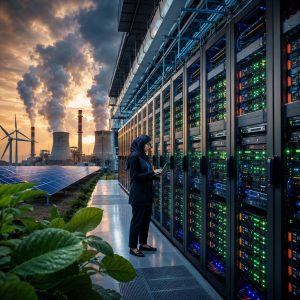
Data centers — the physical infrastructure of cloud computing — consume an estimated 1.5% of global electricity, a share that is growing as AI training and inference workloads explode. A single large language model training run can consume as much electricity as 100 to over 1,000 US homes use in a year, depending on the model’s size. The International Energy Agency (IEA) projected in early 2024 that global data center electricity consumption could reach 1,000 TWh by 2026 — equivalent to Japan’s total electricity consumption. The IEA’s updated 2025 projections estimate data centers reaching approximately 945 TWh by 2030 in the base case, growing at roughly 15% per year — more than four times faster than total electricity consumption from all other sectors. In the US, data centers are already the fastest-growing source of electricity demand, with utilities in Virginia (home to “Data Center Alley” in Loudoun County) struggling to build generation capacity fast enough.
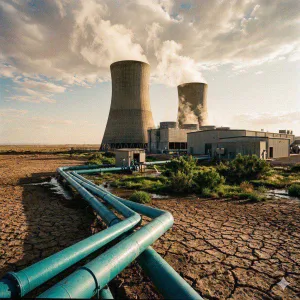
Water consumption is the less-discussed dimension. Data centers require enormous quantities of water for cooling systems. Google’s operations consumed approximately 6.1 billion gallons of water in 2023, with 95% going to data center cooling — a 17% increase from the prior year. In 2024, that figure held at approximately 6 billion gallons. Microsoft consumed 7.8 million cubic meters (approximately 2.1 billion gallons) of water in 2023, up from 6.4 million cubic meters (approximately 1.7 billion gallons) in 2022 — a 22% increase driven largely by AI workloads. In regions facing water stress — the American Southwest, parts of India, the Middle East — data center water consumption directly competes with agricultural and residential needs. Meta’s data center campus in Mesa, Arizona, one of the driest regions of the United States, illustrates the tension: the facility’s full build-out can require over a million gallons of water per day for cooling.
The Regulatory Push: CSRD, SEC, and California
The era of voluntary, unaudited sustainability reporting is ending — though the path forward is neither straight nor certain. The EU’s Corporate Sustainability Reporting Directive (CSRD), which began phased implementation in January 2024, originally aimed to require approximately 50,000 companies (including non-EU companies with significant EU revenue) to report detailed environmental data according to European Sustainability Reporting Standards (ESRS). Crucially, CSRD mandates Scope 3 emissions reporting — the full value chain, including supply chain emissions, product use emissions, and end-of-life disposal. For tech companies, Scope 3 typically represents 70-90% of total emissions, encompassing semiconductor manufacturing, device usage energy, and e-waste processing.
However, the CSRD’s scope has been significantly narrowed. In February 2025, the European Commission proposed an “Omnibus Simplification Package,” and in April 2025 the EU adopted a “stop-the-clock” directive postponing requirements by two years for companies not yet reporting. By December 2025, the European Parliament and Council agreed to raise the threshold to companies with both more than 1,000 employees and more than 450 million EUR in net turnover, while completely excluding listed SMEs. The number of companies in scope has been dramatically reduced from the original estimate. The direction of travel — mandatory, standardized sustainability reporting — remains clear, but the pace has slowed.
In the United States, the SEC adopted climate disclosure rules in March 2024 requiring publicly traded companies to disclose material climate-related risks and, for large accelerated filers, Scope 1 and Scope 2 emissions. The rules were immediately challenged in court and voluntarily stayed by the SEC in April 2024. Then, in March 2025, under the Trump administration, the SEC voted to end its defense of the rules entirely. While the rules technically remain on the books, they are effectively dead as regulatory enforcement tools for the foreseeable future. This represents a significant retreat from federal climate disclosure mandates.
The gap left by the SEC has elevated the importance of state-level action. California’s SB 253 (Climate Corporate Data Accountability Act), signed into law in October 2023, requires companies with more than $1 billion in annual revenue doing business in California to report Scope 1 and Scope 2 emissions starting in 2026, with Scope 3 emissions reporting beginning in 2027. A safe harbor provision protects companies from penalties on Scope 3 disclosures made in good faith through 2030. Given that virtually every major tech company operates in California, this state law has effectively national reach and has become the most consequential US climate disclosure requirement.
The EU’s Carbon Border Adjustment Mechanism (CBAM), while primarily targeting industrial products (cement, steel, aluminum, fertilizer, electricity), signals a broader trajectory: the EU is willing to impose climate-related trade measures that affect market access. As CBAM potentially expands to cover more products and the CSRD creates emissions data (even in its narrowed form), the prospect of emissions-linked trade requirements affecting tech products and services becomes increasingly plausible. Companies that cannot demonstrate accurate emissions accounting may face market access barriers in the EU’s 450-million-consumer market.
Advertisement
The Greenwashing Challenge: Carbon Credits vs. Actual Reduction
Tech companies have relied heavily on carbon offsets and Renewable Energy Certificates (RECs) to claim carbon neutrality while actual emissions increase. Google declared itself “carbon neutral” since 2007 — not because its operations produced zero emissions, but because it purchased enough carbon offsets to mathematically balance its emissions. Starting in 2023, Google stopped maintaining operational carbon neutrality and ceased its mass purchase of offsets, formally announcing the shift in its July 2024 environmental report. The company moved to a more transparent “net zero by 2030” target that emphasizes actual emissions reduction over offsets.
The carbon offset market has faced credibility crises. A January 2023 investigation by The Guardian, Die Zeit, and SourceMaterial, analyzing Verra-certified rainforest protection credits (the most common type used by tech companies), found that over 90% of the credits examined did not represent genuine emissions reductions. The forests were not actually at risk of deforestation, meaning the “avoided deforestation” credits were based on counterfactual scenarios that never would have occurred. Microsoft, which purchased large volumes of carbon credits, acknowledged the quality problem and shifted toward carbon removal (direct air capture, enhanced weathering) rather than avoidance credits, contracting for 22 million tonnes of carbon removal during FY2024 alone.
Renewable Energy Certificates (RECs) present a similar challenge. When Google or Amazon claims to “match” 100% of its electricity consumption with renewable energy, it typically means purchasing RECs — tradable certificates representing renewable electricity generated somewhere, not necessarily at the data center location or at the time of consumption. A data center in Virginia running on coal-generated grid power at 2 AM can claim renewable energy by purchasing RECs from a solar farm in Texas that generated power at noon. The Science Based Targets initiative (SBTi) and the Greenhouse Gas Protocol are both working to tighten rules around what counts as genuine renewable energy procurement versus certificate-based claims.
Is Cloud Computing Net Positive for Climate?
The fundamental question is whether cloud computing — concentrating computation in large, professionally managed data centers — produces better environmental outcomes than the distributed computing it replaces. The case for cloud being net positive rests on efficiency: hyperscale data centers operated by Google, Amazon, and Microsoft achieve Power Usage Effectiveness (PUE) ratios of 1.1-1.2, meaning only 10-20% of energy goes to non-computing overhead (cooling, lighting, power conversion). On-premises corporate data centers typically operate at PUE 1.5-2.0 or worse, wasting 50-100% of energy on overhead.
A study by 451 Research (commissioned by AWS) estimated that migrating workloads to AWS reduces the carbon footprint by up to 88% compared to on-premises deployment, due to more efficient servers, higher utilization rates, and cleaner energy grids. Microsoft and Google cite similar figures for Azure and Google Cloud. If these estimates are accurate, cloud migration is one of the most effective enterprise carbon reduction strategies available.
However, this analysis has a critical flaw: it assumes cloud replaces on-premises computation one-for-one. In reality, cloud computing enables new workloads that would never have existed on-premises. AI training, large-scale data analytics, real-time recommendation engines, and generative AI inference are workloads that exist because cloud makes them economically viable. The efficiency per computation is better, but the total volume of computation — and therefore total energy consumption — is growing faster than efficiency improves. This is the Jevons Paradox applied to computing: making computation more efficient makes it cheaper, which increases demand, which increases total consumption. The IEA’s projection that data center energy consumption could roughly double by 2030 is driven primarily by new AI workloads, not by inefficiency.
For regulators, the implication is that efficiency mandates alone are insufficient. Policies must address absolute emissions, not just emissions intensity. The EU’s Energy Efficiency Directive already requires data centers above 500 kW to report energy consumption and PUE. Future regulation may require absolute emissions caps, mandatory renewable energy procurement (24/7 matching, not annual RECs), water usage limits in stressed regions, and disclosure of AI training energy consumption. The tech industry’s environmental footprint is not a solved problem — it is a problem that is getting bigger and is only now receiving the regulatory scrutiny it requires.
Frequently Asked Questions
What does “The Environmental Regulation of Big Tech” mean?
The Environmental Regulation of Big Tech: Carbon Reporting, Scope 3 Emissions covers the essential aspects of this topic, examining current trends, key players, and practical implications for professionals and organizations in 2026.
Why does the environmental regulation of big tech matter?
This topic matters because it directly impacts how organizations plan their technology strategy, allocate resources, and position themselves in a rapidly evolving landscape. The article provides actionable analysis to help decision-makers navigate these changes.
How does the regulatory push: csrd, sec, and california work?
The article examines this through the lens of the regulatory push: csrd, sec, and california, providing detailed analysis of the mechanisms, trade-offs, and practical implications for stakeholders.
Sources & Further Reading
- Google 2025 Environmental Report
- Google 2024 Environmental Report
- Microsoft 2025 Environmental Sustainability Report
- IEA Energy and AI Report (2025)
- EU Corporate Sustainability Reporting Directive (CSRD)
- EU Omnibus Simplification Package (December 2025)
- SEC Votes to End Defense of Climate Disclosure Rules (March 2025)
- California SB 253 Climate Corporate Data Accountability Act
- The Guardian/Die Zeit Carbon Credits Investigation
- Science Based Targets Initiative (SBTi)