Key Takeaway: Algeria’s SNGID 2035 strategy aims to valorize 47% of household waste and create 100,000 jobs, with cities like Oran and Algiers piloting AI-powered route optimization and IoT-enabled smart bins to transform the country’s waste management from burden to economic opportunity.
Algeria generates approximately 14 million tons of municipal solid waste annually, yet less than 10% is currently recycled. The overwhelming majority ends up in technical landfills or, worse, uncontrolled dumping sites. For a country with 46 million people and rapidly urbanizing cities, this represents both an environmental crisis and an economic missed opportunity. The National Strategy for Integrated Waste Management and Valorization to 2035 (SNGID 2035) is designed to change that equation — and AI technology is central to the plan.
SNGID 2035: A National Reset
Adopted as Algeria’s roadmap for waste transformation, SNGID 2035 sets ambitious targets: valorize 47% of household waste, 47% of special waste, and 60% of inert waste. The strategy estimates the overall economic value of these waste streams at approximately 88 billion Algerian dinars (roughly $650 million). More significantly, it projects the creation of 30,000 direct and 70,000 indirect jobs in the recycling and waste valorization sector.
A watershed moment came in February 2025 with the promulgation of Law No. 25-02, which amended Algeria’s foundational waste management legislation. The law marked a conceptual shift by explicitly recognizing waste as an economic resource rather than solely an environmental burden. This legal framework provides the regulatory backbone for private sector investment in waste technology.
AI-Powered Route Optimization
One of the most immediately impactful AI applications in waste management is collection route optimization. Traditional waste collection follows fixed routes and schedules, regardless of whether bins are full or empty. This wastes fuel, increases vehicle wear, and leaves overflowing bins unserviced while trucks visit half-empty ones.
AI-based route optimization uses data from IoT fill-level sensors installed in bins, combined with traffic patterns, weather data, and historical collection records. Machine learning algorithms calculate the most efficient routes in real time, directing trucks only to bins that need servicing. Research shows that AI-optimized logistics can reduce transportation distances by up to 36.8% and cut costs by up to 13.35%.
Researchers at the University of Tlemcen have already developed computational models for optimizing waste collection circuits in Algerian cities, demonstrating measurable improvements in total distance traveled and collection efficiency.
Smart Bins and IoT Monitoring
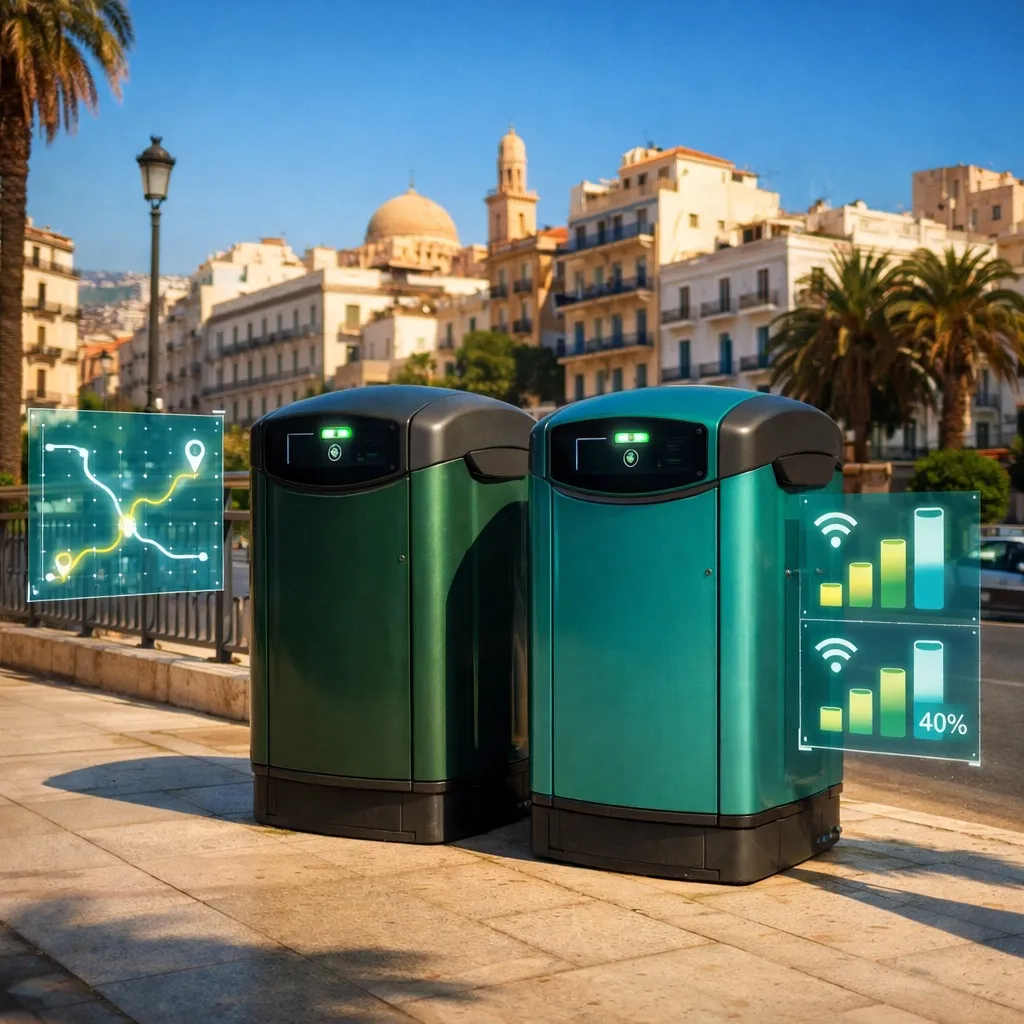
The deployment of smart bins equipped with ultrasonic fill-level sensors represents another technological frontier for Algerian cities. These sensors, typically solar-powered and connected via LoRaWAN or cellular networks, transmit fill-level data to central management platforms. When a bin reaches a configurable threshold (typically 80% full), the system automatically schedules a collection.
An innovative IoT framework developed for the Algerian context has been applied to waste bread collection — a significant waste stream in a country where bread is a dietary staple. The system uses smart recycling bins that monitor fill levels and notify collection SMEs when pickup is needed, reducing both food waste and collection costs.
Advertisement
The MyGeocycle Digital Platform
Geocycle, a subsidiary of Holcim Group, launched the MyGeocycle digital platform in Algeria as part of the SNGID 2035 implementation. The platform enables real-time monitoring and management of waste streams, providing analytics on collection volumes, processing capacity, and environmental compliance.
MyGeocycle represents the kind of public-private partnership that Algeria’s waste transformation requires. By digitizing the waste value chain — from generation through collection, sorting, and valorization — the platform creates the data infrastructure needed for AI optimization at every stage.
Selective Sorting Expansion
Algeria’s selective waste sorting program, which began as a pilot, is now expanding to major cities. In May 2025, Oran deployed 1,700 color-coded sorting containers across eight municipalities, building on earlier pilots. The program aims to achieve recycling rates of 30% for household waste, 30% for special waste, and 50% for inert waste.
AI plays a supporting role in sorting operations as well. Computer vision systems installed at sorting facilities can identify and classify waste materials at speeds far exceeding manual sorting. These systems, trained on local waste composition data, can distinguish between different types of plastics, metals, paper, and organic waste, improving sorting accuracy and throughput.
Algiers: The Smart City Dimension
Algeria’s capital is integrating waste management into its broader smart city ambitions. The Algiers Smart City Investment Plan, which targets urban digitalization through 2030, includes waste collection optimization as a core municipal service. Smart waste management in Algiers would involve sensor-equipped bins in high-density neighborhoods, AI-powered dispatch systems for collection vehicles, and citizen-facing mobile applications for reporting illegal dumping.
The city’s population density and waste generation patterns make it an ideal testbed for AI-optimized collection. With an estimated 3 million tons of waste generated annually in the greater Algiers region, even modest efficiency improvements translate into significant cost savings and environmental benefits.
Barriers and the Path Forward
Algeria’s waste management transformation faces real obstacles. Infrastructure gaps, particularly in rural and peri-urban areas, limit the deployment of smart bins and IoT networks. The informal waste sector, which employs thousands of unregistered waste pickers, must be integrated into formal systems rather than displaced. And the cultural shift toward source separation — asking households to sort their waste — requires sustained public education campaigns.
Connectivity remains a technical barrier for IoT deployment in smaller cities and towns. However, Algeria’s ongoing 4G expansion and planned 5G rollout will progressively address this gap. Solar-powered sensor devices are well-suited to Algeria’s climate, with ample sunshine ensuring reliable power supply for IoT infrastructure.
The financial case is compelling. Algeria currently spends an estimated 100 billion dinars annually on waste management, with minimal value recovery. AI-optimized collection alone could reduce costs by 10-15%, while increased recycling and valorization could generate billions in revenue from materials currently being landfilled.
Frequently Asked Questions
How much can AI route optimization save on waste collection costs?
Research shows that AI-optimized waste collection logistics can reduce transportation distances by up to 36.8% and cut operational costs by up to 13.35%. For Algeria, which spends an estimated 100 billion dinars annually on waste management, even a 10% efficiency gain from AI-optimized routes would save billions of dinars per year while improving service quality through fewer overflowing bins.
What is the MyGeocycle platform and how does it help Algeria’s waste sector?
MyGeocycle is a digital waste management platform launched by Geocycle (a Holcim subsidiary) in Algeria as part of the SNGID 2035 implementation. It enables real-time monitoring of waste streams, providing analytics on collection volumes, processing capacity, and environmental compliance. The platform digitizes the entire waste value chain from generation through valorization, creating the data infrastructure needed for AI-driven optimization.
How does Algeria’s selective waste sorting program work?
The program deploys color-coded sorting containers in participating municipalities, allowing residents to separate recyclable materials at the source. In Oran, 1,700 containers were deployed across eight municipalities in May 2025. The program targets recycling rates of 30% for household waste and 50% for inert waste, with plans to gradually expand to all 58 wilayas across Algeria.
Sources & Further Reading
- Waste Management Landscape in Algeria: Challenges and Opportunities — EcoMENA
- Algeria Launches Initiative to Digitize Waste Management — Sustainability MEA
- Smart Collection of Waste Bread in Algeria Using IoT — ETASR
- Artificial Intelligence for Waste Management in Smart Cities: A Review — Springer
- Selective Waste Sorting System Algeria — Arab Urban Development Institute