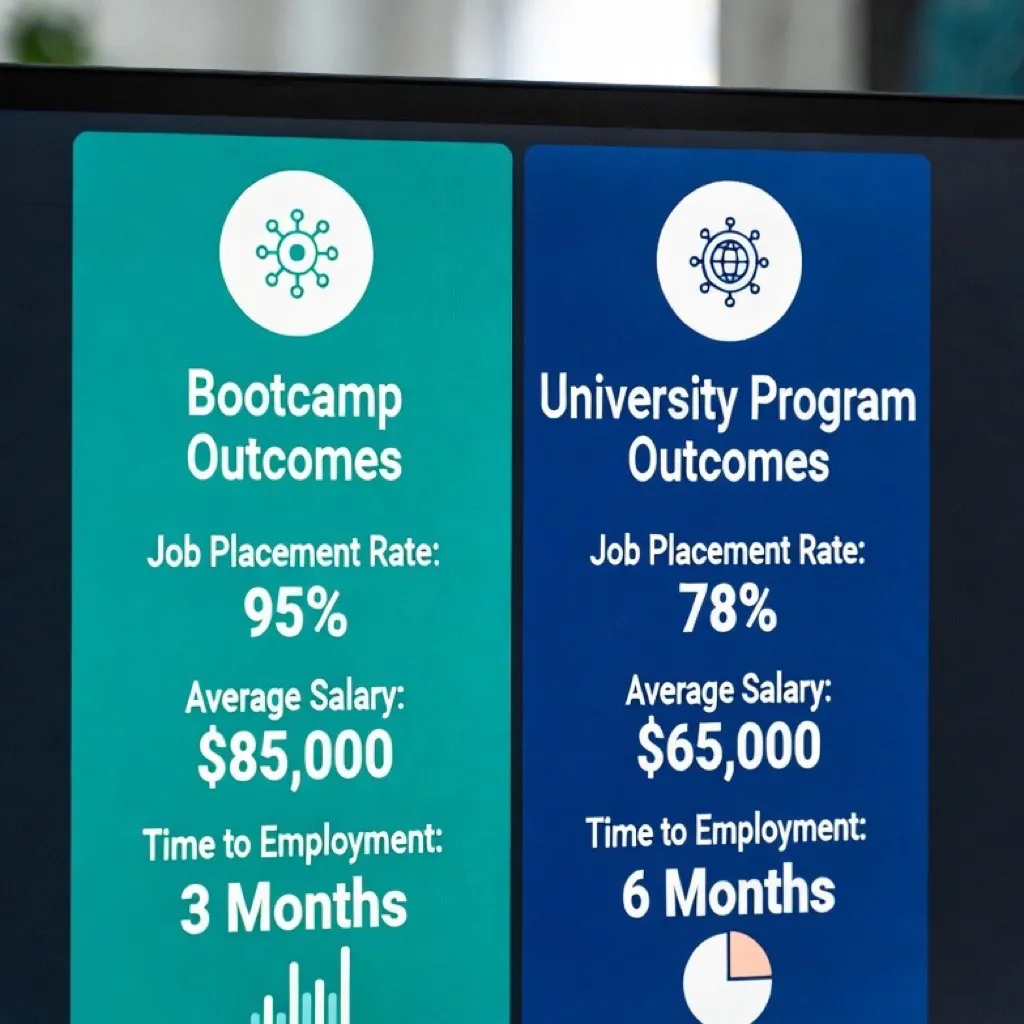
The Landscape in 2026: Four Paths to a Tech Career
Today’s aspiring tech professionals have more routes into the industry than ever before:
- Traditional 4-year CS degree (university)
- Intensive coding bootcamp (3–6 months, full-time)
- Online self-study (free or near-free: freeCodeCamp, The Odin Project, MIT OpenCourseWare)
- Certifications + portfolio (AWS, Google Cloud, CompTIA, Microsoft — often combined with self-study)
Each path has real merit. Each has real limitations. Let’s examine them honestly.
Path 1: The Computer Science Degree
The Case For It
A CS degree from a recognized university remains the most universally respected credential in tech hiring. It provides:
- Deep theoretical foundations: Algorithms, data structures, operating systems, compilers, computer architecture — knowledge that ages slowly and applies everywhere
- Research opportunities: Access to labs, professors, and cutting-edge work
- Network effects: Alumni networks, on-campus recruiting, internship pipelines to top companies
- Prestige signal: Still matters at FAANG/MAANG companies and large enterprises
- Long-term earning ceiling: CS degree holders consistently out-earn bootcamp grads over a 10-year career horizon
The Numbers
Hakia’s 2026 analysis found a 716% ROI on a CS degree calculated over a full career — but that number assumes you attend a reputable program, graduate, and land a relevant job. Drop-out rates at 4-year programs average 40%, which significantly changes the math.
The Case Against It
- Time: 4 years is a long time to wait before earning
- Cost: $100K+ in debt is a crushing burden that shapes career decisions for a decade
- Relevance gaps: Many CS curricula still teach languages and frameworks that aren’t used in industry
- Speed of change: A degree earned in 2022 may include outdated material by 2026
- Opportunity cost: What could you have built or earned in those 4 years?
Path 2: The Coding Bootcamp
The coding bootcamp industry has matured considerably since its early days of aggressive marketing and modest outcomes. The best programs in 2026 have strong employer relationships, rigorous admissions, and verifiable placement data.
The Numbers
The typical bootcamp student enters the program earning around $47,000 in a non-tech role and lands their first tech job at around $70,000–$75,000. That’s a meaningful jump — and the payback on $15,000 in tuition comes within 14–18 months of working.
Top Bootcamp Formats in 2026
Full-stack web development: The most common track. JavaScript/TypeScript, React, Node.js, SQL/NoSQL databases. Prepares graduates for junior developer roles at startups and midsize companies.
Data science and ML: Python-heavy. Pandas, scikit-learn, SQL, basic ML pipelines. Growing demand but increasingly competitive with DS degree holders.
Cybersecurity: CompTIA Security+ prep, penetration testing basics, SIEM tools. Strong job market, especially for SOC analyst roles.
Cloud/DevOps: AWS/Azure/GCP fundamentals, Kubernetes, CI/CD pipelines. Many graduates pursue certifications alongside bootcamp credentials.
UX/UI design: Figma, user research, interaction design. Less coding, more product thinking.
The Case Against Bootcamps
- Depth limitations: Three months cannot teach what four years does. Bootcamp grads often struggle with algorithm-heavy interview questions (LeetCode), system design, and low-level programming
- Market saturation: The junior developer market has become competitive. More graduates fighting for fewer entry-level positions
- Quality varies wildly: The gap between top bootcamps (App Academy, Flatiron School, Lambda School spinoffs) and bottom-tier programs is enormous
- Income Share Agreements (ISAs): Some bootcamps offer ISAs instead of upfront tuition — promising no money until you’re employed — but the total paid can exceed $30,000 if your salary lands high
Path 3: Self-Study (The Hidden Best Value)
For disciplined, self-motivated learners, self-study may offer the best ROI of all three paths:
The challenge with self-study isn’t access to information — it’s accountability and structure. Most people who start free programs don’t finish them. Completion rates for MOOCs (Massive Open Online Courses) average around 5–15%.
The combination that works best: self-study + a structured accountability mechanism (cohort-based programs, study groups, career coaches).
Path 4: Certifications
For non-coding tech roles — cloud infrastructure, cybersecurity, networking, database administration — certifications have become the primary credential:
AWS certifications in particular have strong market validation. A Solutions Architect Professional certification signals cloud competency that employers trust in ways that self-claimed “experience” cannot.
Advertisement
What Big Tech Companies Actually Hire
Major employers have quietly abandoned the blanket “CS degree required” stance:
- Google removed degree requirements in 2021 for many roles and now focuses on skills-based hiring for non-SWE positions
- Apple has no degree requirement for many engineering roles
- IBM eliminated degree requirements for 50% of US tech jobs in 2023
- Microsoft explicitly assesses skills over credentials for many Azure engineering roles
However, this is more nuanced in practice:
- Degree-free: Product management support, IT, cybersecurity operations, technical writing, UX
- Degree-preferred: Core software engineering at FAANG, AI research, systems programming
- Degree-required: Research scientist roles, some PhD-track positions
The AI-assisted hiring surge of 2025 has complicated this further. With AI screening résumés, a CS degree from a known university may still trigger positive algorithmic signals even when the human hiring manager wouldn’t care.
The Emerging Model: Degree + Bootcamp + Certs
Increasingly, the most competitive profiles combine elements of all paths:
- A 2-year community college associate’s degree (low cost, foundational)
- A targeted bootcamp (practical skills, portfolio projects)
- One or two industry certifications (AWS, CompTIA, Google)
- A strong GitHub portfolio with real projects
This hybrid path can take 18–24 months, cost $20,000–$30,000 total, and produce outcomes competitive with many 4-year degree holders — especially at startups, consulting firms, and mid-sized tech companies.
The AI Disruption Factor
AI coding tools are changing the calculus for education in ways that weren’t true even three years ago:
AI as accelerator: With GitHub Copilot, Claude, or Cursor, a motivated learner can produce working code faster than ever. The floor for what a beginner can build has been dramatically lowered.
AI as filter: Simultaneously, the bar for what employers expect has risen. If AI can generate CRUD applications, employers want developers who can architect systems, review AI-generated code critically, and solve problems AI can’t.
The implication for education: The most valuable skills in 2026 are not the ones AI can replicate (writing boilerplate code) but the ones it cannot (system design, debugging non-obvious issues, stakeholder communication, security mindset).
This shifts the advantage toward deeper education — which is one argument for the CS degree that wasn’t as strong three years ago.
Making the Decision: A Framework
Ask yourself these four questions:
1. How much can you invest?
- < $5,000: Self-study + certifications
- $10,000–$20,000: Bootcamp
- $40,000–$120,000: University (if the ROI math works for your target role)
2. How fast do you need to work?
- Need income within a year: Bootcamp or certifications
- Can invest 3–4 years: University degree
3. What role are you targeting?
- Software engineer at large company: CS degree preferred
- Frontend dev at startup: Bootcamp + portfolio
- Cloud/DevOps/security: Certifications + self-study
- Data scientist: CS/stats degree or serious self-study with ML certs
4. How self-motivated are you?
- High discipline: Self-study can work
- Need structure: Bootcamp or university
- Need accountability and feedback: Any structured program
The Honest Bottom Line
Conclusion
The diploma is not dead — but it is no longer the only key to the door. In 2026, the tech industry rewards demonstrated competence over parchment. What matters is what you can build, what you understand, and how you solve problems.
The best investment isn’t necessarily the most expensive one. It’s the one aligned to your specific goals, financial situation, timeline, and learning style. For career changers who need to move fast, bootcamps are often the right answer. For those targeting top-tier research roles or long-term career ceilings, the CS degree still delivers.
And for the growing population of self-directed learners? The internet has never offered more high-quality, free education than it does today. The question is never “can I learn this?” It’s always “will I do the work?”
Frequently Asked Questions
What is bootcamp vs. university in 2026?
Bootcamp vs. University in 2026: Which Path Actually Gets You Hired in Tech? covers the essential aspects of this topic, examining current trends, key players, and practical implications for professionals and organizations in 2026.
Why does bootcamp vs. university in 2026 matter?
This topic matters because it directly impacts how organizations plan their technology strategy, allocate resources, and position themselves in a rapidly evolving landscape. The article provides actionable analysis to help decision-makers navigate these changes.
How does path 1: the computer science degree work?
The article examines this through the lens of path 1: the computer science degree, providing detailed analysis of the mechanisms, trade-offs, and practical implications for stakeholders.